

Within the cold roll forming industry, not every production line is designed to meet the same manufacturing challenges.
While continuous roll forming lines are ideally suited to high-volume production, they quickly reach their limits as product complexity increases. Multiple in-line operations, demanding positioning accuracy and challenging material characteristics require a different engineering approach.
This is where step-by-step roll forming lines provide a decisive advantage.
Based on an indexed feeding system and operations performed while the material remains stationary, they separate strip advancement from the execution of manufacturing operations. This architecture delivers exceptional positioning accuracy while providing complete control over the manufacturing process for highly complex profiles.
A step-by-step roll forming line is designed as part of a complete manufacturing system in which the product, material characteristics and integrated operations are engineered together from the outset.
At JIDET, this philosophy translates into the design of custom step-by-step roll forming lines developed with one clear objective: producing complex profiles with outstanding accuracy, long-term process stability and the level of precision required for advanced industrial roll forming applications.
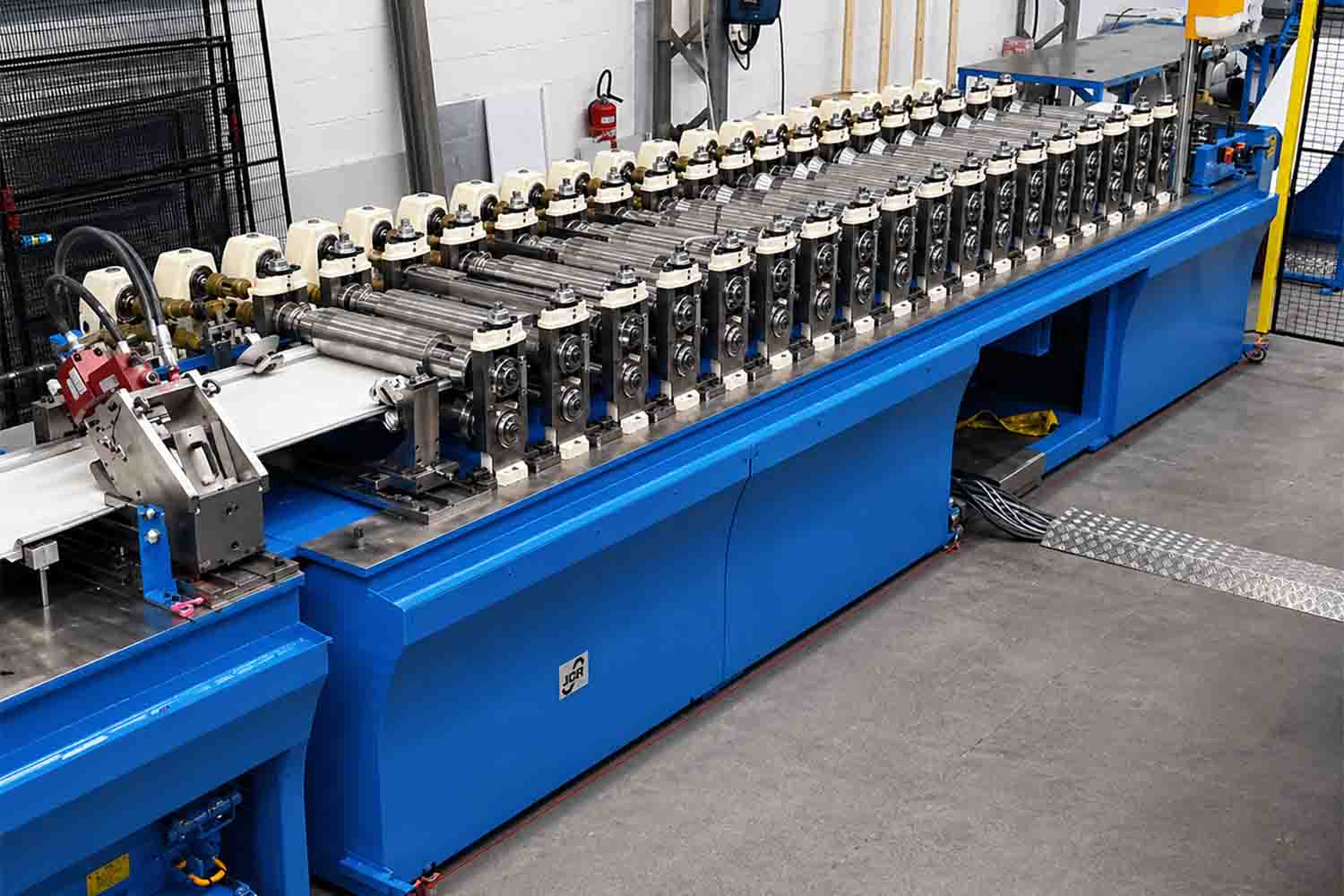
How an Industrial Step-by-Step Roll Forming Line Works: The Principle of Indexed Feeding
Unlike a continuous roll forming line, where every manufacturing operation is directly constrained by strip speed, a step-by-step roll forming line separates machine kinematics from the execution of production operations.
Production speed no longer dictates the working conditions of each station.
Instead, every manufacturing phase can be optimised according to the specific technical requirements of the operation being performed.
This engineering architecture provides:
- exceptional positioning accuracy,
- long-term cycle repeatability,
- reliable synchronisation between workstations,
- seamless integration of complex in-line operations without dynamic constraints,
A step-by-step roll forming line therefore prioritises process stability, precision and manufacturing consistency over maximum production speed.
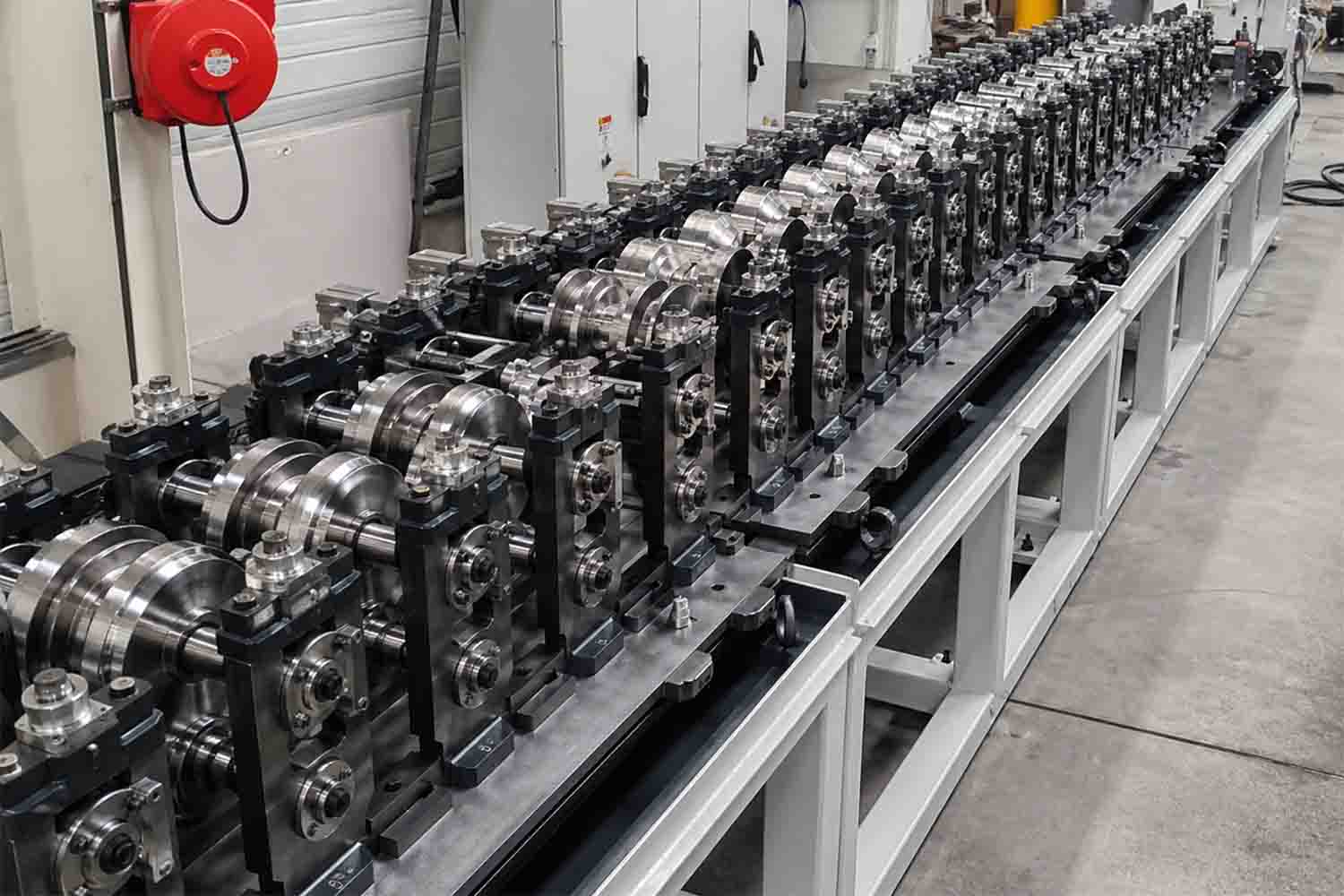
The operation of a step-by-step roll forming line is based on an indexed feeding system.
The metal strip advances in precise increments, with each indexed position corresponding to a predefined manufacturing station within the production process.
Movement is generally controlled using servo-controlled indexing systems, providing extremely accurate control of strip movement, positioning and stopping.
Each index becomes a stable reference point for subsequent manufacturing operations.
The strip is positioned, immobilised and then processed under tightly controlled conditions, ensuring:
- outstanding positioning accuracy,
- consistent dimensional repeatability,
- stable manufacturing conditions,
regardless of overall production cycle duration.
This operating principle is particularly suitable for:
- complex profile geometries,
- tight dimensional tolerances,
- manufacturing processes requiring precise alignment between multiple workstations,
Processing while the material remains stationary is one of the defining characteristics of a step-by-step roll forming line.
All manufacturing operations are performed while the strip is completely immobilised, eliminating the dynamic constraints associated with continuous strip movement.
Each workstation therefore operates with a cycle time optimised for its specific manufacturing task.
This makes it possible to integrate demanding operations such as:
- multi-station punching,
- embossing,
- notching,
- combined manufacturing operations,
under highly stable and fully controlled conditions.
The benefits extend well beyond simple feasibility.
Positioning accuracy is significantly improved, alignment errors are reduced and manufacturing consistency is enhanced – even during highly demanding technical operations.
This level of process control is extremely difficult to achieve on a continuous roll forming line, where every workstation must constantly compensate for the continuous movement of the strip.
A step-by-step roll forming line is never designed around maximum production speed.
Instead, it is engineered around complete control of the manufacturing process.
The line is designed according to:
- the geometry of the required profile,
- the manufacturing operations to be integrated,
- the characteristics of the material being processed,
The production process is then structured around these parameters, with the machine kinematics engineered to support the product rather than forcing the product to conform to the machine.
This engineering philosophy enables manufacturers to produce:
- highly complex profile geometries,
- advanced technical materials,
- products requiring multiple integrated in-line operations,
without compromising manufacturing quality.
The result is a custom roll forming line fully engineered for its industrial application, where every stage of the production process is carefully defined, synchronised and controlled.
Step-by-Step Roll Forming Line vs Continuous Roll Forming Line: Choosing the Right Solution for Your Manufacturing Process
Choosing between a step-by-step roll forming line and a continuous roll forming line involves far more than comparing production speeds.
The design of the production line must take into account the profile geometry, the manufacturing operations to be integrated, material behaviour and the required levels of positioning accuracy and dimensional repeatability.
- A continuous roll forming line is ideally suited to high-volume production of relatively simple, stable profiles,
- A step-by-step roll forming line becomes the preferred solution whenever the manufacturing process involves greater complexity, tighter tolerances or more demanding in-line operations,
The right decision should therefore be based not on production speed alone, but on the ability of the manufacturing system to meet the technical requirements of the finished product.
As soon as a profile incorporates multiple manufacturing operations, the engineering challenge extends well beyond the roll forming process itself.
The integration of numerous punching operations, complex geometries, sequential forming stages or combined manufacturing processes requires a high level of process control.
In this environment, a step-by-step roll forming line secures every stage of production.
Processing while the material remains stationary ensures that each operation is performed with exceptional positioning accuracy while maintaining perfect alignment between successive workstations.
Long-term dimensional repeatability is preserved throughout production, enabling manufacturers to maintain consistent profile geometry – even for the most technically demanding components.
By comparison, a continuous roll forming line rapidly reaches its practical limits when multiple operations become interdependent or require extremely precise positional accuracy.
Material behaviour plays a decisive role when selecting the most appropriate roll forming line.
Within a continuous roll forming process, forming forces are applied dynamically while the strip is moving, potentially generating stresses and deformations that become increasingly difficult to control.
A step-by-step roll forming line, by contrast, performs operations while the strip remains stationary under fully stabilised conditions.
Forming forces are applied in a controlled manner without the influence of strip speed, reducing internal stresses and minimising unwanted deformation.
This engineering approach significantly improves:
- forming stability,
- dimensional consistency,
- final profile geometry,
A step-by-step roll forming line is therefore particularly suitable for:
- high-strength steels,
- thin-gauge materials,
- advanced engineering materials,
- components highly sensitive to dimensional variation,
In these manufacturing environments, process stability becomes considerably more important than maximum production throughput.
Selecting between a continuous and a step-by-step roll forming line requires balancing several key manufacturing parameters.
A continuous roll forming line prioritises:
- maximum production throughput,
- high-volume manufacturing,
- stable production conditions,
- relatively simple profile geometries,
Conversely, a step-by-step roll forming line focuses on:
- exceptional positioning accuracy,
- seamless integration of complex in-line operations,
- greater manufacturing flexibility,
- long-term process repeatability,
The engineering study should therefore consider:
- annual production volumes,
- profile complexity,
- the number of integrated manufacturing operations,
- required quality standards,
- dimensional tolerances,
The more technically demanding the product becomes – and the greater the number of integrated operations – the more compelling the advantages of a step-by-step roll forming line.
Ultimately, the objective is not simply to manufacture faster, but to implement the production system that best aligns with the technical requirements of the product and the realities of the industrial process.
Industrial Applications of Step-by-Step Roll Forming Lines for Technical Profiles
Step-by-step roll forming lines are deployed in manufacturing environments where process stability takes precedence over maximum production throughput.
They are specifically designed for applications involving complex profile geometries, multiple integrated manufacturing operations and stringent quality requirements.
In these production environments, the primary objective is to ensure outstanding positioning accuracy, long-term dimensional repeatability and consistent manufacturing performance throughout the entire production cycle.
Step-by-step roll forming lines are particularly well suited to the production of technical profiles and high-value functional components.
In these applications, the profile is far more than a simple formed section.
It incorporates engineered features such as:
- functional holes,
- complex geometries,
- formed details,
- critical dimensional areas requiring precise process control,
The roll forming line must therefore ensure perfect consistency between every manufacturing operation while preserving the final geometry of the finished component.
Thanks to its indexed feeding system, each operation is positioned with exceptional precision and this accuracy is maintained throughout production.
This approach is particularly valuable for components requiring multiple successive manufacturing stages, where even minor deviations could compromise product functionality.
A step-by-step roll forming line allows manufacturing and finishing operations to be integrated directly into the production process.
Operations such as:
- in-line punching,
- secondary forming,
- notching,
- trimming,
- other application-specific finishing processes,
can all be carried out under fully controlled manufacturing conditions.
Because each operation is performed while the strip remains stationary, every workstation benefits from a cycle time optimised for its specific process, without being constrained by strip speed.
All manufacturing operations remain perfectly synchronised and accurately positioned throughout the production cycle.
This high level of integration significantly reduces the need for secondary offline operations.
Intermediate handling is minimised, improving production continuity while reducing the risk of positioning errors or damage during transfer between workstations.
The step-by-step roll forming line therefore becomes a complete manufacturing system capable of combining progressive roll forming with integrated finishing operations in a single, highly controlled production process.
Step-by-step roll forming lines are particularly advantageous for manufacturing technically demanding products requiring extremely high dimensional accuracy.
When tight tolerances, sophisticated geometries and multiple integrated operations are involved, process stability becomes one of the most critical success factors.
The indexed operating sequence enables every manufacturing stage to be carefully controlled while ensuring consistent dimensional repeatability throughout long production runs.
The combination of precise positioning accuracy and stable processing conditions enables manufacturers to maintain uniform product quality from the first component to the last.
For this reason, step-by-step roll forming lines are ideally suited to advanced industrial applications where dimensional conformity, manufacturing precision and long-term process consistency are essential.
Components and Machine Architecture of an Industrial Step-by-Step Roll Forming Line
The performance of a step-by-step roll forming line depends on the perfect integration of every subsystem within the production line.
Each component fulfils a specific function while contributing to the overall efficiency of the manufacturing process.
The engineering of each subsystem cannot be considered in isolation.
Instead, the complete production line must be designed as a coherent manufacturing system based on:
- the profile to be produced,
- the manufacturing operations to be integrated,
- production requirements,
- material characteristics,
This systems engineering approach ensures the positioning accuracy, dimensional repeatability and process stability required for long-term industrial production.
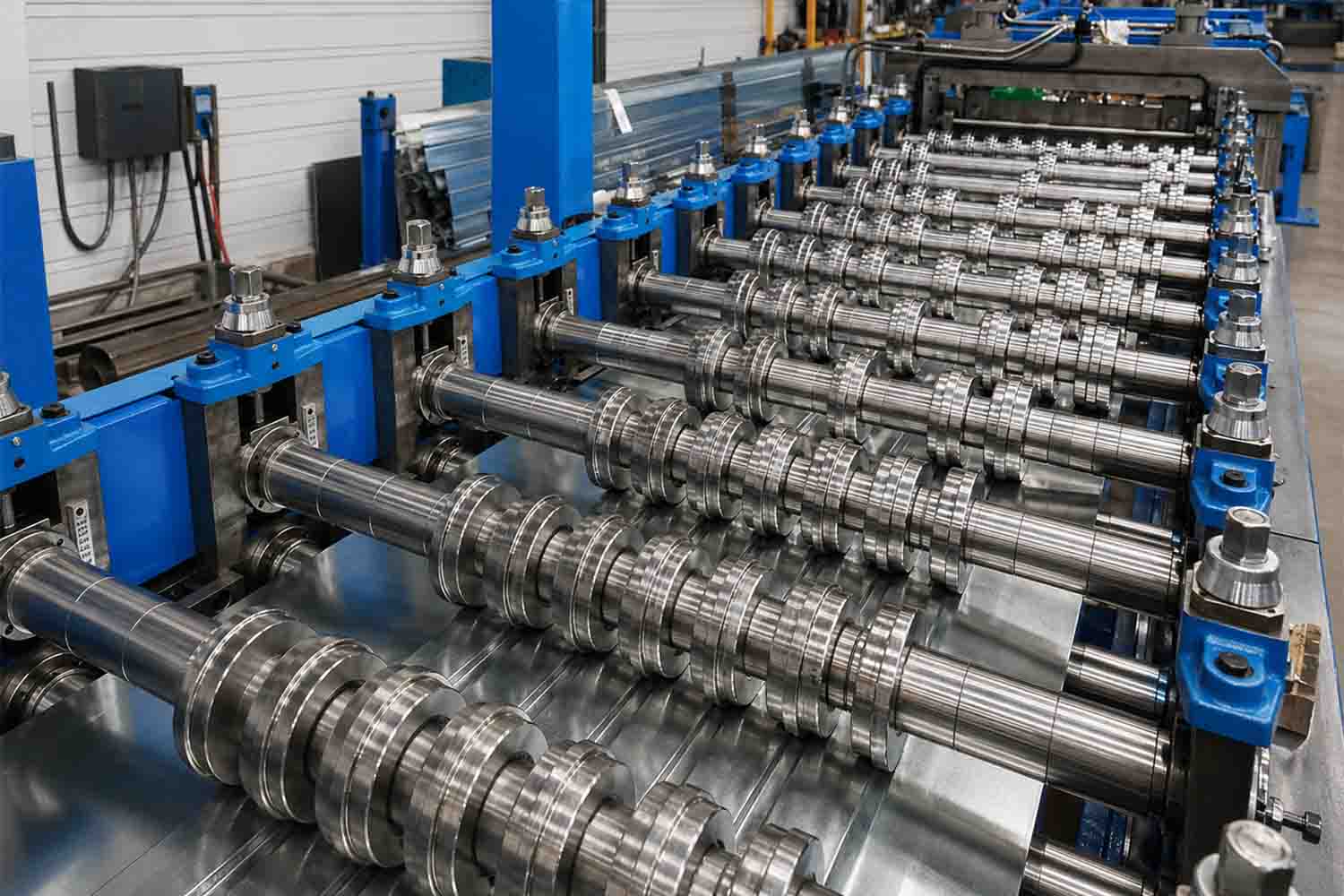
The indexed feeding system is the core of every step-by-step roll forming line.
It controls strip advancement and ensures precise positioning at every production cycle.
Movement is typically achieved using servo-controlled drive systems, providing extremely accurate control of strip movement, acceleration and stopping positions.
The quality of every downstream manufacturing operation depends directly on the positioning accuracy delivered by this system.
Each indexed movement must be perfectly repeatable, and every stop must remain stable regardless of production conditions.
Long-term dimensional repeatability is essential to maintaining consistent manufacturing quality throughout extended production runs.
Far more than a simple strip transport mechanism, the indexed feeding system defines the operating rhythm and overall performance of the entire production line.
A step-by-step roll forming line incorporates multiple integrated workstations arranged according to the manufacturing process.
Each station performs a dedicated operation, including:
- in-line punching,
- embossing,
- trimming,
- secondary forming,
- application-specific manufacturing processes,
The organisation of these workstations is determined by the production sequence and the technical relationships between successive operations.
Their positioning, synchronisation and interaction with the indexed feeding system are fundamental to maintaining stable manufacturing conditions.
Every workstation operates with a cycle time specifically adapted to its manufacturing task.
Together, these stations form a fully integrated production system in which each operation contributes seamlessly to the overall manufacturing process.
It progressively forms the metal strip through a carefully engineered sequence of roll forming passes.
The design of the roll forming tooling, the distribution of forming forces and the progression of each forming stage all have a direct influence on the dimensional quality of the finished profile.
The roll forming process must always be engineered in harmony with both upstream and downstream manufacturing operations.
Potential deformation created during forming must be anticipated from the design stage to preserve final profile geometry.
Carefully engineered progressive forming minimises internal stresses while maintaining profile stability throughout production.
This integrated engineering approach enables manufacturers to achieve outstanding dimensional consistency, repeatability and product quality.
The automation and control system coordinates every piece of equipment within the step-by-step roll forming line.
It manages:
- cycle synchronisation,
- production sequencing,
- communication between workstations,
- coordination of all manufacturing operations,
Every production stage is continuously monitored and every transition is precisely controlled.
Industrial automation ensures stable, repeatable and highly reliable production cycles.
The operator interface enables production personnel to:
- supervise machine performance,
- adjust production parameters,
- monitor manufacturing data in real time,
The quality of the automation system has a direct impact on:
- process stability,
- positioning accuracy,
- production reliability,
- overall manufacturing performance,
A high-performance step-by-step roll forming line therefore depends as much on advanced automation and intelligent control systems as on its mechanical design.
JIDET Expertise in Designing Custom Step-by-Step Roll Forming Lines
The design of a step-by-step roll forming line can never be standardised.
Every industrial project presents its own manufacturing challenges.
Profile geometry, material behaviour, the number of integrated operations and production objectives all require a comprehensive engineering approach.
A step-by-step roll forming line is far more than a collection of individual machines.
It is a complete manufacturing system whose performance depends on the perfect integration of every stage of the production process.
This systems engineering philosophy forms the foundation of JIDET’s expertise.
Every step-by-step roll forming line designed by JIDET is engineered around the customer’s actual manufacturing requirements.
The engineering process begins with the product – not the machine.
Profile geometry, material behaviour, the manufacturing operations to be integrated and the target production throughput define the overall architecture of the production line.
Each of these parameters directly influences key engineering decisions, including:
- machine architecture,
- workstation layout,
- machine kinematics,
- equipment sizing,
- automation strategy,
This product-driven approach enables JIDET to design custom roll forming lines that precisely match each industrial application, without compromising manufacturing quality, productivity or technical feasibility.
JIDET designs complete manufacturing systems rather than individual machines.
Every step-by-step roll forming line is engineered as a fully integrated production solution incorporating all equipment required throughout the manufacturing process.
This may include:
- the roll forming line,
- in-line punching systems,
- cut-off machines,
- industrial automation and control systems,
- product handling and transfer equipment,
Every subsystem is dimensioned, positioned and synchronised as part of one coherent manufacturing process.
The objective is to maintain continuous product flow while ensuring perfect consistency between every manufacturing operation.
This comprehensive engineering approach eliminates production bottlenecks, synchronisation issues and positioning errors, while maximising the stability and overall performance of the production line.
JIDET’s expertise is founded on a comprehensive understanding of cold roll forming and all associated manufacturing operations.
Strip forming, roll forming tooling design, pass distribution and material behaviour are all considered from the earliest engineering stages.
Additional operations – including in-line punching, secondary forming and cut-off operations – are integrated into a single, fully coordinated manufacturing process.
Equipment synchronisation is engineered according to production constraints, product specifications and positioning accuracy requirements.
This complete systems engineering approach ensures:
- outstanding product quality,
- long-term process stability,
- reliable manufacturing performance,
- consistent dimensional repeatability throughout production,
The successful implementation of a step-by-step roll forming line extends well beyond its mechanical design.
Industrial validation represents a critical stage of every project.
Comprehensive testing is carried out to verify:
- production line behaviour,
- positioning accuracy,
- process stability,
- dimensional conformity of the finished profiles,
Where necessary, engineering adjustments are implemented to optimise machine performance and fully secure the manufacturing process before production begins.
This validation phase ensures stable operating conditions from the very first production runs while providing long-term manufacturing reliability.
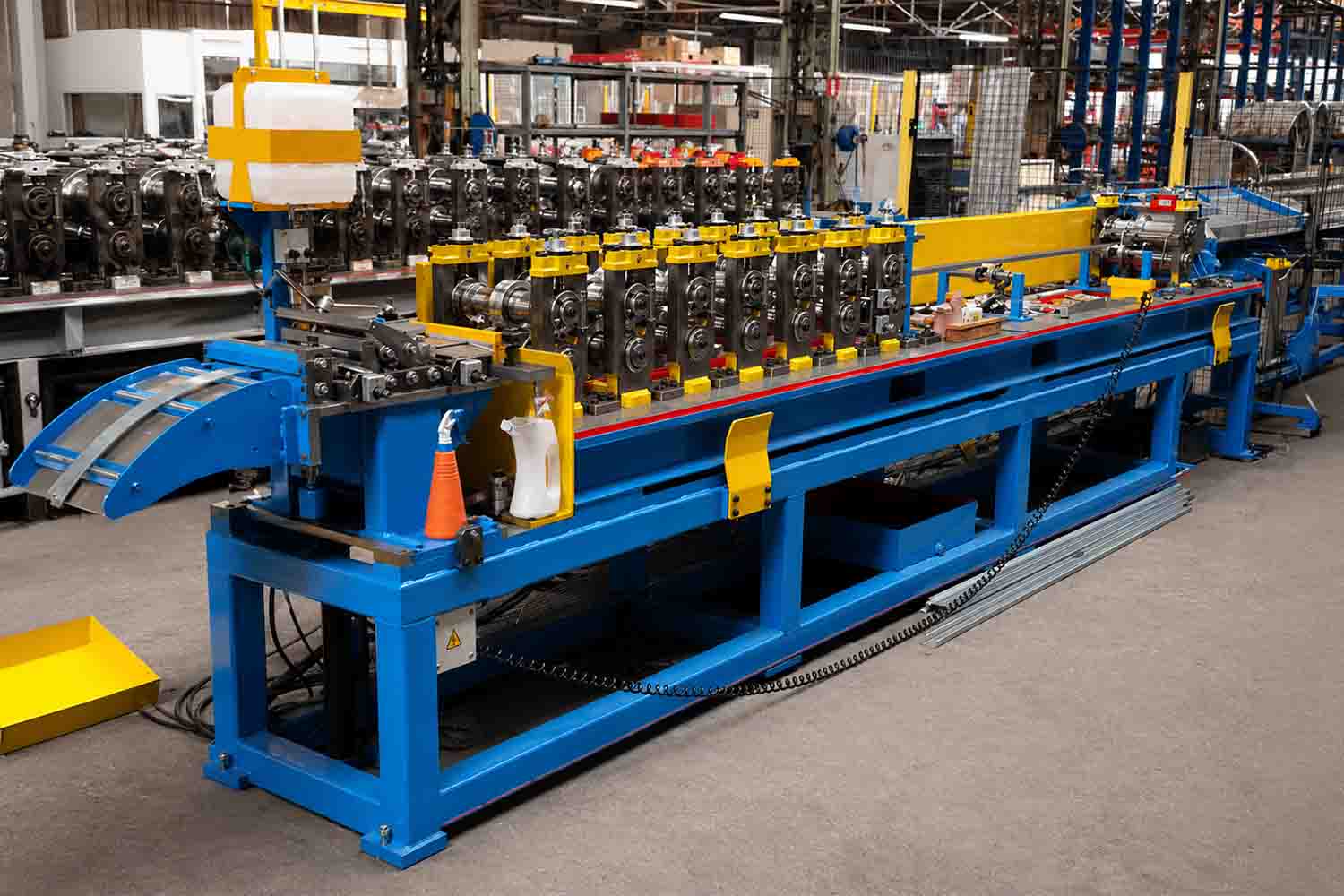
Design Your Step-by-Step Roll Forming Line with an Experienced Manufacturer
The performance of a step-by-step roll forming line depends on far more than the machine itself.
It results from a comprehensive engineering approach that integrates the product, material characteristics, manufacturing operations and overall production strategy into one coherent system.
Every parameter influences the behaviour of the production line and the quality of the finished profile.
Partnering with JIDET means securing:
- complete process consistency,
- exceptional positioning accuracy,
- long-term production stability,
- fully integrated manufacturing performance,
It also means working with an experienced engineering partner capable of designing custom step-by-step roll forming lines that meet the highest technical standards while addressing the specific manufacturing requirements of your industry.