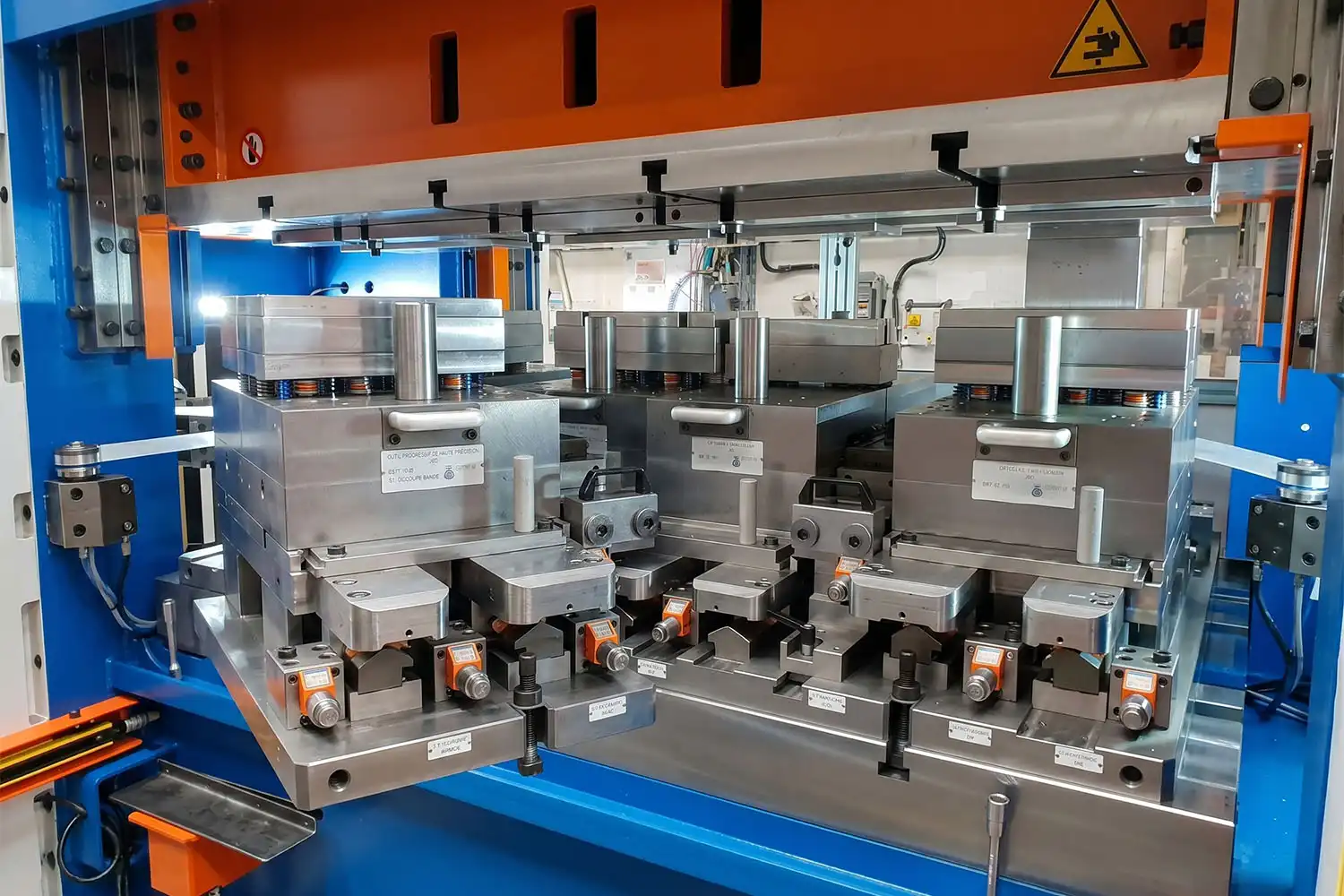

Industrial punching should never be viewed as a simple hole-making or cutting operation. Within a cold roll forming environment, continuous manufacturing process or automated production line, it is a critical process function that directly influences component accuracy, dimensional tolerances and the overall stability of the manufacturing system.
A poorly engineered or incorrectly integrated industrial punching machine quickly leads to positioning errors, functional defects and reduced production throughput, directly impacting product quality and manufacturing profitability.
In a modern production line, punching cannot operate as an isolated process. It must be fully synchronised with the roll forming machine, the cut-to-length system, the forming operations and, where required, industrial marking and traceability systems.
Whether performed as stop punching or flying punching, in-line punching becomes a key element of the manufacturing process, ensuring complete consistency between the roll formed profile and the functional features incorporated into the finished component.
At JIDET, every industrial punching machine and integrated in-line punching system is engineered as a complete mechanical and process solution, fully synchronised with the production line. This engineering approach guarantees outstanding positioning accuracy, consistent dimensional repeatability, stable high-throughput production and seamless integration between punching, cold roll forming and cut-to-length operations.
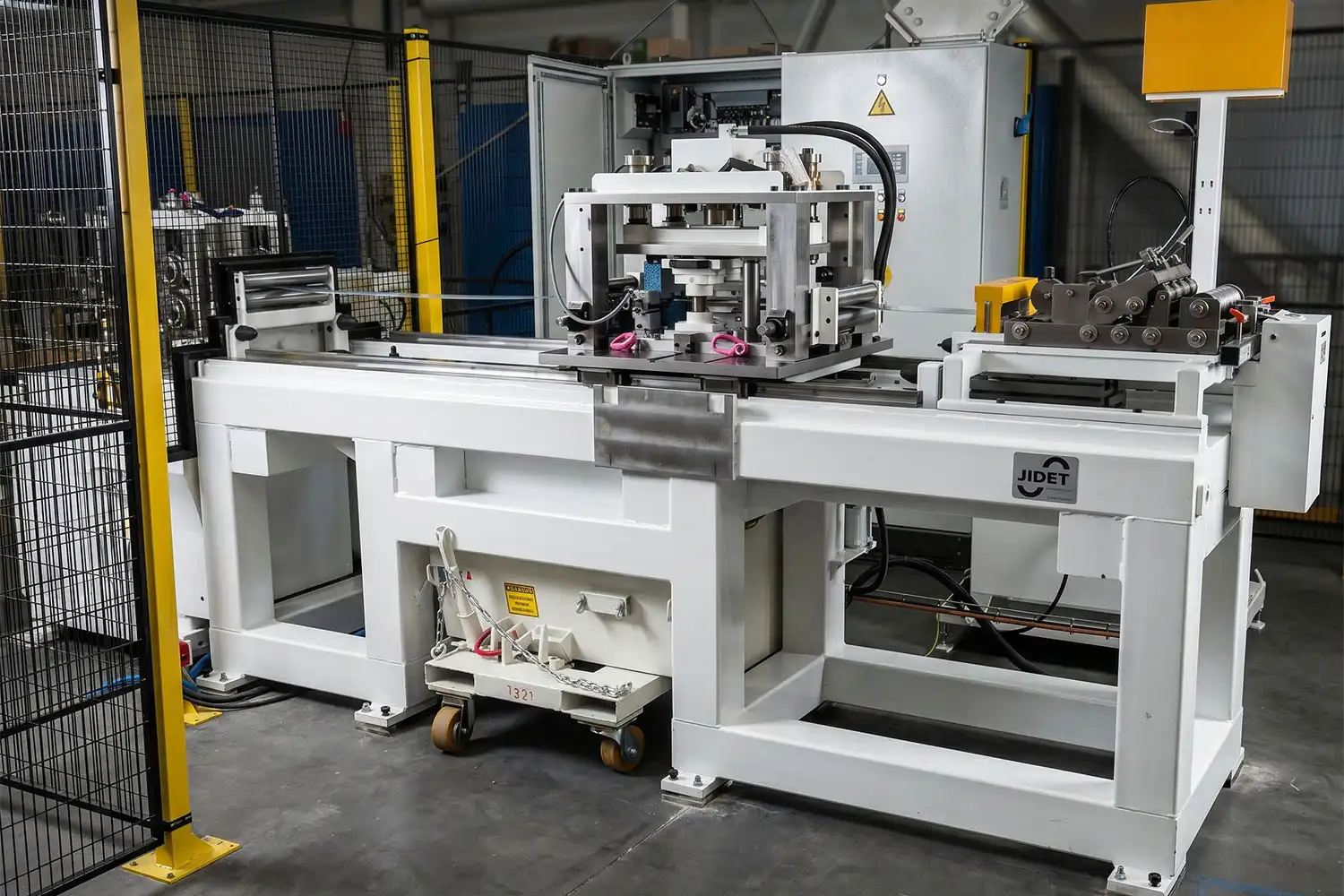
Custom Industrial Punching Machines: Why Standard Solutions Fall Short in Modern Manufacturing
A standard industrial punching machine may be suitable for relatively simple manufacturing applications involving individual punching operations, moderate production rates, generous dimensional tolerances and stable production conditions. In these situations, a generic machine architecture is generally sufficient to perform basic punching functions without requiring advanced synchronisation or process integration.
However, real industrial manufacturing environments – and particularly in-line cold roll forming applications – present a completely different set of engineering challenges. Here, industrial punching becomes a fundamental process operation directly linked to machine kinematics, material behaviour and production throughput.
Under these demanding conditions, a standard industrial punching machine rapidly reaches its limits. It cannot ensure overall process consistency or maintain stable performance throughout long production runs.
This is precisely where the engineering of a custom in-line punching system delivers its full value.
C’est précisément là que la conception d’un système de poinçonnage sur mesure prend tout son sens.
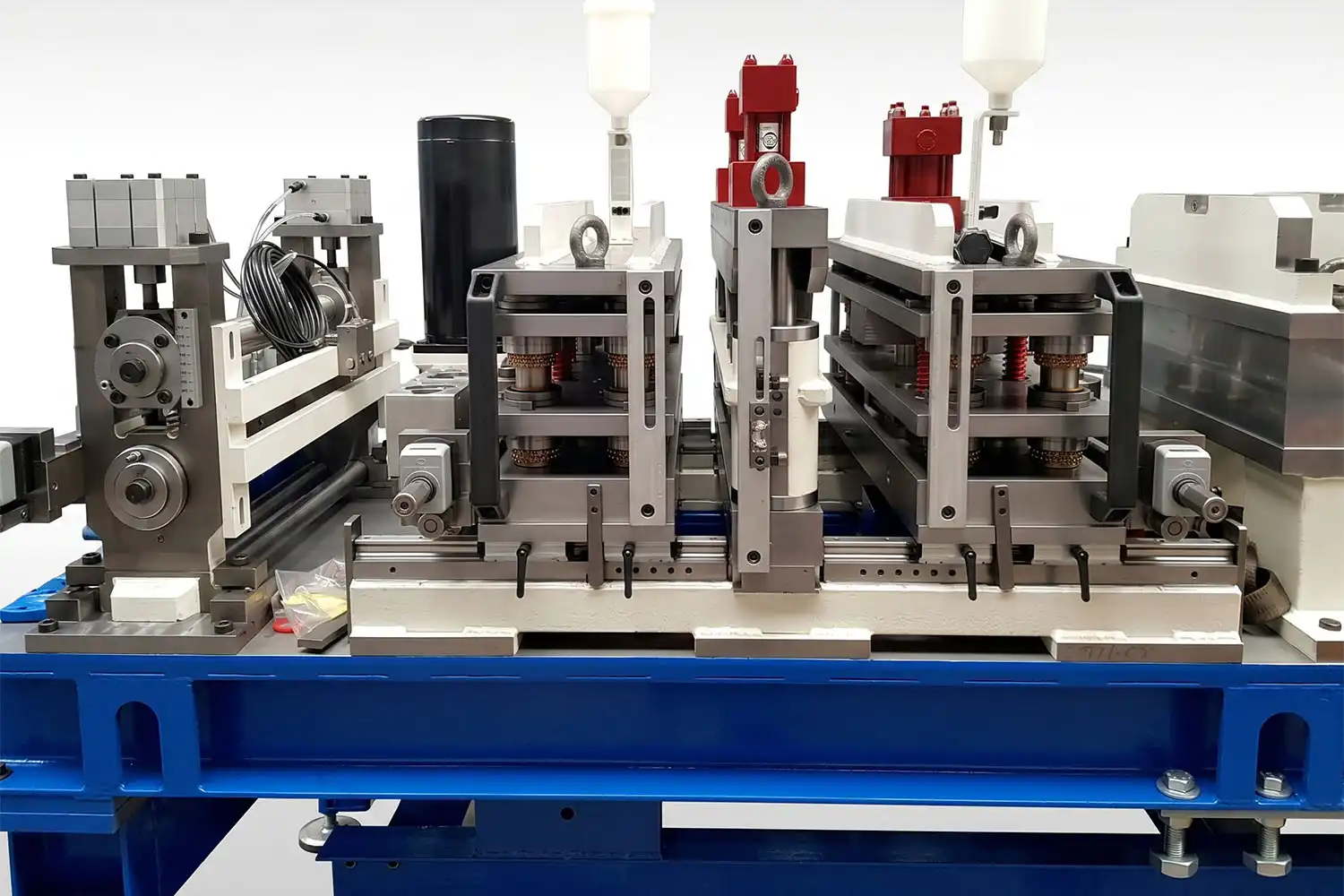
A standard industrial punching machine is based on a fixed mechanical architecture designed to accommodate a wide variety of applications without being optimised for any specific manufacturing process. This approach quickly reaches its limits whenever several critical production constraints must be controlled simultaneously.
In practice, it becomes increasingly difficult to guarantee:
- high positioning accuracy at elevated production speeds,
- reliable dimensional repeatability across multi-tool configurations,
- consistent punching forces when processing advanced engineering materials,
- dynamic synchronisation with a continuously moving production line,
A custom industrial punching machine, by contrast, enables every critical engineering parameter to be optimised, including:
- system kinematics according to the selected in-line punching strategy (stop punching or flying punching),
- actuator sizing and power based on actual punching forces,
- drive technology (mechanical, hydraulic or servo-driven) according to throughput and positioning accuracy requirements,
- synchronisation strategy with the cold roll forming line and all associated manufacturing operations,
This engineering approach results in a fully integrated industrial punching system capable of maintaining stable performance under the most demanding manufacturing conditions.
Within the JIDET engineering philosophy, industrial punching is never treated as an isolated operation. It forms an integral part of a complete manufacturing process in which every production function is interdependent.
The in-line punching system is engineered to interact seamlessly with:
- the roll forming machine,
- cut-to-length systems,
- forming and secondary manufacturing operations,
- material flow throughout the entire production line,
The objective is not simply to punch a hole, but to ensure that every punching operation is carried out with absolute precision, at the correct moment and within a perfectly controlled machine sequence.
This level of synchronisation has a direct impact on final profile quality, hole positioning accuracy and long-term production repeatability.
Within an in-line punching environment, these requirements become increasingly critical as production throughput rises and profile geometries become more complex.
Beyond pure production performance, a custom industrial punching machine represents a powerful means of securing the entire manufacturing process. It stabilises critical production parameters while reducing the operational risks associated with poorly adapted machine designs.
A correctly engineered industrial punching system ensures precise control of:
- hole positioning accuracy, including at high production speeds,
- dimensional repeatability throughout long production runs and variable batch sizes,
- punching quality by minimising burrs, tearing and material deformation,
- long-term machine stability and manufacturing reliability,
This engineering control delivers measurable operational benefits, including:
- significant reductions in scrap caused by punching defects,
- fewer secondary finishing and rework operations,
- improved first-pass product conformity directly from the production line,
- greater long-term manufacturing consistency,
From an industrial perspective, investing in a custom industrial punching machine is therefore far more than a technical decision. It is a strategic investment that secures production, stabilises product quality and sustainably reduces the total manufacturing cost per component.
Technical Design Criteria for an In-Line Industrial Punching System
The design of an industrial punching machine or an in-line punching system is never based on a standardised approach. It begins with a detailed analysis of the manufacturing requirements, where every parameter – including hole geometry, material behaviour, production throughput and integration within a cold roll forming line – directly influences the mechanical architecture and punching strategy.
A high-performance custom punching system is always the result of a careful balance between component geometry, punching forces, machine kinematics and overall process synchronisation.
This integrated engineering approach ensures outstanding positioning accuracy, consistent dimensional repeatability and long-term manufacturing productivity.
Hole geometry forms the foundation of every industrial punching machine design. It directly determines the selection of punching tooling, the distribution of punching forces and the overall punching strategy.
Each punching configuration introduces specific engineering constraints affecting:
- the design of the punches and dies,
- the kinematics of the punching system,
- the distribution of forces within the material,
- profile stability during and after punching,
Failure to consider these parameters during the design stage of an industrial punching system rapidly leads to:
- profile or strip deformation,
- loss of positional accuracy between holes,
- material instability caused by residual internal stresses,
For this reason, every custom industrial punching machine is engineered around the actual geometry of the finished component rather than a generic machine configuration.
Material behaviour is one of the most important engineering parameters when designing an industrial punching machine.
It directly influences the punching forces required, tooling service life and the quality of the punched features.
The key material characteristics considered during the engineering phase include:
- yield strength,
- strip or profile thickness,
- ductility,
- shear strength,
Material properties vary considerably depending on the application:
- high-strength steels require greater punching forces together with highly rigid machine structures,
- stainless steels demand precise control of tooling wear and punching accuracy,
- aluminium alloys, being more ductile, require particular attention to deformation control and surface marking,
A custom punching machine incorporates these material-specific characteristics from the earliest stages of the engineering process, preventing punching defects, dimensional deviations and production instability.
Within an in-line punching configuration, synchronisation with the production line is a critical engineering requirement.
The industrial punching system must operate in complete harmony with the entire manufacturing process.
It must be synchronised with:
- material feed speed,
- cold roll forming operations,
- cut-to-length sequences,
- all other integrated manufacturing processes,
Two principal industrial punching strategies are commonly employed:
- stop punching, ideally suited to moderate production speeds and applications requiring maximum positioning accuracy,
- flying punching, essential for continuous manufacturing and high-throughput production lines,
Poor synchronisation inevitably leads to positional errors, functional defects and a rapid deterioration in product quality.
Conversely, a custom in-line punching system guarantees perfect coordination between material movement and the punching operation throughout the production cycle.
Choosing the appropriate industrial punching machine technology is a key engineering decision that directly affects production performance.
The most suitable solution depends on manufacturing requirements, production throughput and the level of positioning accuracy required.
Several technologies are available, including:
- mechanical punching, valued for its robustness and suitability for high-speed production,
- hydraulic punching, offering high force capacity and excellent flexibility across a broad range of applications,
- servo-driven punching, providing exceptional cycle control, positioning precision and manufacturing flexibility,
A custom industrial punching machine enables the optimum technology to be selected and precisely sized according to the actual manufacturing requirements, ensuring the ideal balance between performance, reliability and operating costs.
Punching tooling is a critical element in the performance of any industrial punching machine.
It forms the direct interface between the machine and the material, determining the quality of the finished component.
A complete punching tooling system typically includes:
- punches,
- dies,
- guidance systems,
The engineering quality of the tooling directly influences:
- punching quality by minimising burrs, tearing and edge defects,
- dimensional repeatability,
- long-term process stability,
- overall operating costs through reduced wear, maintenance and machine downtime,
At JIDET, tooling is never considered independently of the machine itself.
Every punching tooling solution is engineered in complete harmony with the industrial punching system, ensuring optimum performance, maximum durability and perfect adaptation to the customer’s production requirements.
Integrating In-Line Punching into a Cold Roll Forming Line
Within a cold roll forming line, in-line punching is never an isolated operation. It forms part of a fully integrated manufacturing process in which every function – forming, cutting, marking and secondary operations – must be perfectly synchronised to ensure consistent production quality.
Integrating an industrial punching machine into a roll forming line requires a systems engineering approach. Hole positioning, dimensional repeatability, punching quality and overall process stability all depend on the interaction between the roll forming machine, material behaviour and the selected punching strategy.
Depending on the profile geometry, functional requirements and production objectives, several in-line punching system architectures can be implemented.
Selecting the appropriate architecture is a critical engineering decision, as it directly influences component accuracy, process robustness and the overall productivity of the manufacturing line.
Pre-punching consists of performing all punching operations directly on the flat strip before it enters the forming stations.
This configuration is particularly suitable when hole geometry and positioning must be controlled with the highest level of precision.
Its primary advantage lies in the stability of the material during punching.
Because the strip remains perfectly flat, it provides ideal conditions for:
- outstanding hole positioning accuracy,
- consistent pitch over the full strip length,
- excellent punching quality,
This strategy also minimises the mechanical stresses introduced into the profile by avoiding punching operations on an already formed section that may contain residual stresses or exhibit reduced dimensional stability.
However, pre-punching requires precise anticipation of the dimensional changes created during the cold roll forming process.
Hole locations must take into account forming effects such as material elongation and springback to ensure that the final component fully complies with dimensional specifications after passing through the roll forming machine.
Post-forming punching is used whenever component geometry or functional requirements prevent punching operations from being performed on the flat strip.
This approach is particularly well suited to complex profile geometries, including:
- closed sections,
- multi-bend profiles,
- asymmetric or highly engineered cross-sections,
In these applications, the industrial punching system must operate directly on an already formed profile, where mechanical constraints are significantly greater.
Punching formed sections also requires careful control of potential profile deformation, including:
- section collapse,
- ovalisation,
- distortion of functional areas,
A custom in-line punching machine addresses these challenges by optimising machine kinematics, punching tooling and profile support systems to maintain profile stability throughout the punching operation.
Flying punching has become an essential solution for high-speed cold roll forming lines.
It enables punching operations to be performed without stopping the material, supporting continuous manufacturing and maximising production throughput.
This approach provides significant productivity benefits, including:
- elimination of production stops,
- higher overall production throughput,
- optimised material flow,
However, it also introduces demanding engineering challenges.
The industrial punching system must dynamically match the speed of the production line while maintaining exceptional positioning accuracy.
A custom flying punching system incorporates advanced motion control technologies that ensure perfect synchronisation between material movement and the punching operation, even at very high production speeds.
Within an integrated cold roll forming line, in-line punching cannot be considered independently from the other manufacturing operations.
It must be perfectly coordinated with:
- the cut-to-length system, which determines the final position of punched features on the finished component,
- industrial marking systems, used for product identification and traceability,
- integrated manufacturing operations such as local forming, embossing and secondary finishing,
This coordination relies on complete process synchronisation, where every manufacturing operation is controlled using a common material position reference.
Successfully integrating an industrial punching system, cut-to-length system and industrial marking solution creates a highly stable, efficient and fully synchronised production line capable of manufacturing finished components that meet specification immediately after production, without secondary operations or adjustment.
At JIDET, this comprehensive process integration is considered one of the key drivers of industrial performance, combining positioning accuracy, manufacturing productivity and long-term process reliability.
Industrial Applications of In-Line Punching in Metal Roll Forming
In-line punching has become a core manufacturing function across numerous industrial sectors where the production of metal components demands high precision, high throughput and exceptional dimensional repeatability.
When integrated into a cold roll forming line, an industrial punching system enables functional features to be produced directly within the manufacturing process, eliminating secondary operations while ensuring perfect consistency between profile geometry and hole positioning.
This integration transforms punching from a simple hole-making operation into a critical structural and functional manufacturing process directly linked to the final performance of the finished component.
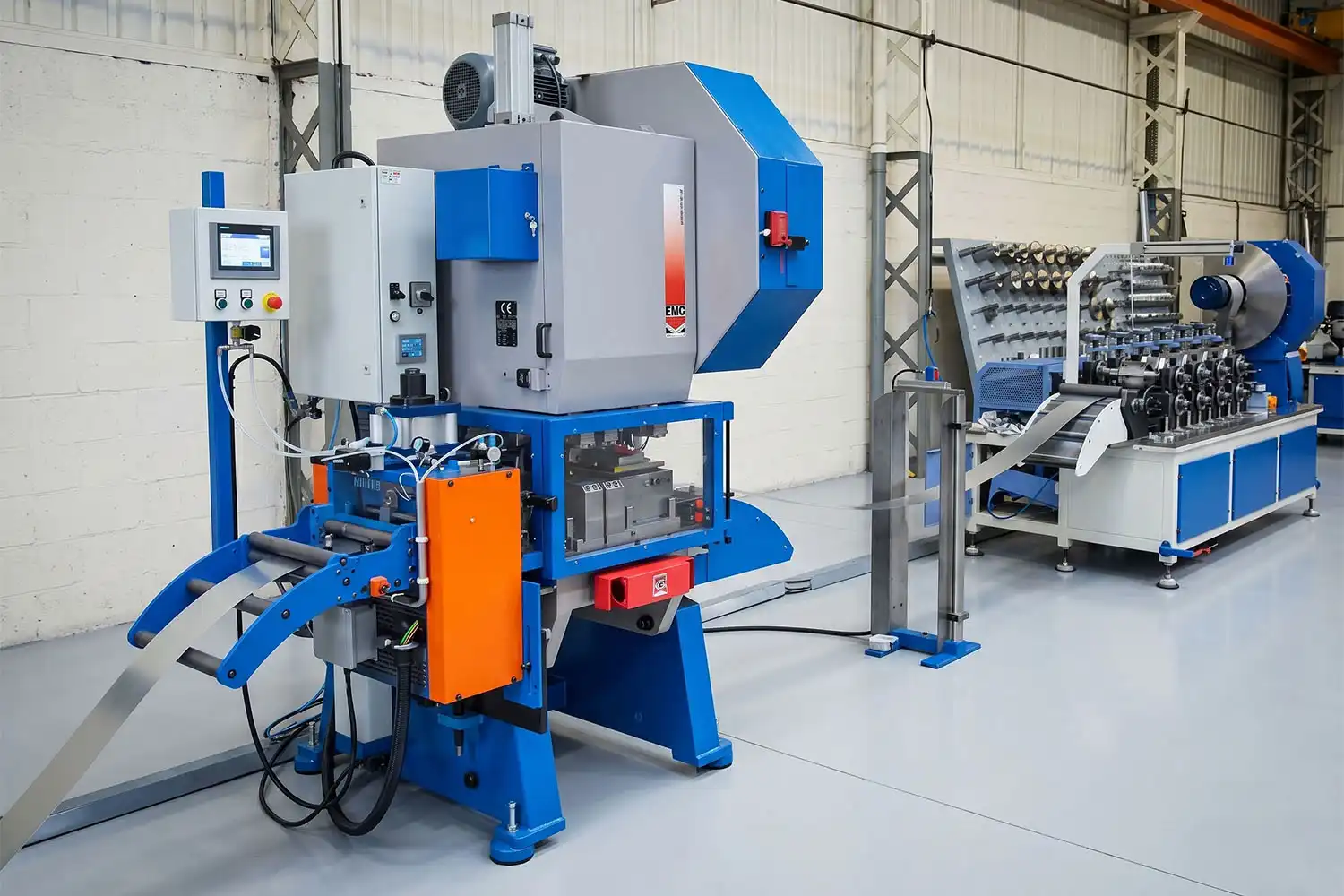
Within the structural steel and metal construction industries, in-line industrial punching is widely used to manufacture structural profiles incorporating their assembly and fastening features directly during production.
Punching therefore becomes a critical functional element of the profile itself.
Even the smallest positional deviation may compromise on-site assembly, fastening accuracy or the structural integrity of the finished installation.
A custom industrial punching machine ensures:
- highly accurate hole positioning,
- consistent pitch over long production runs,
- full compatibility between interconnected structural components,
- excellent production repeatability for large manufacturing volumes,
In the manufacture of industrial shelving, storage systems and warehouse structures, in-line punching plays a central role in achieving modularity and interchangeability.
Every component must remain fully compatible with the complete product range while maintaining the mechanical strength required to support heavy loads.
A custom in-line punching system enables manufacturers to guarantee this level of dimensional consistency while maintaining high production throughput.
The result is a manufacturing process capable of producing interchangeable structural components with exceptional positioning accuracy and long-term repeatability.
Within the automotive and transportation industries, industrial punching is used to manufacture technical components incorporating highly precise functional features.
Hole positioning directly influences downstream assembly operations and the performance of the finished product.
Consequently, punching becomes an essential part of the manufacturing value chain rather than a secondary production step.
A custom industrial punching machine enables manufacturers to achieve the accuracy, repeatability and production stability required for demanding automotive manufacturing environments.
Across a wide range of industrial equipment applications, in-line punching enables manufacturers to produce functional components that are ready for immediate integration into mechanical assemblies.
Here, punching performs a genuine engineering function.
Its objective is not merely to create an opening but to produce a reliable mechanical interface between multiple components while guaranteeing precise dimensional relationships.
Integrating in-line punching within a cold roll forming machine enables complete, fully functional components to be produced directly from the production line while optimising manufacturing flow and eliminating secondary punching operations.
JIDET Industrial Punching Solutions: Custom Machines and In-Line Punching Systems
At JIDET, an industrial punching machine is never regarded as a standalone piece of equipment. Every project is engineered as a complete manufacturing solution integrating the punching machine, punching tooling, machine kinematics and the overall production environment.
The objective is to develop a custom in-line punching system that is perfectly adapted to the profile geometry, material characteristics and required production throughput.
This engineering approach ensures complete consistency between in-line punching, the cold roll forming machine and every other integrated manufacturing operation, delivering outstanding positioning accuracy, dimensional repeatability and long-term industrial productivity.
JIDET’s integrated punching units are specifically engineered to match the architecture of each production line and the technical requirements of the profile being manufactured.
Unlike standard punching solutions, every unit is designed around the customer’s actual manufacturing requirements, incorporating positioning accuracy, production throughput and process synchronisation from the earliest stages of development.
Each industrial punching unit is based on:
- a dedicated mechanical design engineered according to punching forces and profile geometry,
- complete integration within the cold roll forming line, ensuring perfectly coordinated material flow,
- full synchronisation with line speed and all associated manufacturing operations, including forming, cutting and industrial marking,
This approach guarantees stable, highly accurate and fully repeatable in-line punching, even for complex profile geometries and high-throughput manufacturing environments.
To meet the requirements of increasingly sophisticated manufacturing applications, JIDET develops multi-tool and multi-station industrial punching systems capable of performing several punching operations simultaneously or sequentially within the same production cycle.
These advanced system architectures enable manufacturers to:
- maximise overall production throughput by reducing the number of punching cycles,
- integrate multiple punching operations within a single production line,
- manufacture highly technical profiles incorporating complex punching geometries,
The ability to manage multiple operations within a single in-line punching system represents a major competitive advantage for manufacturers producing complex metal profiles while maintaining outstanding productivity and dimensional repeatability.
For manufacturers operating in demanding high-productivity environments, JIDET designs industrial punching machines specifically engineered for continuous production and very high manufacturing speeds.
These solutions incorporate:
- flying punching systems capable of operating without stopping the material,
- advanced automation and motion control technologies ensuring perfect synchronisation with the production line,
- robust mechanical structures engineered to absorb dynamic punching forces under continuous operating conditions,
High-speed in-line punching requires absolute control of both machine kinematics and the dynamic loads generated throughout the manufacturing cycle.
By combining advanced mechanical engineering with intelligent process synchronisation, JIDET ensures exceptional positioning accuracy, long-term process stability and maximum production throughput.
JIDET’s true competitive advantage lies in its ability to engineer an industrial punching system as a fully integrated manufacturing solution combining the punching machine, punching tooling and the complete production process.
Every project follows a structured engineering methodology based on:
- an in-depth analysis of the profile to be manufactured and the functional features to be incorporated,
- detailed evaluation of material behaviour, including yield strength, thickness and mechanical constraints,
- precise sizing of the industrial punching machine and associated punching forces,
- engineering of custom punching tooling specifically adapted to the required geometries and production throughput,
- full industrial validation of the complete system under real manufacturing conditions,
By integrating all these engineering parameters from the earliest design stages, JIDET delivers reliable, high-performance and durable in-line punching systems capable of meeting the most demanding industrial requirements for positioning accuracy, productivity and long-term process stability.