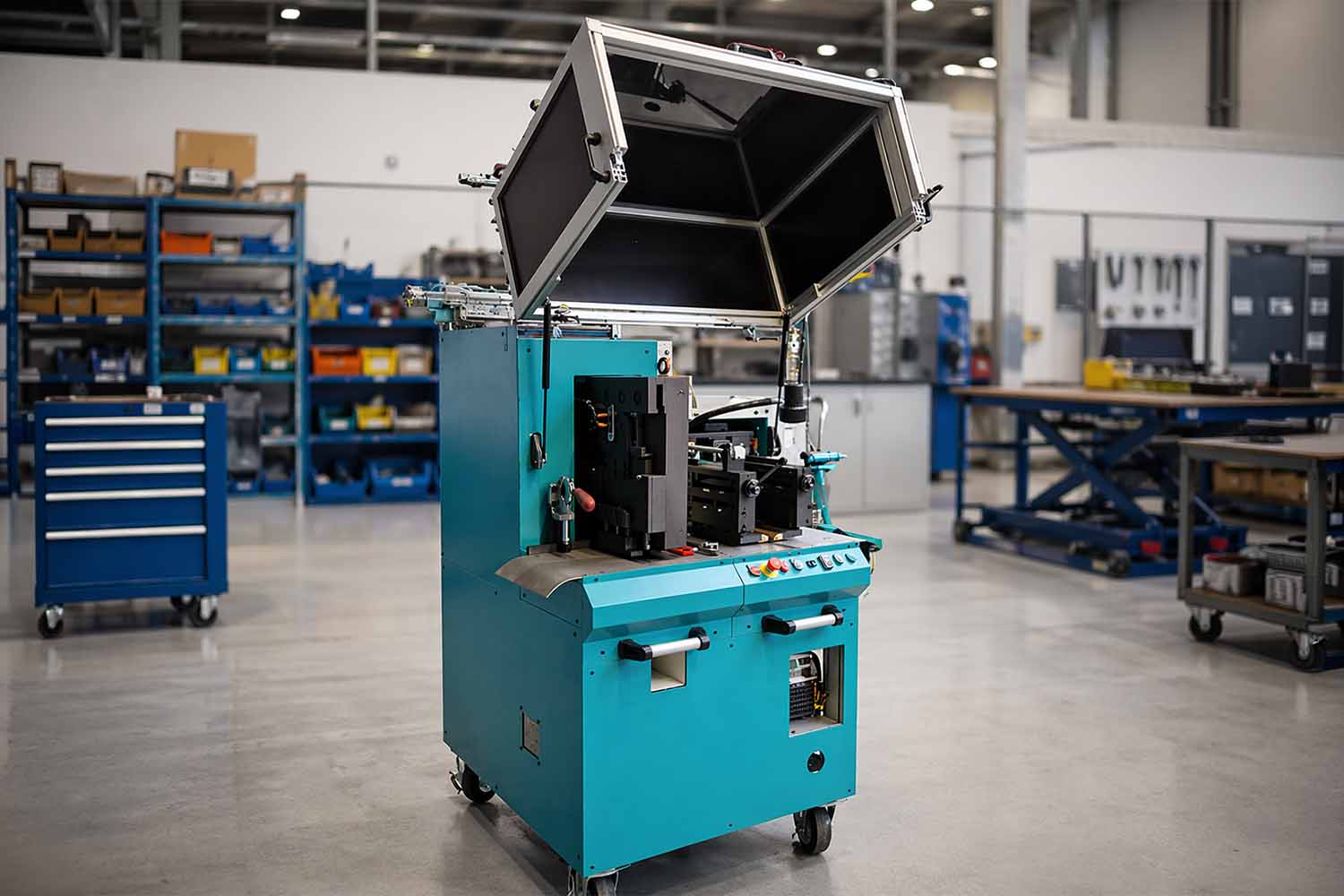

Strip joining is a critical operation in coil processing lines, particularly in cold roll forming, in-line punching and strip processing applications.
An industrial coil joining machine does far more than simply connect two strips together. It directly determines the continuity of material flow, the stability of the manufacturing process and the overall performance of the production line.
Within a continuous production environment, the joining process must produce a reliable connection capable of withstanding mechanical loads while remaining fully compatible with downstream operations such as roll forming, in-line punching and cut-to-length processing.
An inadequately engineered joining solution rapidly leads to dimensional variation, production instability and unplanned downtime, with a direct impact on productivity and manufacturing costs.
At JIDET, every industrial coil joining machine is engineered as an integrated subsystem within the production line, operating in close interaction with the decoiler, leveller and downstream processing equipment.
The objective is to deliver reliable, highly repeatable coil joining that supports high-throughput continuous production, even within the most demanding industrial environments.
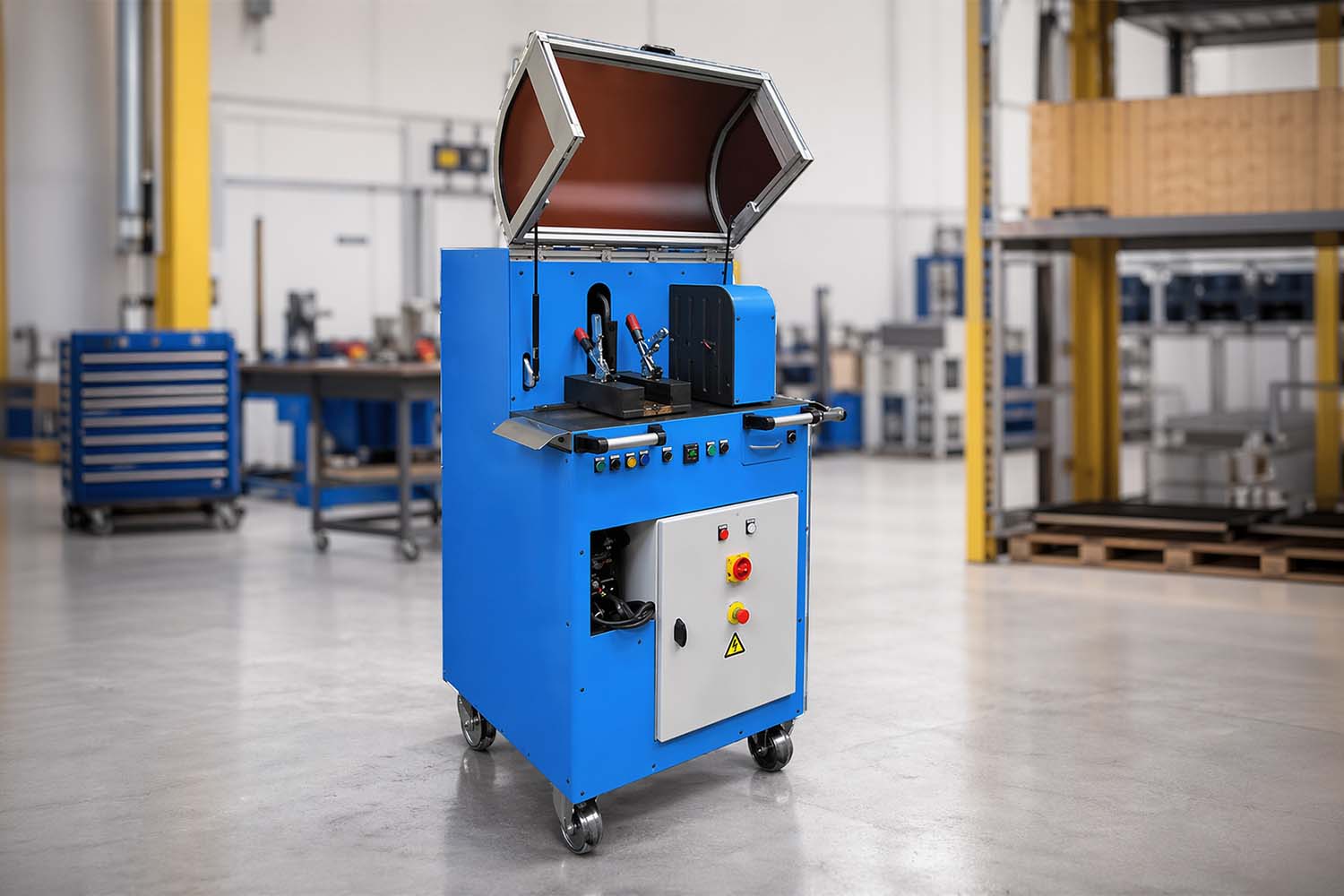
Why Integrate a Coil Joining Machine into a Continuous Industrial Production Line?
Strip joining transforms discontinuous coil feeding into a continuous material flow, enabling manufacturers to fully exploit the performance of a modern production line.
Within cold roll forming, in-line punching and strip processing applications, every interruption caused by a coil change introduces mechanical instability, process variation and productivity losses.
As production throughput increases and manufacturing lines integrate more continuous operations, the coil joining machine becomes a strategic element of the production system.
It no longer simply creates a joint between two strips.
It directly contributes to:
- stable material flow,
- consistent tensile loading,
- overall process stability,
- long-term manufacturing performance,
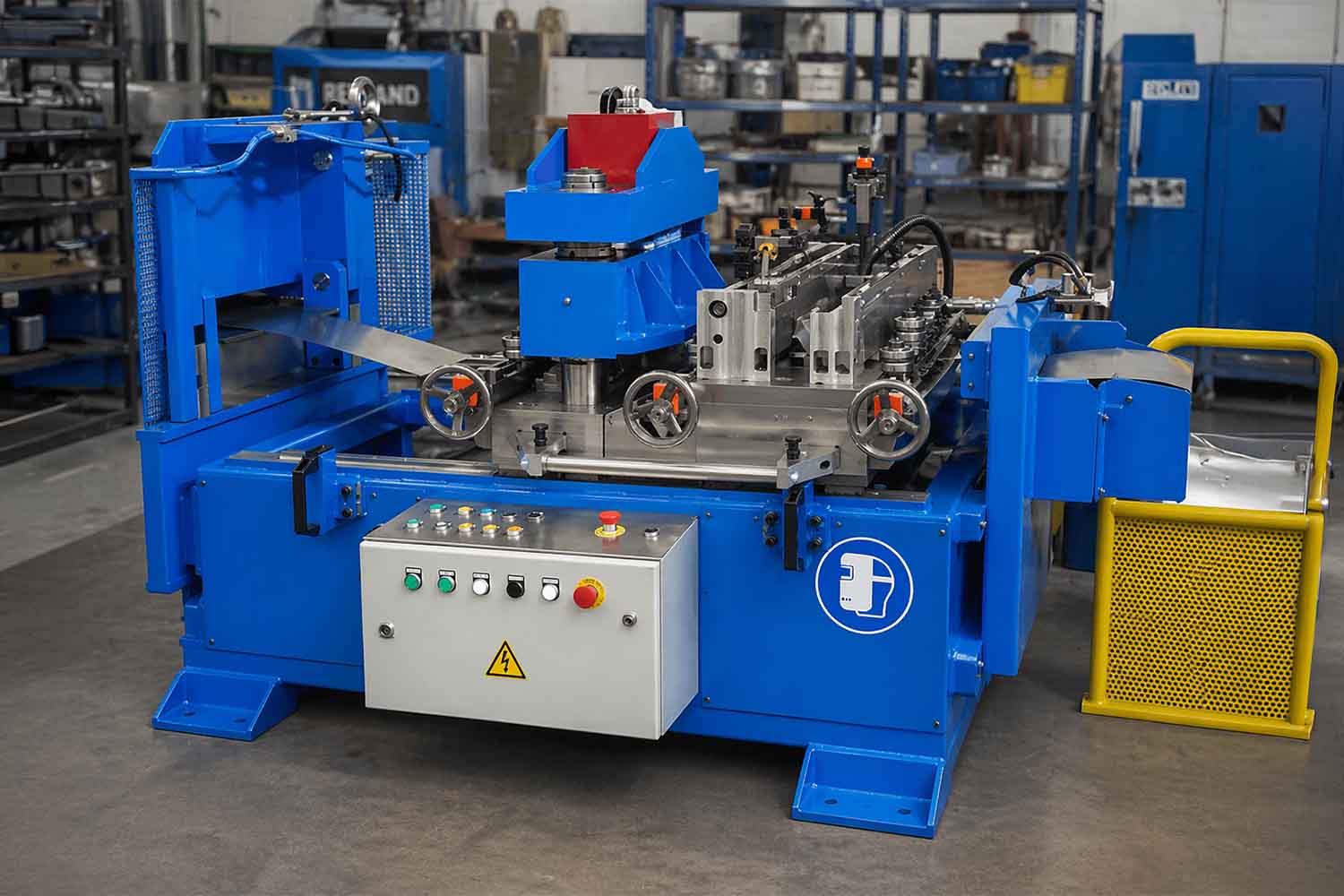
Within a production line that does not incorporate a coil joining station, every coil change requires a complete production stop followed by a restart sequence that is often unstable.
These interruptions generate:
- reduced production throughput,
- non-productive downtime,
- process variation,
- production losses,
Integrating an industrial strip joining machine enables successive coils to be joined with minimal interruption while maintaining continuous material flow.
The production line therefore retains its operating momentum, significantly improving machine availability and overall manufacturing performance.
Beyond the immediate time savings, eliminating repeated stop-start sequences also reduces transient process effects that frequently generate defects during production restart.
Maintaining a continuous material flow is essential for ensuring the stability of any strip processing line.
Even small variations in strip tension or sudden disturbances in material feeding can immediately affect roll forming, in-line punching or cut-to-length operations.
An industrial strip joining machine controls the transition between two coils by ensuring:
- continuous strip feeding,
- stable strip tension,
- smooth transition without dynamic disturbances,
This level of control prevents variations in material behaviour, particularly when processing materials that are sensitive to springback or tensile loading, while contributing to the overall stability of the continuous production process.
The quality of the strip joint has a direct impact on every downstream manufacturing operation.
A poorly aligned joint – or one with excessive thickness or insufficient mechanical strength – can disrupt tooling engagement and generate production defects.
Within a cold roll forming line, this may result in local profile deformation or dimensional variation.
During in-line punching, punching accuracy can be compromised.
During cut-to-length operations, cut-length errors or poor edge quality may occur.
A high-performance coil joining machine produces joints that are fully compatible with all downstream operations, ensuring smooth passage through the production line without disruption.
It therefore plays a key role in maintaining component quality and overall process stability.
Production stoppages and restart sequences are among the most critical phases in terms of product quality.
They frequently generate:
- non-conforming parts,
- material scrap,
- additional machine adjustments,
- unnecessary production losses,
Continuous strip joining minimises these issues by eliminating abrupt transitions between successive coils.
It therefore becomes a direct contributor to material yield optimisation.
By reducing scrap, making full use of remaining coil material and stabilising production, an industrial coil joining machine improves material utilisation, lowers manufacturing cost per component and enhances the overall profitability of the production line.
Strip Joining Technologies: Manual, Automatic and Industrial Welding Solutions
Selecting a strip joining machine cannot be approached as a generic equipment choice.
The optimum solution depends directly on the material being processed, strip thickness, tensile loads, production throughput and the level of integration required within the manufacturing process.
A joining solution suitable for a simple production environment quickly reaches its limits when integrated into continuous production lines, cold roll forming systems or other high-speed strip processing applications.
Not all coil joining technologies deliver the same level of performance.
Some are appropriate for low-volume or occasional production, while others are specifically engineered for highly automated manufacturing environments where continuous material flow, mechanical stability and process repeatability are essential.
Butt welding is widely recognised as the most effective technology for ensuring reliable material continuity in continuous production environments.
Unlike mechanical joining methods, it produces a joint with virtually no increase in strip thickness, maintaining almost perfect geometric and mechanical continuity across the full strip width.
This absence of discontinuity is particularly important in cold roll forming, where even minor variations in thickness or stiffness can generate forming defects, unwanted stresses or dimensional instability.
The quality of a welded strip joint depends on several critical parameters:
- preparation of the strip ends,
- precise strip alignment,
- accurate control of welding parameters,
- management of the heat-affected zone,
An industrial strip welding machine controls all of these parameters with exceptional repeatability, producing joints capable of withstanding tensile forces, forming loads and repeated passage through downstream tooling—even at high production speeds.
For this reason, butt welding has become the preferred joining technology for cold roll forming lines, in-line punching systems and any continuous manufacturing process where uninterrupted production is essential.
Mechanical joining methods – including clamping, crimping and other mechanical fastening systems – create a physical connection between successive strip ends without any metallurgical bonding.
Although these systems offer a simple and rapid joining process, they introduce significant limitations in demanding industrial environments.
Their principal drawback is the local increase in strip thickness created at the joint.
This geometric discontinuity may:
- interfere with downstream tooling,
- increase mechanical loading,
- generate instability during material feeding,
- produce defects during roll forming or in-line punching operations,
Mechanical joining solutions therefore remain appropriate for relatively simple production environments but are generally unsuitable for high-speed continuous processing where joint quality directly affects manufacturing performance.
Beyond the joining technology itself, the level of machine automation plays a decisive role in the overall performance of the production line.
Depending on production throughput and automation requirements, manufacturers may choose between manual, semi-automatic or fully automatic coil joining machines.
A manual coil joining machine relies heavily on operator intervention to:
- position the strip,
- align both strip ends,
- initiate the joining cycle,
This configuration may be suitable for low-volume production, but rapidly reaches its limits regarding repeatability, positioning accuracy and cycle time.
Operator-dependent processes inevitably increase the risk of:
- strip misalignment,
- inconsistent joint quality,
- extended production downtime,
By contrast, an automatic coil joining machine integrates advanced control systems capable of managing the complete joining cycle automatically.
Typical functions include:
- automatic strip alignment,
- controlled clamping,
- automatic joining parameter management,
- synchronisation with production line speed,
This level of automation delivers highly repeatable joining quality while reducing operator intervention and ensuring reliable performance, even within high-throughput manufacturing environments.
Regardless of the joining technology selected, the quality of the final joint depends first and foremost on accurate strip preparation.
Imprecise cutting, poor strip alignment or insufficient clamping can compromise the reliability of the joint, even when using advanced joining equipment.
Strip alignment becomes particularly critical in continuous production lines, where even slight positioning errors may result in profile deviation, punching inaccuracies or unstable strip tracking.
An industrial coil joining machine must therefore incorporate highly accurate guiding, centring and clamping systems capable of delivering exceptional repeatability from one production cycle to the next.
Only this level of precision ensures reliable downstream processing and long-term process stability.
Technical Design Criteria for an Industrial Coil Joining Machine: Strip Tension, Alignment and Production Performance
The design of an industrial coil joining machine cannot be separated from the production environment in which it operates.
Selecting the appropriate joining process is only one aspect of the engineering challenge.
The complete system must be capable of operating within a dynamic manufacturing environment where mechanical loads, material behaviour and process constraints interact continuously.
Only this integrated engineering approach ensures reliable, repeatable coil joining compatible with high-throughput continuous production lines.
Accurate strip alignment is one of the most critical factors influencing the quality of a coil joint.
Even minor positioning errors may create geometric discontinuities, localised stresses or progressive strip tracking deviations throughout the production line.
An industrial coil joining machine must therefore guarantee precise alignment across the entire strip width with exceptional repeatability from one joining cycle to the next.
This requires highly accurate guiding and centring systems capable of compensating for incoming strip variations before the joining process begins.
Strip clamping is equally important.
Throughout the joining cycle, the strip must remain perfectly immobilised without distortion, marking or positional movement.
Poor clamping control can introduce residual stresses or geometric defects that later affect downstream operations, particularly within cold roll forming lines.
Coil joining takes place within a dynamic production system where strip tension is a fundamental process parameter.
Variations in strip tension before, during or immediately after the joining operation may destabilise the entire manufacturing process.
An industrial strip joining machine must therefore manage:
- tensile forces upstream and downstream of the joining station,
- production line speed variations,
- dynamic loading generated as the joint passes through the production line,
Achieving this level of control requires close coordination with upstream equipment, particularly the decoiler, leveller and strip feeding systems.
The objective is to eliminate tension loss and excessive mechanical loading that could disturb strip stability.
Within high-speed production environments, precise tension management becomes even more critical.
Poor control may result in:
- forming defects,
- punching position errors,
- cutting inaccuracies,
- reduced production stability,
Successful coil joining must therefore become part of a continuous dynamic process without disturbing the overall balance of the production line.
The quality of the joint is directly linked to the performance of the coil joining machine.
The joint must provide sufficient mechanical continuity to withstand tensile loads as well as the forces generated by downstream forming and processing operations.
For butt welding applications, this requires precise control of:
- the fusion zone,
- weld penetration,
- metallurgical consistency,
- heat-affected zones,
The finished joint must also remain fully compatible with downstream tooling by eliminating excessive thickness, local stiffness variations and surface defects.
The objective is to produce a joint that becomes virtually “invisible” within the manufacturing process, both mechanically and geometrically.
A coil joining machine should never be engineered as an isolated piece of equipment.
Instead, it must be fully integrated into the operating logic of the complete production line.
This integration requires synchronisation with:
- the decoiler,
- the leveller,
- the roll forming machine,
- in-line punching systems,
- the cut-off machine,
Integration extends beyond simple machine sequencing.
It also encompasses:
- machine kinematics,
- production speed coordination,
- material flow management,
- communication between manufacturing equipment,
This systems engineering approach ensures uninterrupted production while maintaining long-term process stability.
Material behaviour plays a decisive role in the engineering of an industrial coil joining machine.
The mechanical and thermal properties of each material directly influence both joint quality and production stability.
Key material characteristics include:
- yield strength,
- ductility,
- strip thickness,
- thermal sensitivity,
- surface coatings such as galvanised or pre-painted finishes,
High-strength steels, stainless steels and aluminium alloys each respond differently during the joining process, particularly when butt welding is employed.
The joining parameters must therefore be optimised to prevent distortion, metallurgical defects or localised weakening of the material.
The objective is always the same:
to deliver a reliable, highly repeatable joint regardless of the material being processed while maintaining stable production performance over extended manufacturing runs.
Industrial Applications of Coil Joining Machines for Continuous Production Lines
Coil joining is an essential function across all strip processing lines where uninterrupted material flow is critical to manufacturing performance.
Whenever production relies on successive coils feeding continuous downstream operations, the ability to create a reliable joint between two strips becomes fundamental to maintaining process stability and production efficiency.
An industrial coil joining machine therefore plays a vital role in numerous manufacturing environments, from cold roll forming lines and in-line punching systems to high-speed automated strip processing installations.
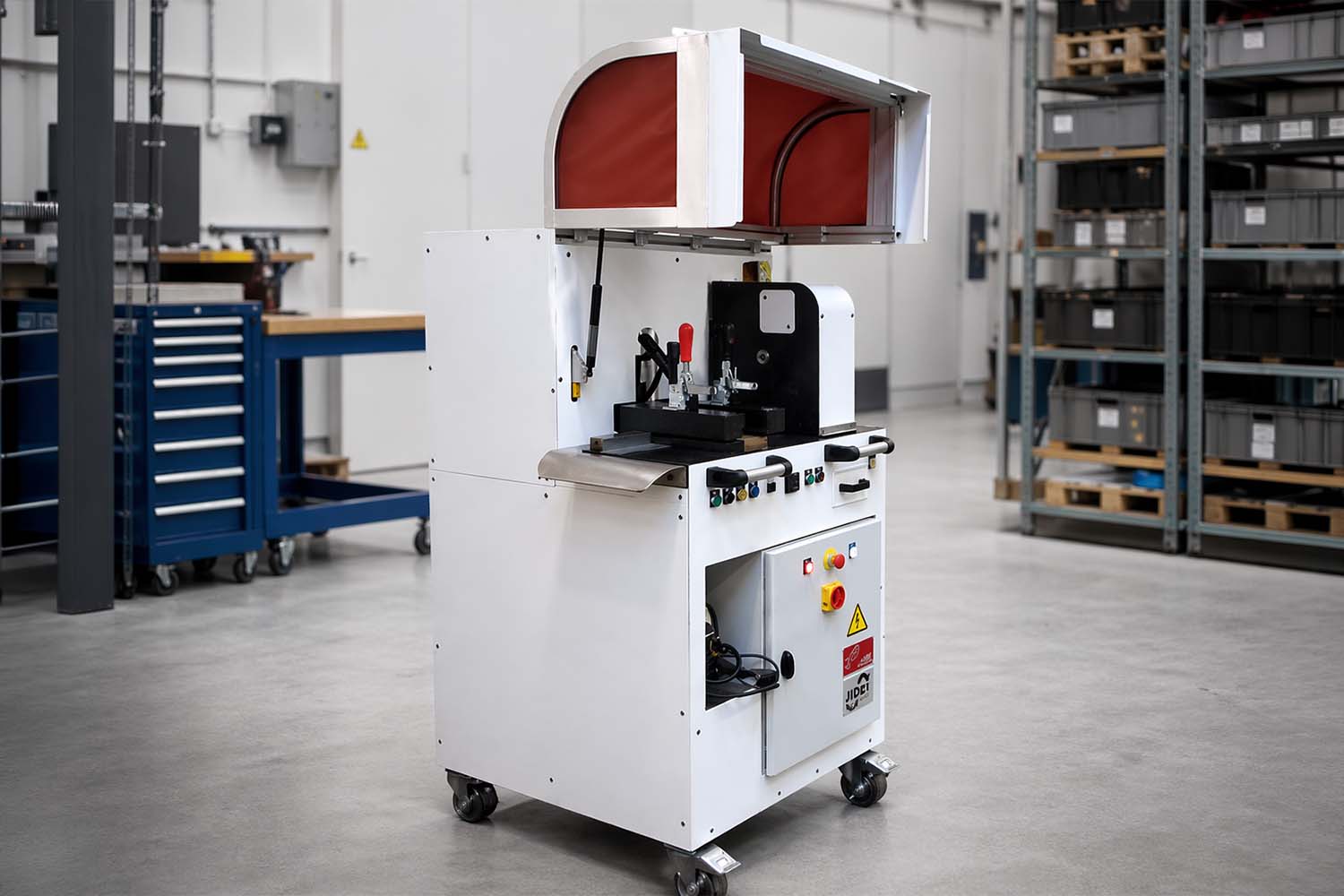
Within a cold roll forming line, coil joining becomes a key contributor to production stability.
The roll forming machine progressively shapes the strip through successive forming stations, making the process particularly sensitive to variations in strip geometry, thickness or stiffness.
An industrial strip joining machine specifically engineered for cold roll forming ensures continuous material flow without introducing functional discontinuities, allowing the strip joint to pass smoothly through every forming station.
Reliable coil joining therefore becomes an essential factor in maintaining the long-term stability and performance of the complete cold roll forming line.
Within production lines incorporating in-line punching or cut-to-length processing, manufacturing accuracy depends heavily on the consistency of material flow.
An industrial coil joining machine ensures a smooth and controlled transition between successive coils, maintaining synchronisation between the moving strip and downstream tooling.
This enables manufacturers to preserve:
- punching accuracy,
- cut-length precision,
- dimensional repeatability,
- long-term process stability,
Reliable coil joining therefore contributes directly to the precision and repeatability of all downstream manufacturing operations.
Coil joining is widely employed across industrial strip processing applications involving carbon steels, stainless steels and aluminium alloys.
Each material exhibits different mechanical and thermal characteristics that directly influence the joining process.
An industrial coil joining machine must therefore adapt its joining parameters to each material in order to deliver a reliable joint without compromising material integrity or downstream manufacturing performance.
This capability enables manufacturers to process a broad range of materials while maintaining consistent production quality and process stability.
Within highly automated manufacturing environments, automatic coil joining becomes indispensable for maintaining continuous production.
At high production speeds, even short interruptions during coil changes may immediately reduce productivity and destabilise downstream operations.
A fully automatic coil joining machine therefore becomes a strategic component of modern production lines, where manufacturing performance depends upon:
- uninterrupted material flow,
- consistent production speed,
- process repeatability,
- advanced automation,
JIDET Industrial Coil Joining Solutions for Continuous Production Lines
At JIDET, the coil joining machine is never considered as a standalone piece of equipment.
Instead, it is engineered as a fully integrated subsystem within the complete production line.
Each solution is specifically developed according to the customer’s:
- production throughput,
- material characteristics,
- profile geometry,
- manufacturing process,
- equipment interaction requirements,
The objective extends far beyond simply joining two strips together.
Every JIDET coil joining machine is designed to deliver reliable, highly repeatable coil joining that remains fully compatible with all downstream manufacturing operations—even within the most demanding high-speed production environments.
Every coil joining station developed by JIDET is individually engineered to match the characteristics of the production line in which it will operate.
This bespoke engineering approach considers:
- the production process (cold roll forming, in-line punching, cut-to-length, etc.),
- production speeds,
- mechanical loading,
- available installation space,
The coil joining machine is therefore designed as an integral part of the complete manufacturing system, ensuring controlled material continuity and long-term operational stability.
Rather than relying on standardised equipment, JIDET develops tailor-made solutions that accurately reflect real industrial operating conditions.
JIDET develops industrial butt welding systems specifically designed for demanding manufacturing environments where joint quality directly influences production performance.
These solutions provide:
- optimum mechanical continuity,
- virtually no increase in strip thickness,
- full compatibility with downstream tooling,
- excellent resistance to dynamic production loads,
Particular attention is paid to controlling thermal effects in order to minimise heat-affected zones and maintain consistent joint properties, even when processing advanced materials such as high-strength steels, stainless steels or aluminium alloys.
The objective is to create a joint that becomes virtually transparent within the production process, passing through the line without generating mechanical disturbances or production instability.
The performance of an industrial coil joining machine depends largely on how effectively it is integrated into the production line.
At JIDET, this integration is considered from the earliest stages of machine design and coordinated with every major production subsystem.
The coil joining machine operates in synchronisation with:
- the decoiler,
- the leveller,
- the roll forming machine,
- in-line punching systems,
- the cut-off machine,
This synchronisation covers machine speeds, strip tension management and production cycles, ensuring perfectly continuous material flow throughout the manufacturing process.
JIDET applies a complete systems engineering approach to industrial coil joining, simultaneously considering the machine, the material and the production process.
Each project begins with an in-depth engineering analysis of:
- the profile or application,
- material characteristics,
- production constraints,
- throughput and quality objectives,
This enables the engineering team to optimise:
- the joining technology,
- strip alignment and clamping systems,
- machine operating parameters,
- integration within the production line,
This comprehensive engineering methodology delivers durable, high-performance solutions capable of meeting the requirements of the most demanding industrial production environments.