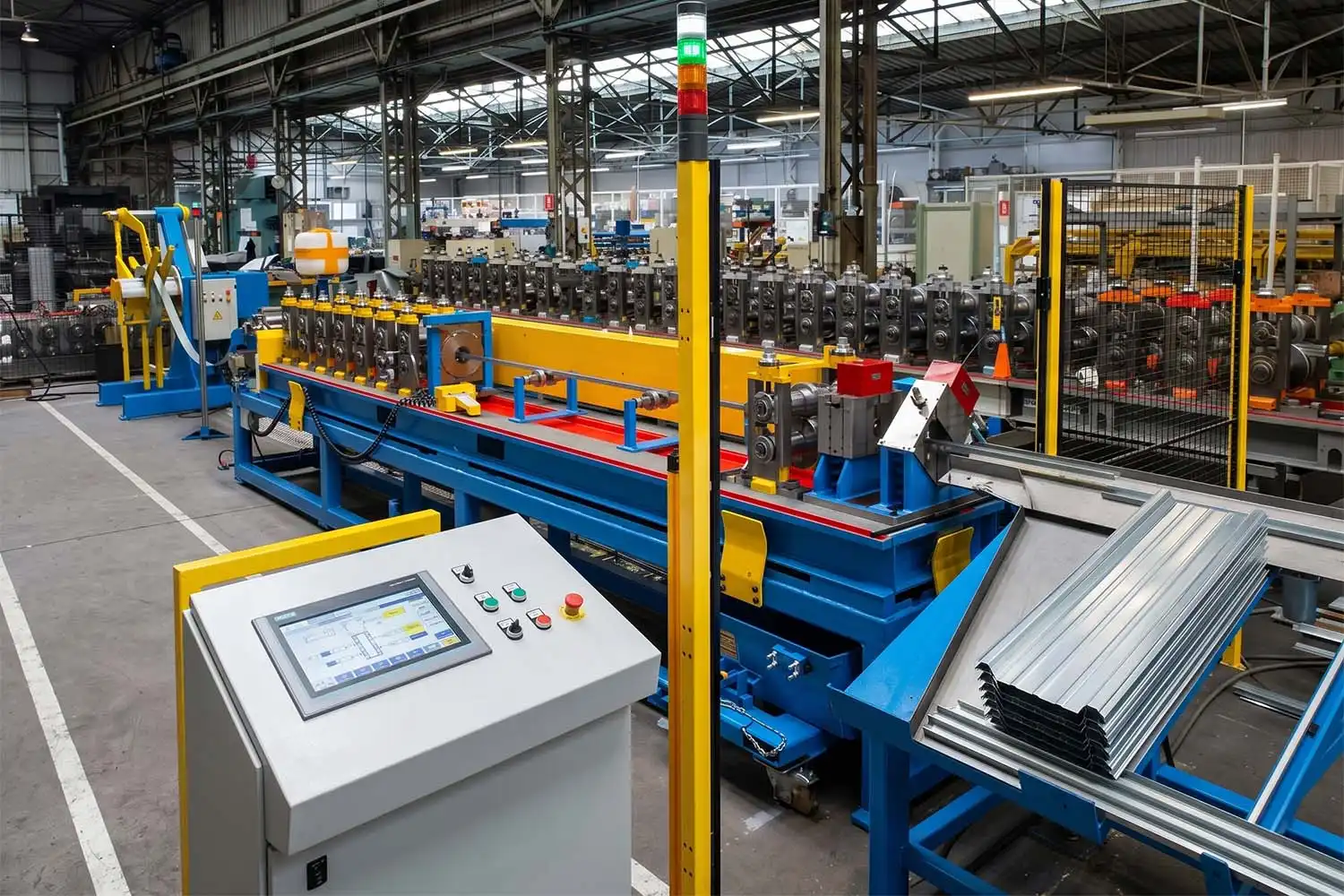

Within a cold roll forming line, the cut-off machine is a key element of the manufacturing process.
Far more than a simple separation device, it ensures precise cut-to-length of metal profiles under highly demanding conditions of production speed, dimensional accuracy and process synchronisation.
Installed downstream of the roll forming machine, the cut-off system must operate in perfect coordination with the production speed, forming operations, as well as punching and marking cycles. This seamless integration guarantees uninterrupted cold roll forming and complete synchronisation across the entire production line.
At JIDET, every cut-off machine is engineered as a complete mechanical subsystem integrating the cutting tooling, machine kinematics, drive system and dynamic synchronisation with the cold roll forming line.
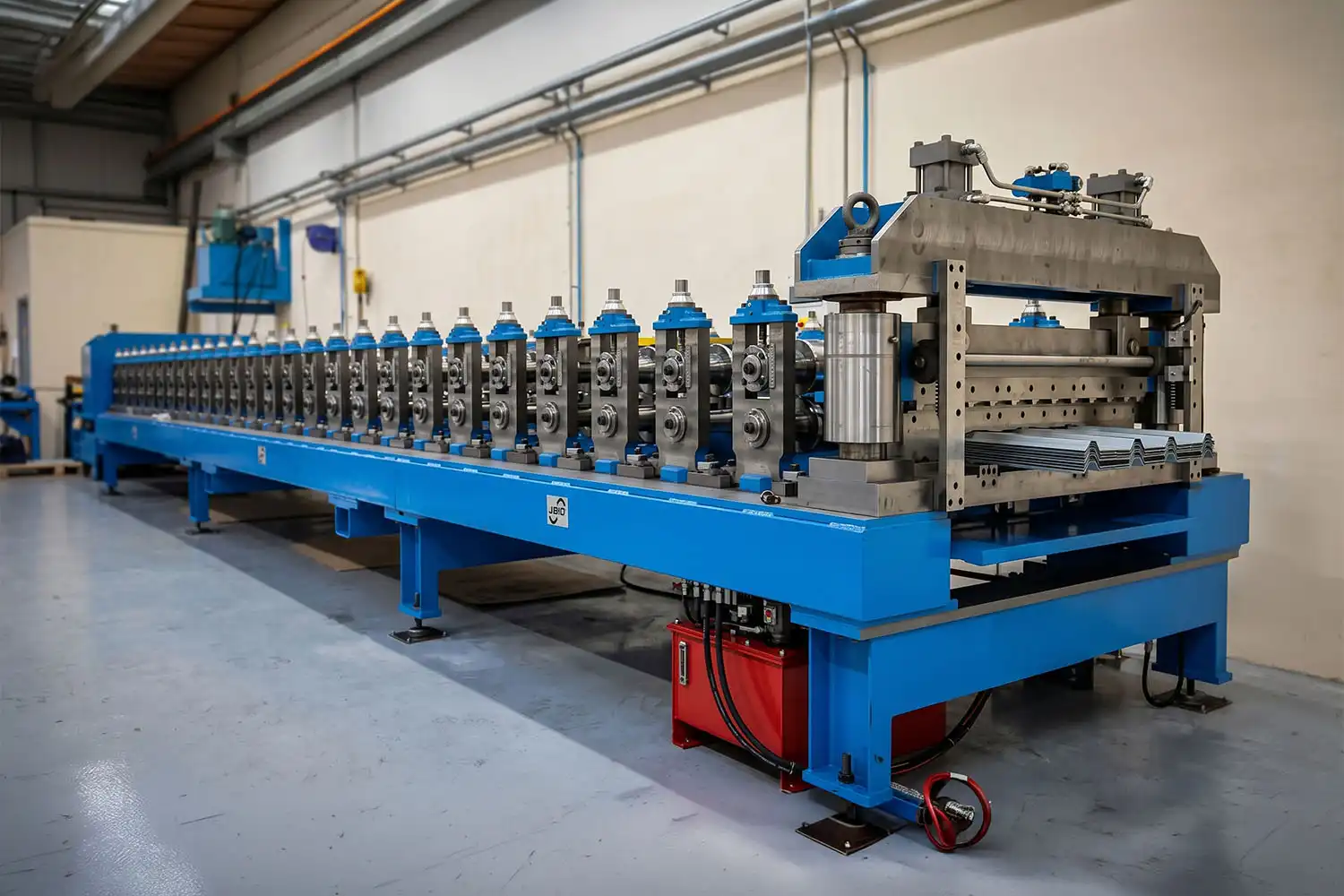
The Role of a Cut-Off Machine in an Industrial Cold Roll Forming Line
Within a cold roll forming line, the cut-off machine is far more than the final separation stage.
It is a strategic manufacturing subsystem that directly contributes to production stability, profile dimensional accuracy and the overall performance of the roll forming line.
Rather than focusing solely on the cutting tool itself, the cut-off machine must be viewed as a complete engineering system integrating:
- advanced machine kinematics,
- dynamic synchronisation with the roll forming machine,
- the capability to withstand high production speeds,
- controlled transmission of cutting forces,
- reliable operation under high-throughput manufacturing conditions,
This systems engineering approach enables manufacturers to achieve stable production, exceptional dimensional repeatability and long-term industrial reliability.
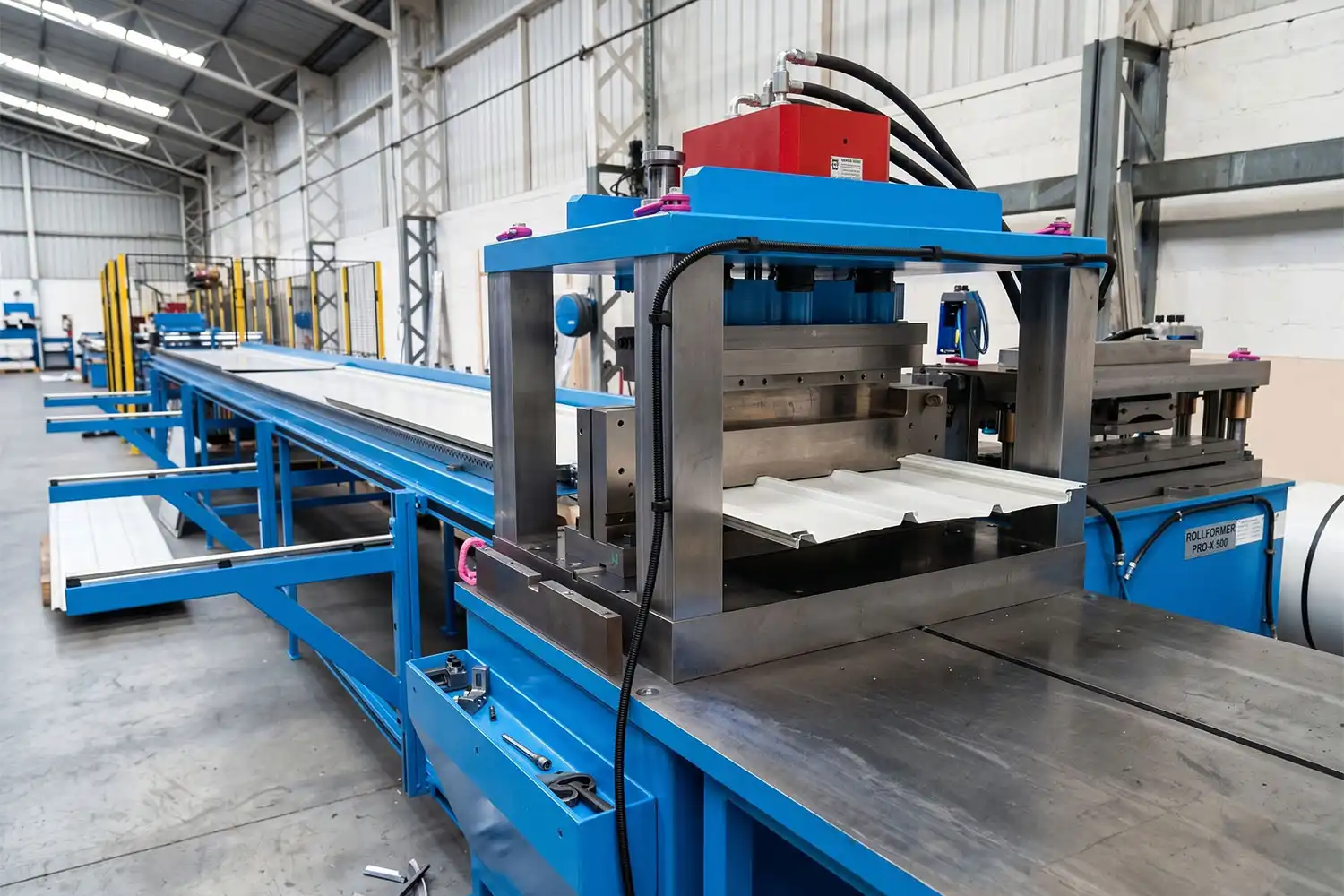
Within a continuous manufacturing process, the cut-off machine must remain perfectly synchronised with the linear speed of the roll forming machine.
This requirement is particularly critical for flying cut-off systems, where profiles are cut without stopping the material flow.
Machine kinematics must therefore ensure:
- instantaneous speed matching between the moving profile and the cutting unit,
- precise positioning throughout the cutting cycle,
- outstanding dimensional repeatability, even at very high production throughput,
Even the slightest loss of synchronisation can lead to cut-length deviations, profile distortion or process instability.
For this reason, dynamic synchronisation is one of the most critical engineering considerations when designing a high-performance industrial cut-off machine.
The machine kinematics of a cut-off system encompass all movements required to perform precise cutting operations under demanding industrial conditions.
The system must be engineered to satisfy several simultaneous requirements:
- absorb cutting forces without deforming the profile,
- ensure precise guidance of the cutting tooling throughout the cutting cycle,
- maintain mechanical stability despite dynamic operating loads,
- return rapidly to its initial position to maximise production throughput,
Within a cold roll forming line, these challenges become even more demanding due to continuous material flow and high production speeds.
The quality of the machine kinematics directly determines:
- cut quality,
- component service life,
- long-term machine reliability,
- overall process stability,
The cutting tooling – including blades, punches and dies – cannot be considered independently from the machine that carries it.
Its performance depends entirely upon the mechanical environment into which it is integrated.
Within an in-line cut-off system, the tooling forms part of a much larger engineering assembly that includes:
- the machine structure and its rigidity,
- guidance and profile support systems,
- force transmission mechanisms,
- adjustment and positioning devices,
Only the combination of these engineering elements enables consistent cutting quality and long-term production stability.
The cut-off machine plays a decisive role in maintaining the overall stability of the cold roll forming process.
Poorly controlled cutting operations may generate:
- profile deformation after cutting,
- residual stresses,
- geometric or surface defects,
- disturbances throughout the production line.
Conversely, a correctly engineered industrial cut-off machine enables manufacturers to:
- stabilise production,
- ensure consistent component conformity,
- maintain high production throughput without performance drift,
- reduce scrap and unplanned downtime.
The cut-off machine therefore becomes a genuine driver of industrial performance, contributing just as significantly to production efficiency as the roll forming machine itself.
Cut-Off Machine vs Cutting Tool: Understanding the Complete Cut-Off System in Cold Roll Forming
Within the cold roll forming industry, it is essential to clearly distinguish between the cutting tool and the cut-off machine.
Reducing the cutting process to the tooling alone overlooks the mechanical, dynamic and process-related parameters that ultimately determine cutting quality and industrial performance.
In reality, cut-to-length operations result from a fully integrated engineering system in which every component – mechanical, kinematic and control-related- contributes to positioning accuracy, dimensional repeatability and long-term process stability.
The cutting tooling – including blades, punches and dies- is the component that comes into direct contact with the material. It physically separates the profile to its specified length.
Its design depends directly on several key engineering parameters:
- profile geometry,
- material thickness and grade,
- cutting forces,
- quality requirements such as burr height, profile deformation and cut squareness,
Poorly engineered cutting tooling can result in:
- poor cut quality,
- localised deformation,
- premature tooling wear,
- deterioration of finished component quality,
However, even perfectly designed tooling cannot guarantee high-performance cutting on its own.
Its effectiveness depends entirely on the mechanical environment in which it operates.
A cut-to-length machine for cold roll forming is far more than a support structure for cutting tooling.
It is a complete engineering system designed to control, coordinate and stabilise the entire cutting cycle within a demanding industrial manufacturing environment.
*Controlled Machine Kinematics
The machine defines every movement involved in the cutting cycle, from tool approach to profile separation and rapid return to its initial position.
Its machine kinematics must provide exceptional positioning accuracy, dimensional repeatability and the capability to withstand the dynamic loads associated with high production throughput.
*Guidance and Profile Support Systems
Guidance systems ensure accurate positioning of the cutting tooling relative to the moving profile.
They are designed to:
- eliminate mechanical play,
- maintain perfect alignment,
- secure consistent cut quality,
The rigidity of the entire assembly is essential to prevent dimensional drift during production.
*Synchronisation with the Cold Roll Forming Line
Within a cold roll forming line, the cut-off machine must remain perfectly synchronised with both the speed of the roll forming machine and the continuous material flow.
This synchronisation is essential to:
- guarantee consistent cut lengths,
- eliminate defects caused by speed mismatches,
- maintain uninterrupted production, particularly with flying cut-off systems,
*Motion Control and Machine Control Systems
The machine incorporates advanced motion control systems capable of:
- managing cutting cycles,
- automatically adapting operating parameters to production throughput,
- maintaining dimensional repeatability,
- communicating seamlessly with the rest of the production line,
Machine control therefore becomes a key contributor to maintaining stable industrial performance under real production conditions.
Within cold roll forming, cutting performance never depends upon a single component.
Instead, it results from the interaction between:
- the cutting tooling,
- the cut-off machine,
- the material,
- production throughput,
- the overall manufacturing environment,
Only this systems engineering approach can deliver:
- consistently accurate cutting,
- exceptional dimensional repeatability,
- high production throughput without process drift,
- extended tooling service life,
At JIDET, engineering never focuses solely on the tooling itself.
Every project is based on complete mastery of the integrated cut-off system within the cold roll forming line, ensuring long-term performance perfectly matched to real industrial manufacturing requirements.
Cut-Off Machine Technologies for Cold Roll Forming: Flying Cut-Off, Stop Cut-Off and Integrated Cutting Systems
Selecting a cut-off system for a cold roll forming line is far more than choosing a particular cutting technology.
The optimum solution depends directly on the manufacturing process requirements, including production throughput, profile geometry, material behaviour, the desired level of process integration and dimensional accuracy.
Each cutting technology is based on its own machine kinematics and responds to different industrial production objectives.
For this reason, the cut-off machine must always be engineered in complete harmony with the architecture of the roll forming line and the expected production performance.
The Flying Cut-Off Machine is specifically designed to cut profiles without interrupting the continuous material flow.
It has become the benchmark solution for high-throughput cold roll forming lines, where uninterrupted production is essential for maximising productivity.
Its operating principle is based on dynamic synchronisation between the speed of the moving profile and the speed of the cut-off machine.
During the cutting cycle, the machine travels together with the profile, allowing separation to take place without stopping the production line.
This technology enables manufacturers to:
- maintain maximum production throughput,
- achieve exceptional cut-length repeatability,
- minimise mechanical stress associated with repeated stopping and restarting,
- optimise the overall productivity of the cold roll forming line,
These benefits require an advanced engineering design incorporating:
- sophisticated machine kinematics,
- highly accurate dynamic synchronisation,
- advanced motion control,
- exceptional structural rigidity,
Flying Cut-Off Machines are particularly suited to technical profiles, high-volume production and demanding industrial environments where process stability is critical.
A Stop Cut-Off Machine operates according to a simpler principle.
The profile is cut only after the material has been temporarily stopped or following a controlled interruption of the material feed.
This solution is typically selected when:
- production throughput is moderate,
- productivity constraints are less demanding,
- mechanical simplicity is a priority,
Its main advantages include:
- simpler machine kinematics,
- lower integration costs,
- easier maintenance,
- excellent overall robustness,
However, this technology also presents several limitations:
- interruption of continuous production,
- reduced overall production throughput,
- additional acceleration and deceleration constraints on the production line,
A Stop Cut-Off Machine therefore remains an appropriate solution for specific production environments, relatively simple profile geometries or applications where manufacturing flexibility is more important than maximum production speed.
Within the most advanced manufacturing configurations, the cut-off machine performs far more than profile separation.
It also integrates additional manufacturing and finishing operations directly within the cutting cycle.
These integrated systems can combine multiple processes, including:
- punching,
- notching,
- embossing,
- local forming,
- complex profile cutting,
This integrated approach enables manufacturers to produce near-finished components directly at the exit of the cold roll forming line.
The benefits are significant:
- fewer secondary manufacturing operations,
- elimination of offline rework,
- higher production throughput,
- reduced handling costs,
- improved consistency between forming and functional operations,
The integrated cut-off machine therefore becomes a true manufacturing module positioned at the heart of the cold roll forming line, significantly increasing the added value of the entire production process.
How a Cut-Off Machine Impacts Production Throughput, ROI and Industrial Performance
Within a cold roll forming line, the cut-off machine should never be considered simply as the final station of the production line.
It has a direct influence on:
- production throughput,
- process stability,
- and ultimately the manufacturing cost per component,
An inadequately engineered cut-off machine rapidly becomes a production bottleneck, leading to:
- reduced production speed,
- dimensional variation,
- premature tooling wear,
- unplanned production downtime,
Conversely, a cut-off machine designed in complete harmony with the roll forming machine and the overall manufacturing process becomes a genuine driver of industrial performance.
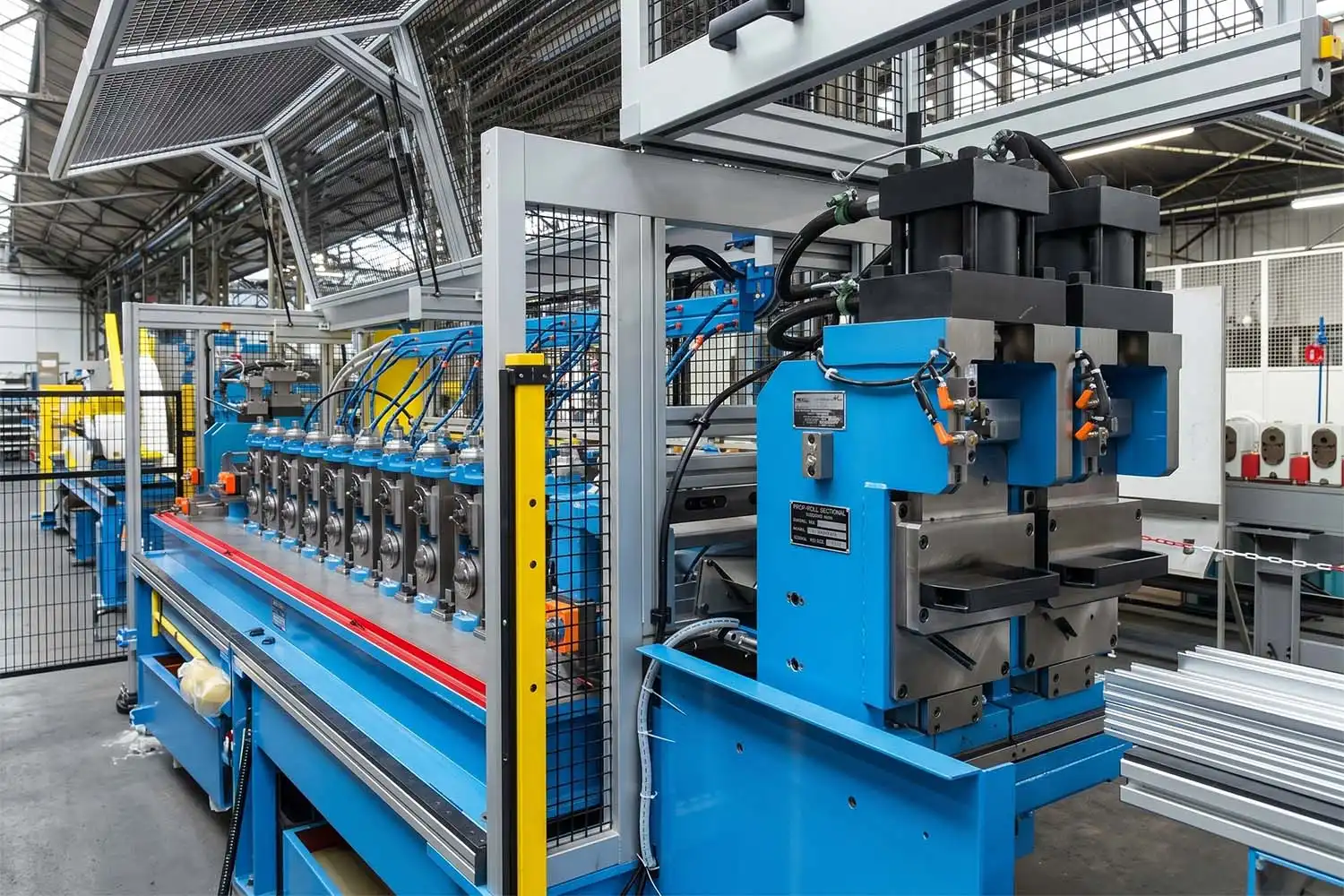
The cut-to-length operation directly determines the maximum production throughput that can be achieved on a cold roll forming line.
Within Flying Cut-Off configurations, the machine must continuously match the linear speed of the moving profile without interrupting material flow.
This requires:
- perfect synchronisation with the roll forming machine,
- machine kinematics capable of sustaining rapid operating cycles,
- excellent dynamic stability at high production speeds,
Any limitation within the cut-off machine immediately results in:
- reduced production throughput,
- micro-stoppages or production slowdowns,
- a loss of overall manufacturing efficiency,
The cut-off machine therefore becomes a determining factor in the performance of the production line, just as important as the forming stations themselves.
The engineering of an industrial cut-off machine has a direct impact on the return on investment (ROI) of a cold roll forming line.
It contributes to economic performance by:
- reducing scrap generated by cutting defects,
- minimising rework and secondary operations,
- optimising cycle times,
- extending tooling service life,
- reducing unplanned production downtime,
Conversely, unstable or inaccurate cutting generates substantial hidden costs through:
- non-conforming components,
- material waste,
- increased operator intervention,
- corrective maintenance,
A properly engineered cut-off machine enables manufacturers to sustainably reduce the cost per part while ensuring smooth, reliable and repeatable production.
The stability of a cold roll forming line depends upon the balance between all of its manufacturing subsystems.
The cut-off machine plays a central role in maintaining that balance.
Poorly controlled cutting operations may generate:
- residual stresses within the finished profile,
- profile deformation,
- disturbances to material flow,
- vibration or alignment issues,
Conversely, a fully integrated and properly synchronised cut-off machine enables manufacturers to:
- stabilise production flow,
- preserve profile geometry,
- prevent downstream process disturbances,
- maintain high production throughput over extended production runs,
The cut-off machine therefore contributes directly to the overall reliability of the production line by reducing variability and ensuring consistent manufacturing performance.
The performance of a cut-off machine cannot be separated from that of the roll forming machine itself.
Both systems must be engineered together while taking into account:
- target production speed,
- profile geometry,
- integrated operations such as punching, marking and forming,
- material characteristics,
This systems engineering approach enables manufacturers to:
- eliminate production bottlenecks,
- optimise process continuity,
- achieve consistent performance across the entire cold roll forming line,
At JIDET, every cut-off machine is engineered as an integral structural element of the roll forming line, directly contributing to productivity, product quality and long-term manufacturing profitability.
Integrated Cut-Off Machines for JIDET Cold Roll Forming Lines
Within a cold roll forming line, the cut-off machine should never be considered an independent module simply positioned at the end of the production line.
It must instead be engineered as a fully integrated element of the overall roll forming machine, working in continuous interaction with the forming stations, intermediate operations and the complete manufacturing sequence.
At JIDET, integration of the cut-off system is based on a systems engineering approach in which every parameter – mechanical design, machine kinematics and motion control – is developed in accordance with the profile geometry, material characteristics, production throughput and industrial manufacturing requirements.
The performance of an industrial cut-off machine depends directly upon its level of integration within the production line.
A fragmented approach inevitably creates process imbalance through:
- synchronisation errors,
- uneven distribution of mechanical loads,
- reduced process stability,
Conversely, a fully integrated solution enables manufacturers to:
- maintain uninterrupted material flow,
- synchronise machine kinematics with the roll forming machine,
- coordinate production speeds and operating cycles,
- eliminate stress concentrations at the exit of the forming section,
The cut-off machine therefore becomes a natural extension of the cold roll forming process, rather than a source of production instability.
Within a JIDET cold roll forming line, the cut-off machine is fully synchronised with all upstream manufacturing operations, including:
- progressive roll forming,
- in-line punching,
- industrial marking and identification,
- in-line finishing operations,
This complete synchronisation ensures:
- consistently accurate cut lengths,
- perfect alignment between functional operations and finished component dimensions,
- exceptional dimensional repeatability, even at high production throughput,
This capability is particularly critical for Flying Cut-Off Machines, where every cutting cycle must remain perfectly synchronised with the moving material.
JIDET cut-off machines can integrate additional manufacturing functions directly within the cutting station, transforming it into a complete in-line finishing module.
Depending on customer requirements, the machine can combine:
- final punching,
- notching,
- embossing,
- local forming,
- application-specific cutting operations,
This integrated approach enables manufacturers to:
- reduce secondary manufacturing operations,
- eliminate offline rework,
- increase overall production throughput,
- maintain complete consistency between forming and finishing operations,
The cut-off machine therefore becomes a fully integrated manufacturing module capable of delivering near-finished components directly from the production line.
Integration of the cut-off system must also consider both profile geometry and material behaviour.
Complex profiles – including multi-bend geometries, closed sections and asymmetrical profiles – as well as demanding materials such as high-strength steels, stainless steels and technical aluminium alloys require:
- precise control of cutting forces,
- effective management of profile deformation,
- anticipation of residual stresses,
A fully integrated engineering approach makes it possible to optimise:
- cutting tool geometry,
- machine kinematics,
- profile support throughout the cutting cycle,
The objective is to maintain consistently high cut quality while fully preserving profile geometry.
Modern manufacturing environments increasingly require rapid product changeovers and flexible production.
JIDET cut-off machines are therefore engineered to integrate seamlessly within flexible production architectures supporting:
- interchangeable tooling cassettes,
- rapid format changes,
- highly repeatable machine settings,
This approach enables manufacturers to:
- minimise downtime,
- secure rapid product changeovers,
- maintain high production performance, even in multi-product manufacturing environments,
The integration philosophy behind every JIDET cut-off machine is based on one simple principle: ensuring complete consistency between every element of the manufacturing process.
This systems engineering approach enables manufacturers to:
- achieve long-term production stability,
- reduce production variability and unplanned downtime,
- guarantee consistent product quality,
- maximise the overall productivity of the cold roll forming line,
The cut-off machine is no longer simply a functional production station.
It becomes a strategic component of the cold roll forming line, directly contributing to manufacturing performance, reliability and long-term profitability.