

Industrial packaging should never be regarded as a simple end-of-line packing operation.
It is a fundamental stage of the manufacturing process, directly influencing the overall performance of the production line.
Within industrial environments such as cold roll forming, strip processing and metalworking, packaging presents particularly demanding engineering challenges. Product format variability, high production throughput, long or complex components, together with material handling and traceability requirements, all require a carefully engineered solution.
In this context, an industrial packaging line cannot rely on a standardised approach.
The choice between a manual packaging station, a semi-automatic packaging system or a fully automatic packaging machine depends directly on production requirements, throughput targets, product variability and operational efficiency objectives.
At JIDET, every custom industrial packaging solution is engineered as a direct extension of the production line.
From the earliest design stages, each system integrates:
- material flow management,
- synchronisation with upstream operations such as cold roll forming, cut-to-length and in-line punching,
- optimisation of the complete manufacturing process,
The objective is to ensure seamless continuity between production and packaging while maximising productivity, reliability and long-term manufacturing performance.
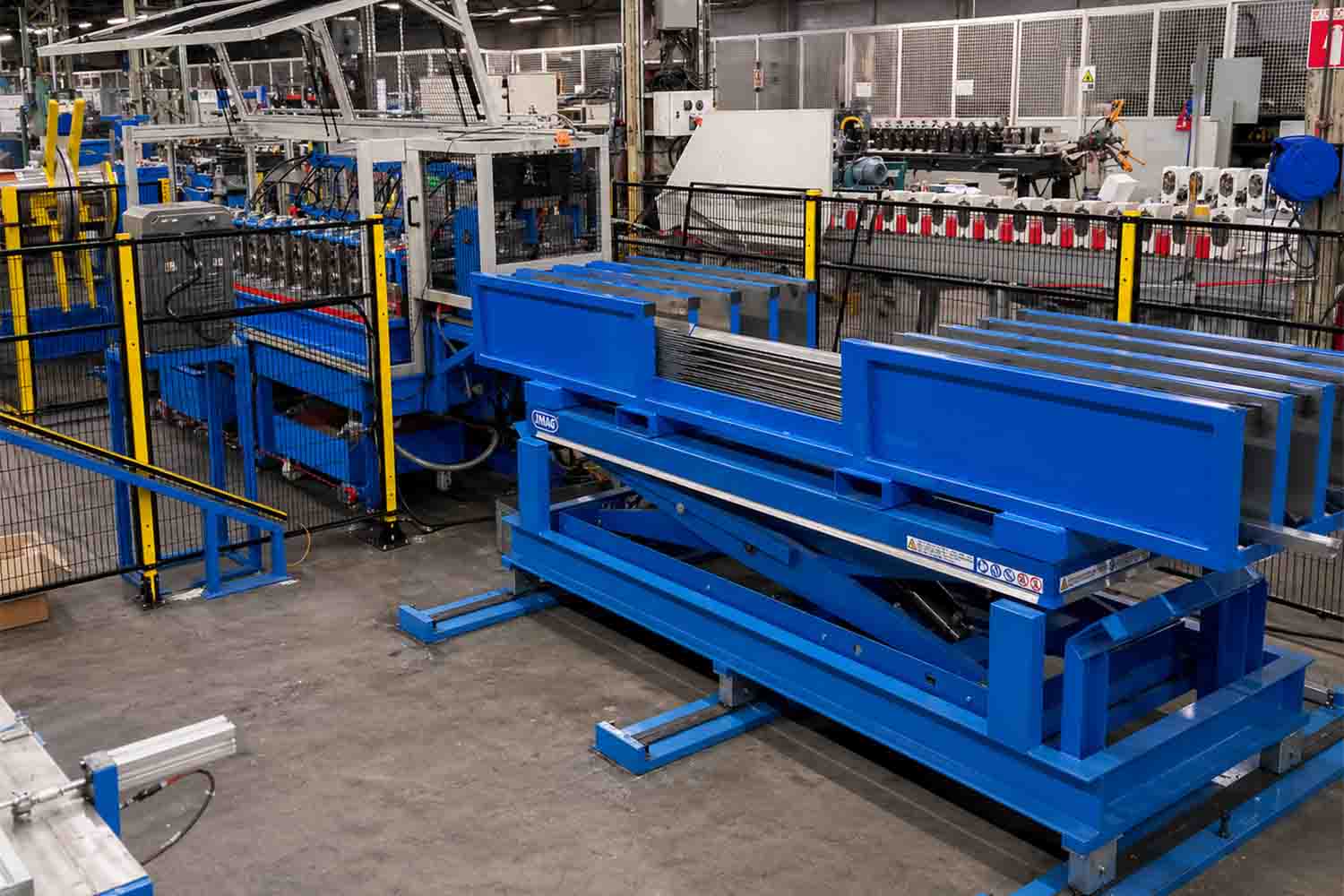
Why Design a Custom Industrial Packaging Machine for Your Production Line ?
A standard industrial packaging machine may adequately meet relatively simple production requirements where products are uniform, production throughput remains stable and product variability is limited.
Under these conditions, a generic packaging solution can provide reliable end-of-line packaging without significantly affecting production organisation.
However, as soon as manufacturers process metal profiles, long products, complex geometries, variable product lengths, high production throughput or demanding handling and traceability requirements, the limitations of standard packaging equipment quickly become apparent.
Packaging then becomes a critical manufacturing operation directly affecting process stability, production continuity and overall line performance.
Designing a custom industrial packaging machine is therefore not simply a matter of convenience.
It is an engineering necessity.
The objective is to adapt the packaging solution precisely to real production conditions, ensuring:
- continuous material flow,
- consistent packaging quality,
- optimised operating costs,
- maximum manufacturing efficiency,
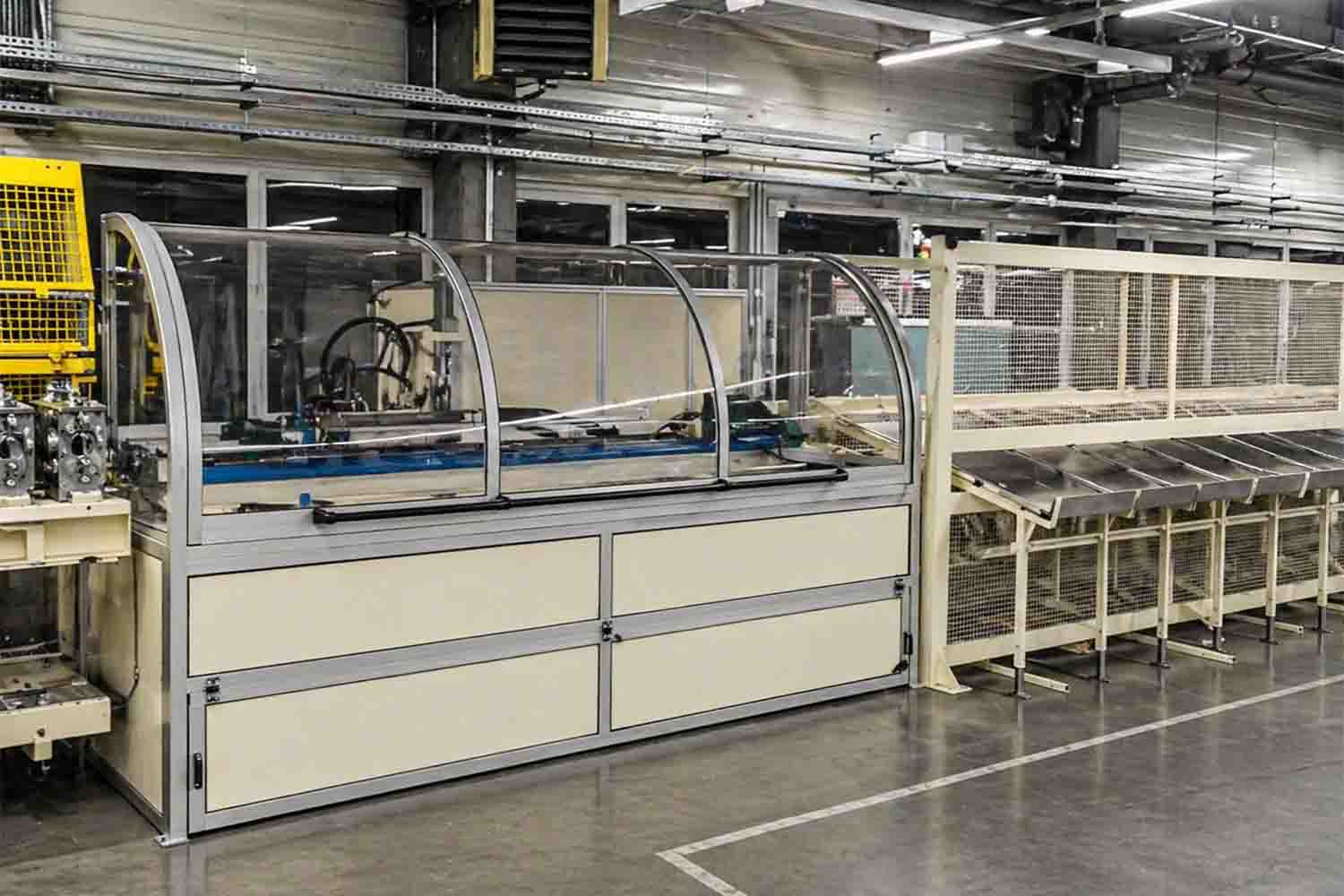
Standard packaging systems are designed for generic production environments.
They rapidly reach their limits when products cannot be stacked conventionally, when product lengths vary, when positioning tolerances become critical or when high production throughput requires perfectly continuous material flow.
By contrast, a custom industrial packaging machine allows the transfer kinematics to be engineered specifically for the characteristics of the products being handled.
It can integrate dedicated functions such as:
- product sorting,
- stacking,
- grouping,
- batch formation,
while maintaining excellent product stability throughout the packaging process.
The complete system is engineered to absorb production variability, secure material flow and maintain consistent production throughput—even within highly demanding industrial environments.
Industrial packaging should never be considered an isolated operation positioned at the end of the production line.
Instead, it must be engineered in complete harmony with the manufacturing process while taking into account interactions with upstream equipment such as the cold roll forming line, the cut-off machine, the in-line punching system and other production operations.
The performance of an industrial packaging line depends directly on its ability to:
- match production speeds,
- manage uninterrupted product flow,
- integrate seamlessly with the factory’s overall logistics,
Even slight synchronisation errors may generate product accumulation, production stoppages or reduced throughput.
At JIDET, every custom packaging solution is engineered as a fully integrated component of the complete manufacturing system.
From the initial engineering phase, the design incorporates:
- material flow management,
- production synchronisation,
- optimisation of overall manufacturing performance,
The objective is to ensure seamless continuity between production and packaging while securing the efficiency of the entire industrial process.
Not every manufacturing environment requires the same degree of automation.
A fully automatic packaging machine is not always the most appropriate solution.
In many production environments, an optimised manual packaging station or a semi-automatic packaging system provides a more effective balance between flexibility, investment cost and operational performance.
A custom industrial packaging line should therefore be engineered as a scalable system capable of adapting its level of automation to actual production requirements.
At JIDET, every solution is designed to match the customer’s manufacturing environment precisely, combining:
- production performance,
- operational flexibility,
- optimised return on investment,
Technical Design Criteria for Industrial Packaging Machines and Packaging Lines
The performance of an industrial packaging machine begins with a thorough understanding of the customer’s manufacturing requirements.
A custom packaging line is far more than a sequence of conveyors and mechanical operations.
It is a fully engineered system in which the product, production throughput, material flow and factory organisation are considered together to create a balanced and efficient manufacturing solution.
Only this systems engineering approach delivers long-term productivity, operational reliability and process stability.
The products to be packaged determine virtually every aspect of an industrial packaging line.
They directly influence the mechanical architecture, transfer kinematics and product handling strategy.
Product characteristics determine the design of:
- conveying systems (rollers, belts, chains or dedicated support systems),
- gripping and transfer devices (grippers, stops, guides and automatic transfer mechanisms),
- stacking, grouping and batch formation systems,
Within JIDET production environments, packaged products typically include:
- constant cross-section metal profiles,
- processed strip exiting production lines,
- long or technically complex components requiring controlled handling and stability,
A custom industrial packaging machine enables each of these parameters to be optimised in order to ensure consistent packaging quality and exceptional repeatability.
Production throughput is one of the defining parameters when designing an automatic or semi-automatic packaging system.
It should never be considered simply as a theoretical production speed.
Instead, it must remain perfectly synchronised with the entire manufacturing process.
An industrial packaging line must therefore be capable of:
- matching the actual production rate,
- absorbing fluctuations in product flow,
- maintaining uninterrupted manufacturing continuity,
A bespoke engineering approach guarantees this global consistency while preventing bottlenecks that could limit the performance of the production line.
A high-performance industrial packaging line must achieve the optimum balance between automation, operational flexibility and ease of use.
Its engineering should consider:
- the required level of automation (manual, semi-automatic or fully automatic),
- the ability to handle different product types,
- rapid adjustment and product changeovers,
- long-term mechanical robustness,
A custom industrial packaging machine should be designed as an adaptable manufacturing system capable of evolving alongside changing production requirements.
At JIDET, every solution is engineered so that its level of automation precisely reflects the customer’s manufacturing objectives, ensuring the ideal combination of:
- production performance,
- operational flexibility,
- optimised return on investment,
JIDET Industrial Packaging Solutions: Automatic Packaging Lines, Semi-Automatic Systems and Manual Workstations
JIDET’s industrial packaging solutions are never based on a standardised approach.
Instead, they are engineered as fully integrated manufacturing systems designed to meet the specific requirements of industrial production lines, particularly within cold roll forming, strip processing and metalworking applications.
Every industrial packaging machine is individually engineered according to:
- product characteristics,
- production throughput,
- material flow,
- the required level of automation,
This bespoke engineering approach ensures seamless integration into the manufacturing process while delivering maximum productivity and operational reliability.
The automatic packaging lines developed by JIDET are designed to integrate directly with production output within a continuous-flow manufacturing environment.
These systems enable manufacturers to:
- manage product flow at the end of the production line without uncontrolled accumulation,
- automate stacking, grouping, transfer and batch formation operations,
- integrate seamlessly with cold roll forming, cut-to-length and other industrial processing lines,
The design of every automatic packaging machine is based on precise synchronisation with upstream production equipment, ensuring perfect consistency between production throughput and packaging capacity.
Within demanding manufacturing environments, a custom automatic packaging line becomes a direct driver of productivity while improving the stability of the complete manufacturing process.
*Semi-automatic packaging systems provide an effective intermediate solution for a wide range of industrial production environments.
They automate the most critical packaging operations while maintaining operator involvement where flexibility adds value.
These solutions are specifically engineered to:
- automate key packaging functions,
- assist operators during handling operations,
- secure critical stages of the packaging process,
*Semi-automatic packaging machines are particularly well suited to:
- mixed-product manufacturing,
- medium production batches,
- production environments where operational flexibility is essential.
They improve productivity without introducing unnecessary rigidity into the manufacturing organisation while ensuring greater packaging consistency.
A manual packaging station continues to provide significant value in many industrial environments.
When properly engineered, it can deliver high levels of productivity while offering exceptional operational flexibility.
These solutions are particularly appropriate for:
- small production batches,
- highly variable production,
- complex or application-specific products,
At JIDET, a manual packaging station is never regarded as a basic solution.
Instead, it is developed as an optimised industrial workstation incorporating detailed engineering focused on:
- operator ergonomics,
- product flow,
- handling safety,
The objective is to transform manual packaging into a highly efficient industrial operation fully integrated within the overall manufacturing process.
The true differentiator of JIDET industrial packaging solutions lies in their comprehensive engineering approach.
Packaging is never treated as an independent item of equipment.
Instead, it is designed as a fully integrated component of the production system.
This engineering methodology includes:
- detailed analysis of the products to be packaged,
- comprehensive evaluation of material flow and production constraints,
- precise synchronisation with upstream production equipment,
- industrial validation of every technical solution,
Each custom packaging line is therefore engineered according to a complete systems approach, ensuring every component operates in perfect harmony with the overall manufacturing process.
At JIDET, designing an industrial packaging machine means securing the performance of the entire production chain by delivering seamless integration between manufacturing, material handling and packaging.
Industrial Applications of Packaging Machines and Packaging Lines
Industrial packaging plays a vital role across numerous manufacturing sectors where efficient end-of-line material flow is essential to operational performance.
Whether manual, semi-automatic or fully automatic, an industrial packaging machine must be capable of adapting to product characteristics, production throughput and logistics requirements.
Within complex manufacturing environments, packaging extends far beyond a simple end-of-line operation.
It becomes a strategic contributor to overall manufacturing performance by ensuring:
- uninterrupted production flow,
- product stability,
- optimised material handling,
- efficient preparation for storage and shipment,
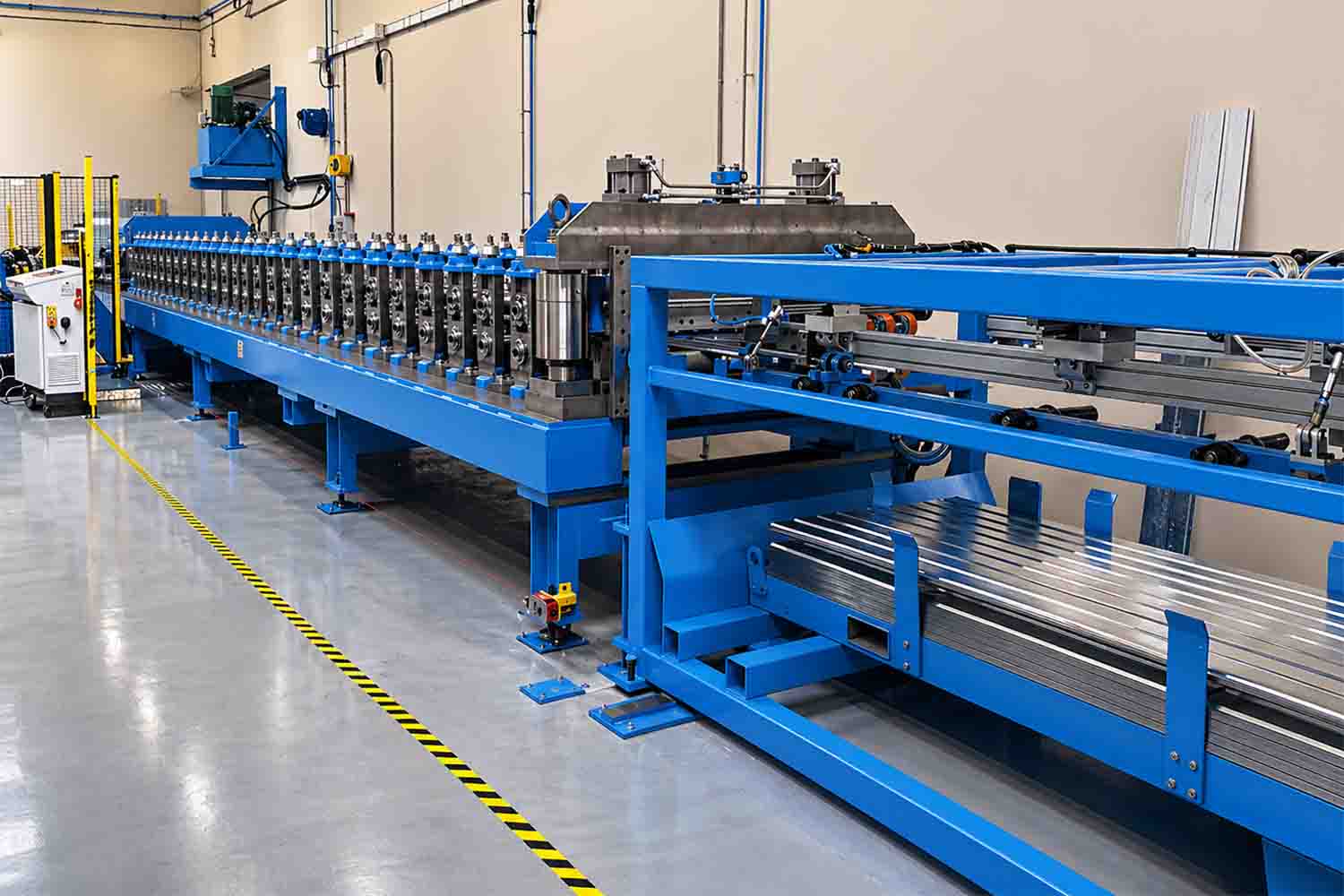
Within cold roll forming and strip processing applications, end-of-line packaging represents one of the most critical stages of the manufacturing process.
Products leaving these production lines often present specific challenges associated with their geometry, length and handling stability.
Industrial packaging systems must therefore be capable of processing:
- constant cross-section metal profiles,
- rails and linear components,
- structural products designed for demanding technical applications,
A fully integrated automatic packaging line enables packaging operations to remain perfectly synchronised with production, eliminating interruptions while ensuring consistently high packaging quality.
Within the metalworking industry, packaging requirements are directly influenced by the diversity of manufactured products and their mechanical characteristics.
Components may feature complex geometries, significant lengths or demanding handling and protection requirements.
Custom industrial packaging machines must therefore accommodate products such as:
- precision-engineered components,
- long products requiring controlled stabilisation,
- industrial assemblies with strict positioning requirements,
The packaging system consequently becomes a natural extension of the manufacturing process, contributing directly to product quality and efficient material flow.
Beyond manufacturing itself, industrial packaging plays a central role in logistics and shipment preparation.
It determines how products are grouped, handled, protected and transported throughout the supply chain.
A high-performance industrial packaging line should therefore integrate functions such as:
- grouping products into consistent batches,
- palletising according to transport requirements,
- preparing products for shipment,
An automatic or semi-automatic packaging machine enables manufacturers to standardise packaging quality, improve product traceability and reduce preparation errors.
Within a fully integrated manufacturing environment, packaging becomes the essential link between production and logistics, contributing directly to operational efficiency, delivery reliability and customer satisfaction.