

Selecting a custom cold roll forming machine should never be based solely on standard production capacity or a generic machine configuration. Profile geometry, the complexity of successive bends, material characteristics (steel, stainless steel or aluminium), yield strength, springback behaviour, dimensional tolerances, production throughput, integrated operations (punching, cutting, marking and finishing), and the frequency of product changeovers all require a far more advanced approach to mechanical and process engineering.
A high-performance industrial roll forming machine is far more than a succession of forming rolls. Its performance depends on the precise balance between machine frame rigidity, roll shaft sizing, control of forming forces, transmission stability, station-by-station adjustment accuracy and the management of interactions between the material and the roll tooling throughout the entire cold roll forming process.
At JIDET, every custom cold roll forming machine is engineered as a complete production system, where the mechanical architecture, roll tooling, drive kinematics and quick changeover solutions (interchangeable cassette systems, rapid adjustment mechanisms and automation) are designed specifically around the profile to be manufactured and the customer’s production requirements.
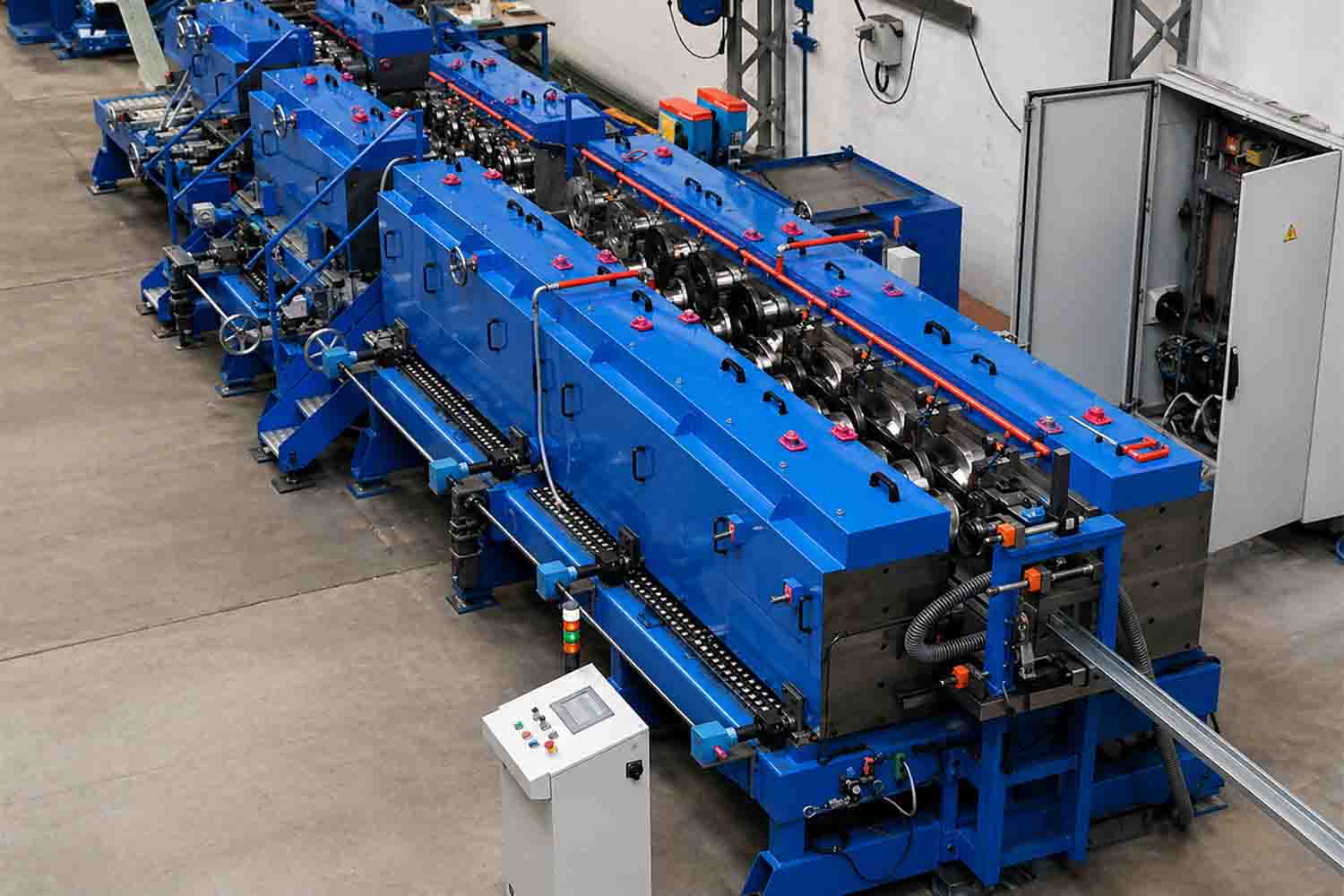
Why Choose a Custom Cold Roll Forming Machine for Your Industrial Profiles?
A standard cold roll forming machine may be suitable for relatively simple profiles with open geometries, limited technical constraints and stable production conditions. It is generally intended for repetitive manufacturing with minimal variations in material properties, dimensional tolerances or production speed.
In reality, however, industrial profiles are rarely standard. As soon as a profile incorporates multiple bends, tight radii, asymmetric sections, stiffening features, perforations or demanding dimensional tolerances, the limitations of a generic machine design rapidly become apparent.
Similarly, certain materials – including high-yield-strength steels, stainless steels and engineering-grade aluminium alloys – introduce springback effects, work hardening and forming path sensitivity that cannot be effectively controlled using a standardised machine architecture.
Higher production rates, the integration of multiple inline operations (punching, cutting and marking) and the need to manufacture a wide range of profile variants with rapid changeovers all require a considerably more sophisticated engineering approach.
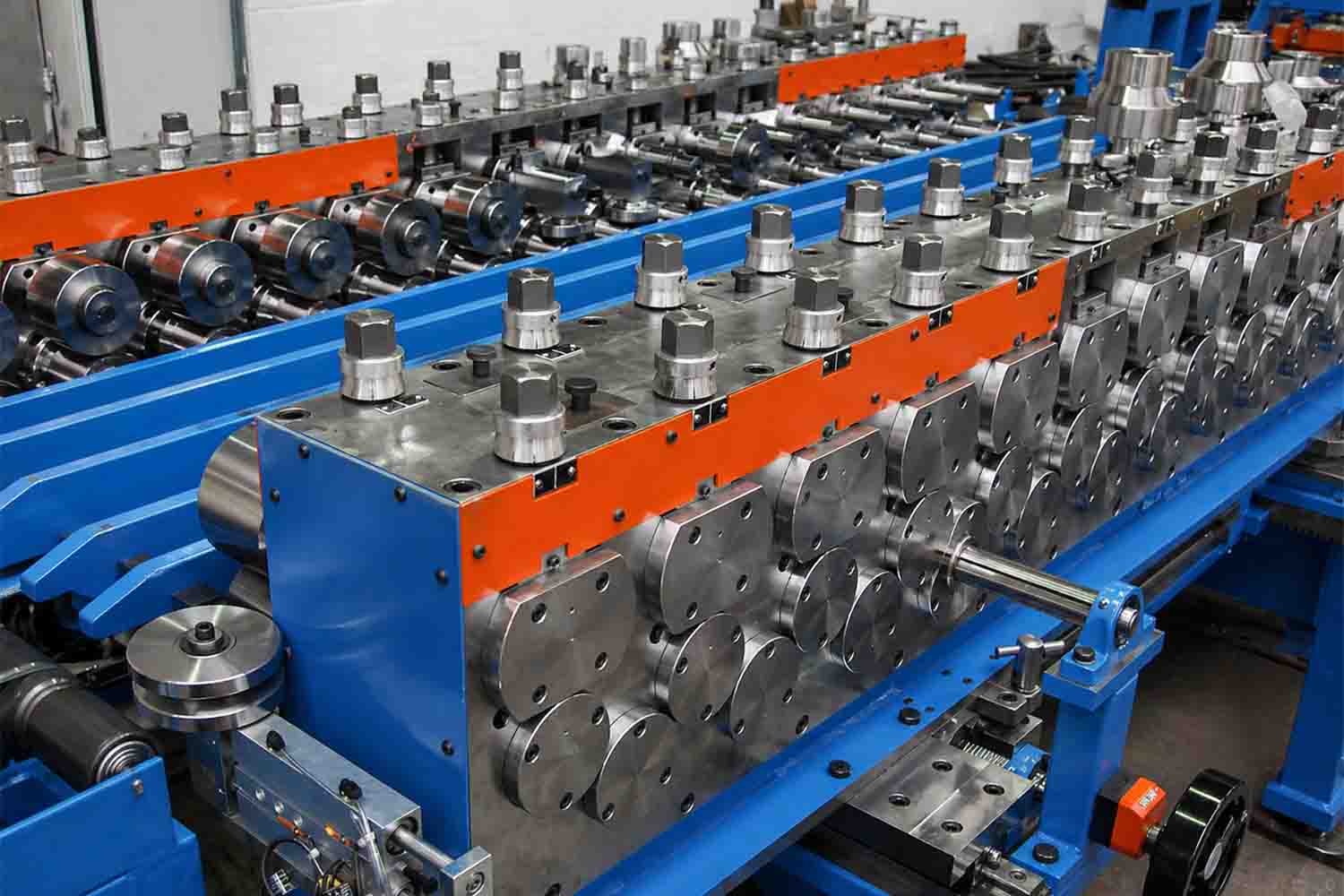
A standard cold roll forming machine may be suitable for straightforward profiles with open geometries and stable manufacturing conditions. It is designed for repetitive production where material specifications, dimensional tolerances and production throughput remain largely unchanged.
Industrial applications, however, rarely follow such standard conditions.
Once a profile includes multiple bends, tight radii, asymmetric geometries, stiffening features, perforations or demanding dimensional accuracy requirements, a conventional machine configuration quickly reaches its limits.
Likewise, materials such as high-strength steels, stainless steels and technical aluminium alloys generate springback, work hardening and forming sensitivity that require precise control throughout the forming sequence – something that standard machine designs cannot reliably achieve.
In addition, increasing production speeds, integrating several inline processes such as punching, cutting and marking, and managing frequent product changeovers all demand a significantly more advanced roll forming solution.
A custom cold roll forming machine makes it possible to optimise:
- the number of forming stations,
- the distribution of forming forces,
- the progression of each forming stage,
- the kinematics of the forming rolls,
- and the overall architecture of the roll forming machine,
to ensure a fully controlled forming process without material damage or profile distortion.
The performance of an industrial roll forming machine depends on far more than the forming rolls themselves. It is built upon a complete mechanical architecture engineered to absorb, transmit and precisely control the forming forces generated throughout the cold roll forming process.
The final quality of the profile is directly influenced by several key engineering parameters:
- machine frame rigidity, which determines overall structural stability under radial and axial loads,
- the sizing of the roll shafts, particularly their torque capacity, deflection under load and long-term durability,
- the stability of the drive system (universal shafts, gear transmissions and drive mechanisms), ensuring constant line speed and preventing variations during forming,
- precise station-by-station adjustments (vertical, lateral and roll penetration settings) to accurately control the deformation path,
- interchangeable cassette systems, which directly affect repeatability following product changeovers,
- the integration of secondary operations such as punching, cutting and embossing, which must remain perfectly synchronised with the roll forming process,
A standard machine rarely allows all these parameters to be optimised simultaneously. By contrast, a custom roll forming machine is engineered to ensure perfect consistency between every mechanical element, resulting in greater process stability, reduced manufacturing variation and consistently high-quality profiles.
- profile dimensional repeatability,
- compliance with tight dimensional tolerances, even for complex profiles or high-speed production,
- stable production throughput without variations caused by load fluctuations or machine vibration,
- faster and simpler product changeovers through optimised cassette systems and adjustment mechanisms,
- component wear by reducing excessive mechanical stresses and unbalanced forming loads,
- the overall reliability of the roll forming line, delivering higher machine uptime and fewer unplanned production stoppages,
In practice, a custom industrial roll forming machine does far more than simply produce a compliant metal profile. It secures long-term manufacturing performance, stabilises production efficiency and reduces the overall cost of ownership, particularly in demanding industrial environments or where production flexibility is essential.
Technical Design Criteria for a Custom Cold Roll Forming Machine
The engineering of a custom cold roll forming machine is never based on a standardised configuration. It results from a detailed analysis of the manufacturing requirements, where every parameter – including profile geometry, material characteristics, production throughput, integrated operations and production variability – directly influences the machine architecture.
A high-performance industrial roll forming machine is always the result of a carefully engineered balance between the profile geometry, material behaviour and production constraints. This overall consistency is what ensures a controlled forming process, dimensional stability and long-term manufacturing efficiency.
Profile geometry is the fundamental starting point for the design of any cold roll forming machine.
Every characteristic of the profile section directly influences:
- the number of forming stations,
- the progression of the forming sequence,
- the design of the roll tooling,
- the distribution of forming forces,
- the dimensional stability of the finished profile,
The main engineering parameters include:
- profile height and width,
- bending radii and the sequence of successive bends,
- return flanges and closed sections,
- asymmetric profile geometries,
- critical areas susceptible to thinning or stress concentration,
- dimensional tolerance requirements,
- the required finished appearance, straightness and dimensional stability,
A complex profile cannot simply be forced through a standard roll forming machine. It requires a dedicated forming strategy with a progressive deformation sequence designed to minimise internal stresses, prevent surface marking and maintain dimensional accuracy throughout the process.
For this reason, every custom roll forming machine is engineered around the profile to be produced – not the other way around.
The selection of a cold roll forming machine depends directly on the material being processed, including its thickness, yield strength, ductility, springback characteristics and the required dimensional stability of the finished profile.
The design and sizing of an industrial roll forming machine are heavily influenced by:
- the material type (carbon steel, stainless steel, aluminium, pre-painted or galvanised steel),
- material thickness,
- yield strength,
- ductility,
- strain hardening behaviour,
- springback after forming,
High-yield-strength steels and stainless steels, for example, require extremely precise control of forming forces together with accurate springback compensation to ensure that the finished profile meets dimensional specifications.
Conversely, more ductile materials may tolerate different forming sequences but introduce other technical challenges, particularly regarding surface marking and surface stability.
Material behaviour directly influences:
- the number of forming passes,
- roll tooling geometry,
- applied forming pressure,
- springback compensation strategy.
A custom cold roll forming machine allows each of these parameters to be optimised during the design stage, preventing defects, process instability and dimensional deviations.
The number of forming stations is one of the most critical parameters in the design of a roll forming machine.
Unlike standard machine configurations, it is never determined arbitrarily. Instead, it depends on the ability to distribute deformation progressively throughout the entire forming line.
The number and configuration of forming stations are directly related to:
- profile complexity,
- material behaviour,
- required dimensional tolerances,
- target production throughput,
This is one of the key areas where a custom industrial roll forming machine provides a clear engineering advantage.
Production throughput is not simply a target production speed. It defines the entire architecture of the cold roll forming machine.
Higher production speeds generate:
- increased dynamic loads,
- greater stresses on the transmission system,
- higher structural rigidity requirements,
- the need for perfectly stable linear speed throughout production,
This directly affects:
- motor sizing and available drive torque,
- transmission systems (universal shafts and gear drives),
- roll shaft dimensions,
- machine frame rigidity,
- vibration management,
- synchronisation with inline punching and cutting operations,
A custom roll forming machine is specifically engineered around the required production throughput rather than being constrained by the limitations of a standard machine configuration.
Managing product changeovers has become a major challenge in today’s manufacturing environments, where production flexibility is increasingly important.
A high-performance cold roll forming machine must minimise downtime, reduce adjustment operations and eliminate the risk of errors during profile changeovers.
This is where JIDET provides significant added value through machine architectures incorporating:
- interchangeable cassette systems,
- rapid changeover mechanisms,
- highly repeatable adjustment systems,
- automation-ready solutions,
These features make it possible to:
- secure product changeovers,
- maintain repeatability after machine reconfiguration,
- minimise non-productive downtime,
- improve overall production flexibility,
In modern manufacturing, the performance of a custom roll forming machine is measured not only by production speed but also by its ability to efficiently process a wide variety of profile series while keeping changeover constraints to an absolute minimum.
Custom Cold Roll Forming Machine: Achievable Profile Geometries and Industrial Applications
A custom cold roll forming machine is designed for demanding industrial manufacturers. It enables the production of constant cross-section metal profiles with a high level of dimensional accuracy, accommodates complex geometries, varying production rates and tight dimensional tolerances, and integrates seamlessly into automated production lines to ensure repeatability, process stability and long-term productivity.
A custom roll forming machine is capable of producing a wide range of profile sections, from open profiles such as U, C and Z sections to closed profiles, asymmetric profiles, ribbed profiles and multi-bend sections. It can also incorporate inline operations including cutting, punching and pre-punching within the same production process.
It is engineered to meet demanding throughput and consistency requirements while maintaining full control over material behaviour – including springback, internal stresses and surface integrity. This enables manufacturers to switch from high-volume production to technically complex profile geometries without compromising the overall architecture or performance of the roll forming machine.
A custom cold roll forming machine incorporates progressive forming strategies and specifically engineered roll tooling geometries to produce tight radii, multiple bends and complex profile sections without compromising dimensional tolerances. The machine is designed to distribute forming loads progressively across all forming stations, reducing local stress concentrations while preserving the mechanical properties, dimensional stability and surface integrity of the material.
Furthermore, inline monitoring systems and closed-loop control continuously adjust key cold roll forming process parameters – including production speed, forming pressure and roll positioning – to compensate for springback and maintain exceptional dimensional repeatability.
Repeatable machine settings, combined with interchangeable cassette systems, further enhance process stability and ensure consistent production performance during extended manufacturing campaigns.
Above all, dimensional accuracy relies on a fully integrated approach combining material behaviour, forming process and machine engineering. The number of forming passes, forming speeds, roll kinematics and roll tooling profiles are optimised according to the material being processed – including high-strength steels, stainless steels and aluminium alloys – to guarantee profile conformity, dimensional stability and consistent production quality, even across variable production batches or multi-profile manufacturing programmes.
A custom cold roll forming machine can integrate structural and functional features directly into the profile section, including stiffening ribs, local reinforcements, assembly flanges, functional returns and fixing holes. This engineering approach enables the finished metal profile to perform its structural function immediately as it exits the roll forming line, eliminating costly secondary manufacturing operations.
The custom industrial roll forming machine is specifically engineered to manufacture these features with outstanding precision and repeatability while consistently maintaining tight dimensional tolerances.
In addition, the integration of inline punching, notching, cutting and local forming modules enables manufacturers to produce profile sections that are immediately ready for structural or load-bearing applications.
This type of roll forming machine with integrated inline operations reduces assembly stages, minimises intermediate handling and improves overall production flow. It also strengthens product traceability by ensuring complete consistency between roll forming, functional machining operations and inline product identification.
As a result, the custom roll forming machine becomes a true integrated manufacturing platform capable of combining forming, material transformation and component preparation within a single industrial process, delivering measurable gains in productivity, product quality and overall manufacturing cost control.
A custom cold roll forming machine is engineered to match the mechanical behaviour of the materials being processed.
It is designed for forming:
- standard carbon steels and high-strength steels,
- galvanised and pre-coated steels,
- stainless steels,
- aluminium and lightweight alloys,
Each material introduces specific requirements regarding:
- forming forces,
- the number of forming passes,
- roll tooling geometry,
- springback compensation,
A custom industrial roll forming machine integrates these parameters from the earliest design stage to ensure:
- conformity of the finished profile,
- compliance with dimensional tolerances,
- long-term process stability throughout production,
Cold roll forming machines are used across numerous industrial sectors where the production of precision metal profiles is a critical manufacturing process.
They are widely employed for manufacturing metal profiles used in:
- the construction industry (tracks, studs, structural profiles and cladding systems),
- storage and shelving systems (uprights, shelves and load-bearing components),
- the automotive industry (reinforcements, structural members and technical components),
- industrial equipment (machine frames, supports and mechanical assemblies),
- the energy sector (support structures, technical frameworks and functional profiles),
- welded tube production and specialised profile manufacturing,
The Main Custom Cold Roll Forming Machine Architectures Developed by JIDET
Not all cold roll forming machines are based on the same mechanical principles.
The choice of machine architecture has a direct impact on its ability to absorb forming forces, accommodate profile variations, maintain long-term dimensional accuracy and maximise production efficiency.
At JIDET, several custom industrial roll forming machine architectures are available, each designed to address specific manufacturing challenges, including profile complexity, production throughput, production flexibility, product changeovers and cost optimisation.
Rather than offering a one-size-fits-all solution, JIDET engineers and sizes the most appropriate machine architecture according to each customer’s manufacturing requirements, production objectives and technical constraints.
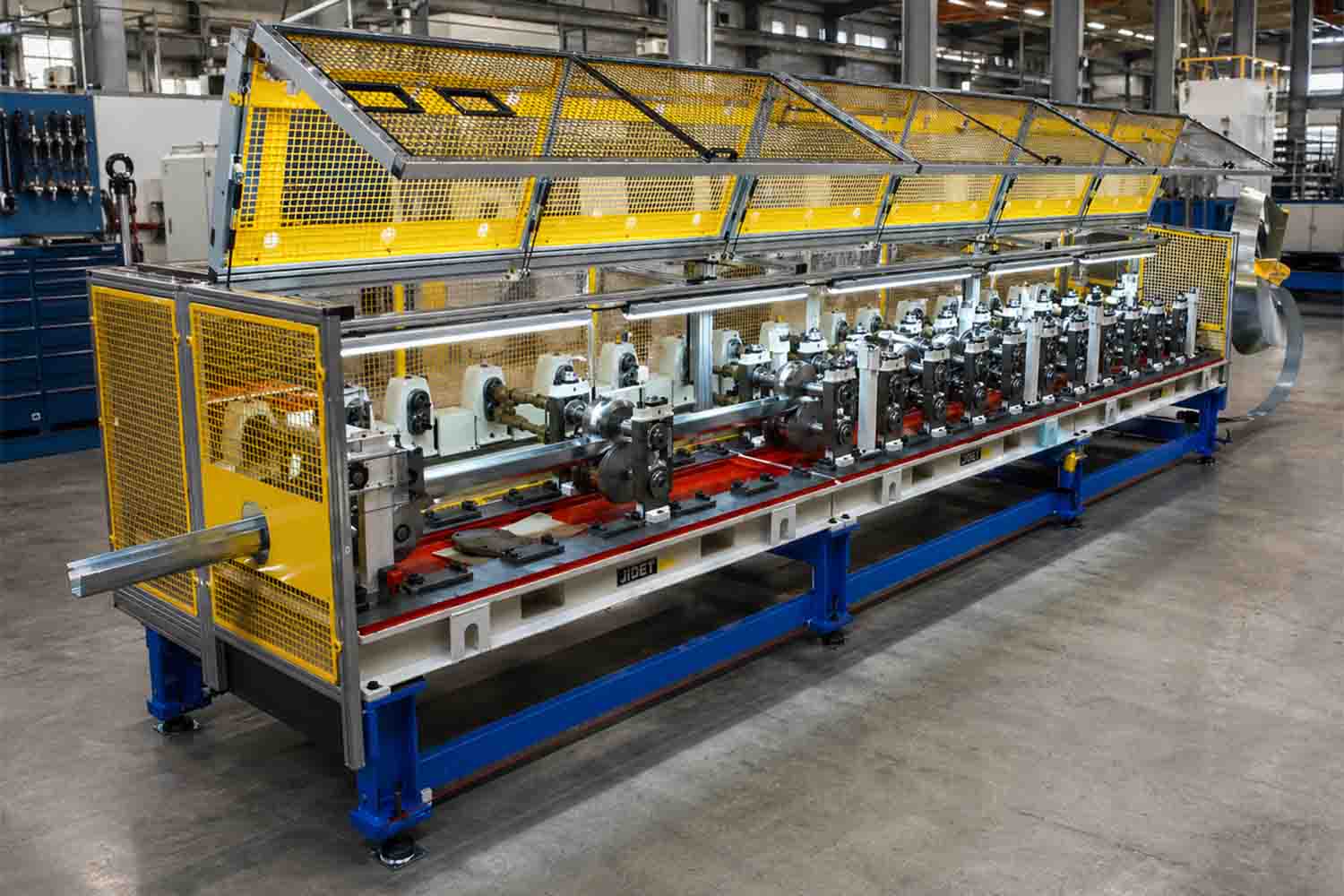
A custom cold roll forming machine equipped with a universal shaft drive system is the preferred solution for manufacturing technically demanding metal profiles and for industrial environments where process stability and progressive material deformation are critical quality factors.
This drive architecture distributes drive torque efficiently across all forming stations while ensuring excellent synchronisation between the forming rolls throughout the production process.
By maintaining constant torque transmission, it minimises speed variations between stations and guarantees a highly stable forming sequence, even when processing complex profile geometries, high-strength materials or tight dimensional tolerances.
The universal shaft transmission also allows each forming station to operate under optimal mechanical conditions, reducing local overloads, limiting torsional stresses and improving the overall reliability of the roll forming line.
This architecture is particularly suited to:
- complex profile geometries,
- high-strength steels and stainless steels,
- profiles requiring a large number of forming stations,
- demanding dimensional tolerances,
- high-value-added industrial applications,
Its robust mechanical design also contributes to longer component life, reduced maintenance requirements and consistently high machine uptime.
A dog clutch drive cold roll forming machine provides an industrial solution specifically designed to maximise production flexibility while maintaining high levels of precision, throughput and operational reliability.
This architecture is particularly suitable for manufacturers producing multiple profile families and requiring frequent product changeovers with minimal downtime.
The use of dog clutch transmission systems allows rapid engagement and disengagement of interchangeable forming cassettes without affecting the alignment of the mechanical drive train.
Combined with interchangeable cassette systems and repeatable machine settings, this solution significantly reduces setup times while maintaining exceptional dimensional repeatability after each product changeover.
A gear-driven or chain-driven cold roll forming machine is based on a robust mechanical design using a direct transmission system that provides a rigid mechanical connection between the roll shafts.
This architecture delivers outstanding dimensional accuracy and repeatability, making it particularly suitable for high-volume production of metal profiles.
The direct mechanical transmission ensures constant drive stability throughout the production cycle, reducing speed fluctuations and minimising dimensional variation over long manufacturing runs.
Its simplified kinematic design also contributes to:
- improved mechanical reliability,
- lower maintenance requirements,
- reduced wear on transmission components,
- excellent long-term process stability,
- competitive investment costs.
For applications where production flexibility is less critical than production efficiency, a gear-driven architecture represents a reliable and economically optimised solution.
Designed to support evolving product ranges and highly variable production programmes, the custom variable-width cold roll forming machine delivers the performance and quality levels required by the most demanding industrial manufacturers.
This architecture incorporates automated width adjustment systems capable of repositioning the forming units with exceptional precision while maintaining perfect alignment, continuous power transmission and stable roll forming conditions throughout the production process.
Variable-width technology enables manufacturers to process different profile widths without replacing the complete roll forming line, considerably reducing machine downtime and increasing production flexibility.
Key advantages include:
- rapid adaptation to different profile widths,
- reduced setup and adjustment times,
- improved production responsiveness,
- greater utilisation of the production line,
- lower tooling change costs,
- increased manufacturing versatility,
This architecture is particularly well suited to manufacturers producing multiple profile variants while seeking to maximise equipment utilisation and minimise non-productive downtime.