

Cold roll forming machines for the industrial racking and storage sector are engineered to meet demanding manufacturing requirements, where profile accuracy, production repeatability and high throughput directly influence the performance, safety and reliability of storage systems.
A roll forming line for industrial racking must be capable of continuously producing complex structural profiles – including perforated uprights, beams, cross members and reinforcement profiles – designed to withstand significant mechanical loads while ensuring precise assembly within modular storage systems.
JIDET designs and manufactures custom cold roll forming lines for steel racking systems, integrating the processing of structural steels with advanced in-line punching, cut-to-length and industrial marking operations. Each production line is engineered to deliver the productivity, precision and process stability required for high-volume industrial manufacturing.
Engineering Challenges of Cold Roll Forming for Industrial Racking and Storage Systems
Manufacturing steel racking profiles, warehouse racks and storage system components by cold roll forming requires complete control of the strip processing operation.
Every parameter within the roll forming line directly affects profile accuracy, dimensional repeatability, structural load capacity and the compatibility of components during final assembly.
The production of racking profiles therefore depends on achieving the right balance between:
- profile geometry,
- integrated in-line operations,
- material behaviour,
- production throughput,
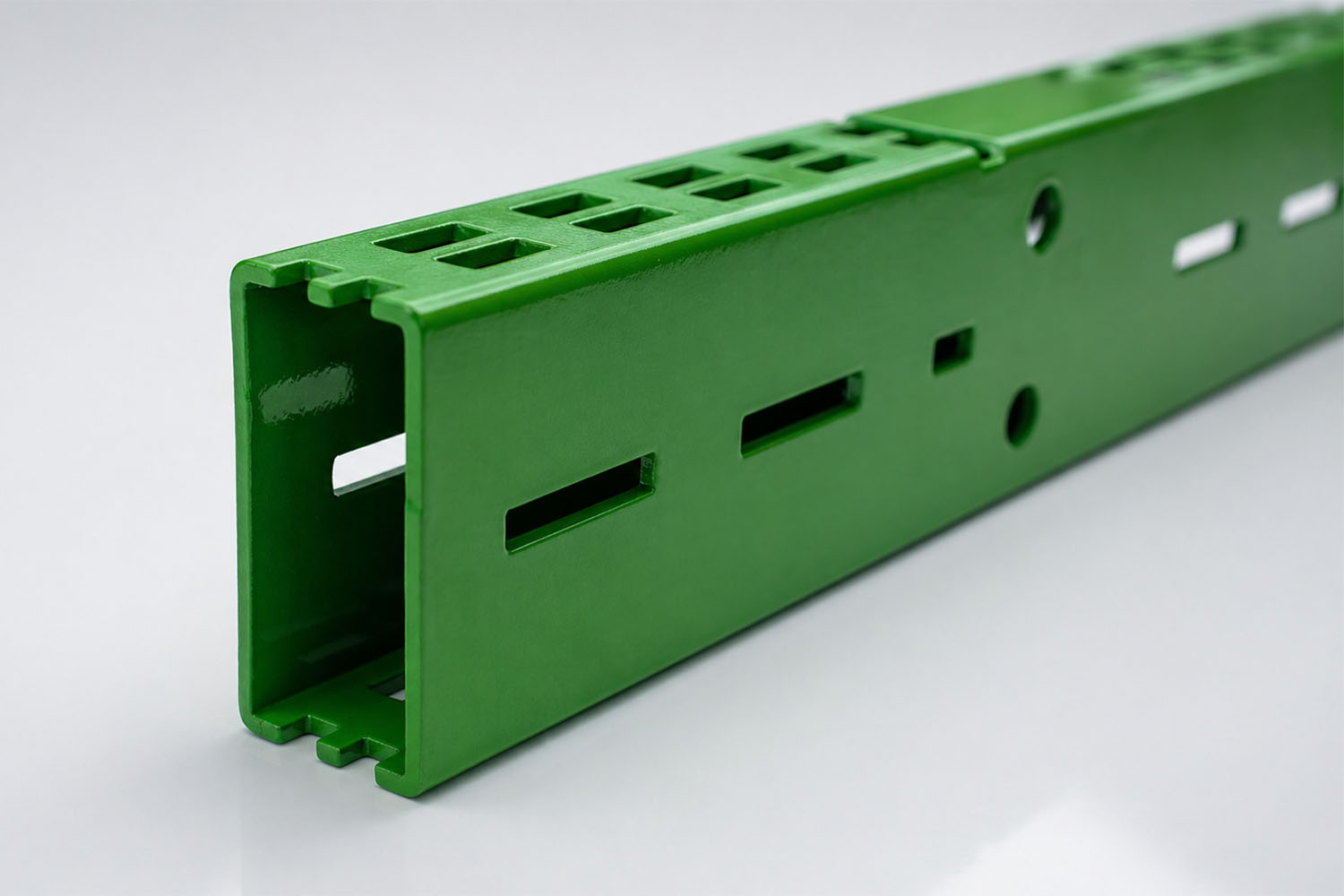
Perforated profiles are one of the defining characteristics of the industrial racking sector.
Structural uprights and load-bearing components incorporate complex, repetitive punching patterns that provide the modularity and interchangeability required for modern storage systems.
The production line must therefore ensure perfect synchronisation between in-line punching and strip speed while maintaining full control over the mechanical loads generated during continuous punching operations.
At the same time, the forming process must preserve profile geometry despite the presence of perforated areas, guaranteeing consistent:
- hole spacing,
- hole geometry,
- hole positioning,
- dimensional repeatability,
Because perforations directly influence profile stiffness, stress distribution and dimensional stability, the quality of the in-line punching process plays a decisive role in the mechanical performance, assembly accuracy and long-term reliability of the finished racking system.
Profiles used in industrial racking systems are structural components designed to withstand substantial static and dynamic loads.
The cold roll forming process must therefore ensure:
- consistent dimensional accuracy over the entire profile length,
- mechanical properties suited to the required load capacity,
- uniform profile geometry throughout production,
Components such as uprights, beams, cross members and reinforcement sections require carefully engineered production lines capable of preventing profile distortion, limiting buckling phenomena and maintaining consistent mechanical characteristics across long production runs.
Manufacturers of industrial racking and warehouse storage systems typically operate in high-volume production environments.
Their roll forming lines must therefore deliver continuous manufacturing at high production speeds while maintaining exceptional repeatability over extended production runs.
To achieve this, the production line must ensure:
- precise synchronisation between roll forming, punching and cut-to-length,
- stable strip movement,
- consistent production cycles,
The objective is to combine high productivity with reliable dimensional consistency throughout every manufacturing batch.
Material behaviour is a critical factor in the manufacture of steel racking profiles.
Phenomena such as:
- springback,
- strain hardening,
- internal stress distribution,
must all be anticipated during the engineering phase, particularly when the profile incorporates punched areas.
The definition of:
- the number of forming passes,
- the forming sequence,
- the geometry and positioning of the forming rolls,
enables the material to deform progressively while maintaining profile conformity and long-term process stability.
The objective is to ensure fully compliant profiles that consistently meet both dimensional and mechanical requirements throughout production.
Applications of Cold Roll Forming for Industrial Racking, Warehouse Racks and Storage Systems
Cold roll forming is widely used to manufacture the structural profiles that form the backbone of industrial racking, warehouse storage systems and automated logistics installations.
The process enables the continuous production of highly engineered steel profiles that combine dimensional accuracy, structural strength and production repeatability—three essential requirements for modern storage equipment.
By integrating in-line punching, cut-to-length and industrial marking, manufacturers can produce finished components ready for assembly while maintaining high production throughput and consistent quality.
Rack uprights are the primary load-bearing elements of industrial storage systems.
These vertical profiles support the entire structure while providing the modularity required to adjust beam levels and configure storage layouts.
They typically incorporate complex and repetitive punching patterns that allow components to be assembled quickly and accurately.
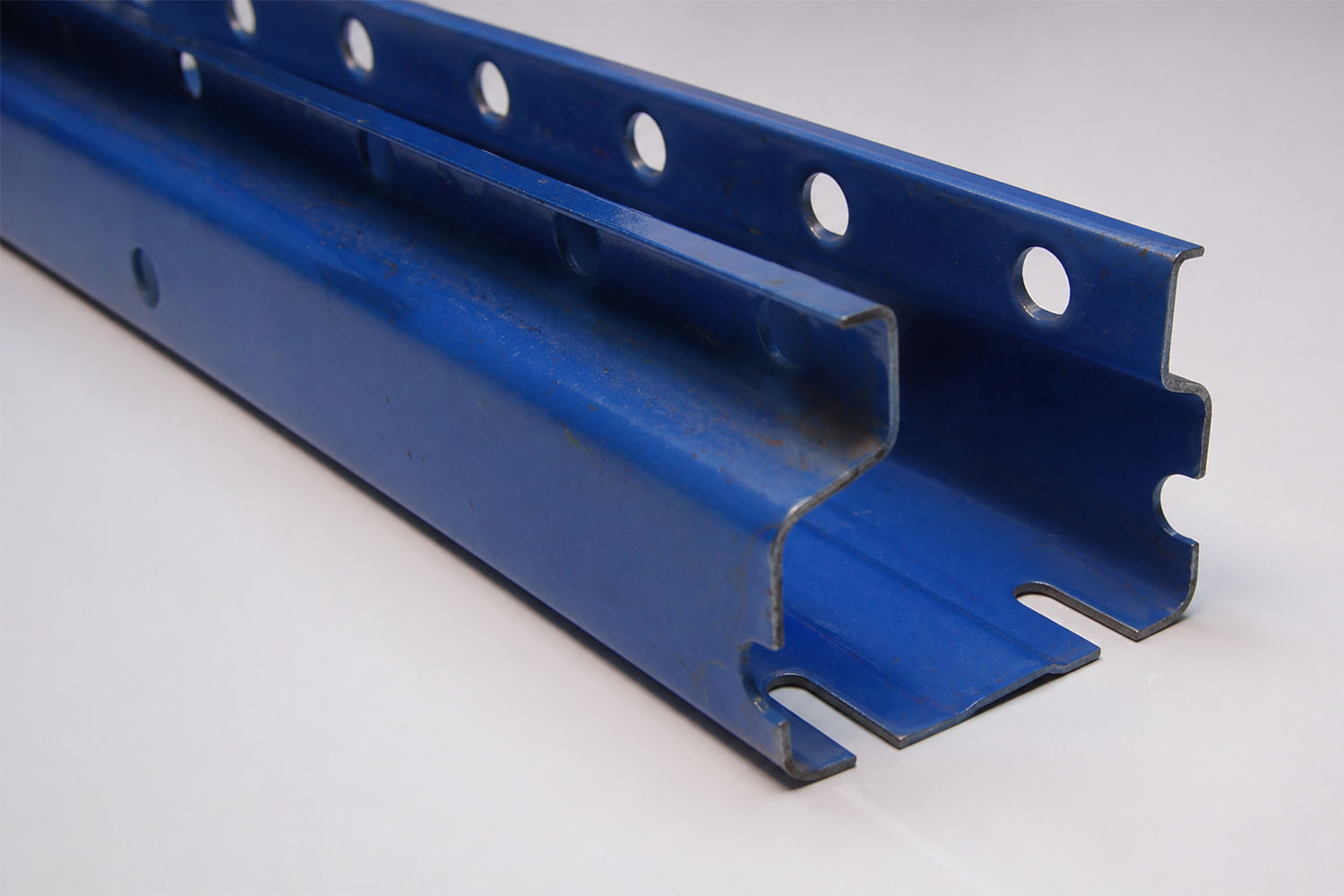
A cold roll forming line can manufacture a wide variety of upright geometries, including:
- C-sections,
- reinforced U-sections,
- sigma profiles,
- open box sections,
- asymmetrical load-optimised profiles,
Rack uprights with regularly spaced perforations require perfect synchronisation between strip movement and in-line punching to ensure consistent pitch, accurate positioning and reliable assembly.
Additional reinforcement features such as:
- multiple bends,
- reinforcing ribs,
- multi-radius profiles,
can also be incorporated to improve structural rigidity while optimising material usage.
Rack beams and cross members provide the horizontal connection between uprights and play a critical role in supporting storage loads.
These structural components must combine high mechanical strength with exceptionally consistent profile geometry to ensure the safety and reliability of storage installations.
Depending on the application, the production line may manufacture:
- box profiles,
- Z-sections,
- omega profiles,
- sigma profiles,
- return-flange sections,
Certain applications also require:
- double-wall profiles,
- reinforced multi-fold sections,
- hybrid geometries designed to maximise strength while minimising weight,
Maintaining dimensional consistency, precise forming angles and long-length stability is essential to guarantee accurate assembly and reliable load-bearing performance.
Modern automated storage and retrieval systems (AS/RS) and intralogistics solutions rely on highly accurate technical profiles manufactured to demanding dimensional tolerances.
Cold roll forming enables the production of components such as:
- guide rails,
- conveyor profiles,
- structural members for automated storage equipment,
- support profiles for logistics systems,
These products include:
- precision open guide rails,
- technical U-sections,
- guided C-sections,
- application-specific profiles manufactured to tight tolerances,
- functional profiles incorporating support and guiding features,
In some applications, several functional characteristics – including guiding, fixing and reinforcement features – are integrated into a single profile produced within one continuous manufacturing process.
In addition to the principal structural profiles, cold roll forming is widely used to manufacture the complementary components required for complete storage systems.
Typical products include:
- support brackets,
- reinforcement members,
- base plates,
- connection components,
- mounting accessories,
The production process can manufacture:
- L-sections,
- simple U-sections,
- formed flat profiles,
- lightweight Z-sections,
- application-specific profiles incorporating punching, cutting or secondary forming operations,
Depending on the product design, additional operations such as:
- piercing,
- notching,
- local forming,
may also be integrated directly into the production line, enabling finished components to leave the machine without further processing.
Custom Roll Forming Lines for Industrial Racking Systems
No two industrial racking projects are identical.
Profile geometry, steel grades, integrated manufacturing operations and production volumes all influence the design of the production line.
For this reason, JIDET develops fully customised cold roll forming lines specifically engineered for manufacturers of:
- industrial racking,
- warehouse storage systems,
- logistics equipment,
Each project is designed using a complete systems engineering approach that integrates the entire manufacturing process—from strip feeding and progressive roll forming to in-line punching, secondary forming operations and final cut-to-length.
The objective is to deliver a production line that combines exceptional dimensional accuracy, long-term process stability and the high productivity required for industrial-scale manufacturing.
Every roll forming line designed for industrial racking profiles is engineered to deliver exceptional profile accuracy, long-term process stability and outstanding repeatability throughout high-volume production.
Machine design begins with the precise sizing of the complete production system, including:
- the machine frame,
- structural rigidity,
- shaft capacity,
- drive system stability,
These elements are essential for maintaining consistent profile quality at high production speeds.
The number of forming stations, the design of the roll forming tooling and the progression of the forming sequence are defined according to:
- profile geometry,
- mechanical requirements,
- material behaviour,
This engineering approach ensures controlled material deformation, anticipates springback and guarantees dimensional conformity, even for complex or perforated profiles.
Particular attention is paid to maintaining dimensional stability over the full profile length together with exceptional repeatability—two fundamental requirements for the reliable assembly of industrial racking systems.
In-line punching is one of the defining features of roll forming lines designed for industrial racking, particularly when manufacturing perforated uprights and rack post profiles.
Integrating the punching process directly into the production line ensures perfect synchronisation between strip movement and punching operations while maintaining full control of the forces generated during continuous production.
This integrated approach eliminates secondary punching operations, reduces material handling and optimises manufacturing flow by producing finished profiles directly at the end of the line.
Punching accuracy is critical to achieving:
- consistent hole spacing,
- precise perforation geometry,
- reliable assembly compatibility,
particularly within modular storage systems where every component must remain fully interchangeable.
Manufacturers of industrial racking typically operate high-volume production facilities where productivity and consistency are equally important.
JIDET roll forming lines are therefore engineered for continuous, high-speed production while maintaining exceptional process stability over extended manufacturing campaigns.
Machine performance is supported by:
- a robust structural design,
- high-rigidity machine frames,
- reliable drive systems,
- perfect synchronisation between roll forming, in-line punching and cut-to-length operations,
Precise strip control, repeatable production cycles and stable process parameters minimise dimensional variation while ensuring consistently high-quality profiles.
Together, these engineering principles maximise manufacturing efficiency, productivity and long-term profitability for producers of industrial racking and warehouse storage systems.
Design a Roll Forming Line for Industrial Racking with an Experienced Manufacturer
The performance of a roll forming machine for industrial racking depends on much more than the machine itself.
Successful production requires a comprehensive engineering approach that integrates:
- profile geometry,
- material behaviour,
- production constraints,
- productivity objectives,
Every roll forming line for warehouse racking must be engineered as one coherent manufacturing system in which roll forming, in-line punching, cut-to-length and strip handling operate in perfect synchronisation.
By partnering with JIDET, manufacturers benefit from proven expertise in the design of custom cold roll forming lines tailored specifically to the industrial racking sector.
This systems engineering approach secures process consistency, long-term production stability and the overall performance required to manufacture high-quality storage systems efficiently and reliably.