

Cold roll forming machines for the automotive industry are engineered to meet exceptionally demanding industrial requirements, where precision, production throughput and complete control of material behaviour directly determine the quality of the finished components.
An automotive roll forming line must be capable of continuously manufacturing complex technical components – such as seat rails, structural reinforcements and crash box components – whose mechanical performance requires rigorous process engineering.
JIDET designs production lines capable of continuously manufacturing technical automotive components while processing High-Strength Low-Alloy (HSLA) and Ultra High-Strength Steels (UHSS), integrating in-line punching, cutting and industrial marking operations within a single, fully synchronised manufacturing process.
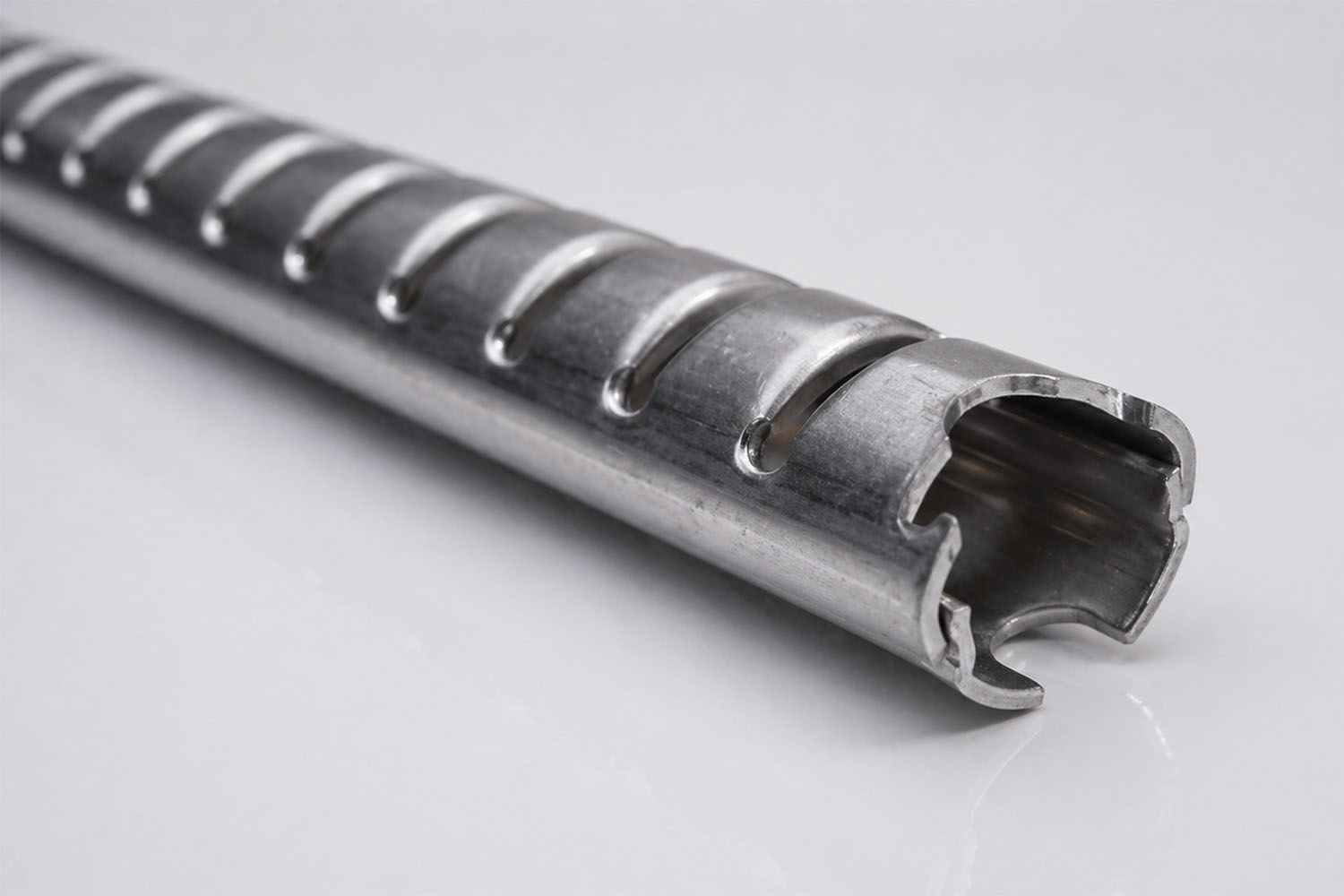
Technical Challenges of Cold Roll Forming for Automotive Components
The automotive industry places exceptionally demanding requirements on cold roll forming, where every engineering parameter directly affects the conformity and performance of the finished automotive component.
Manufacturing automotive parts by cold roll forming requires complete control of every stage of the forming process within high-speed industrial environments operating under stringent quality standards.
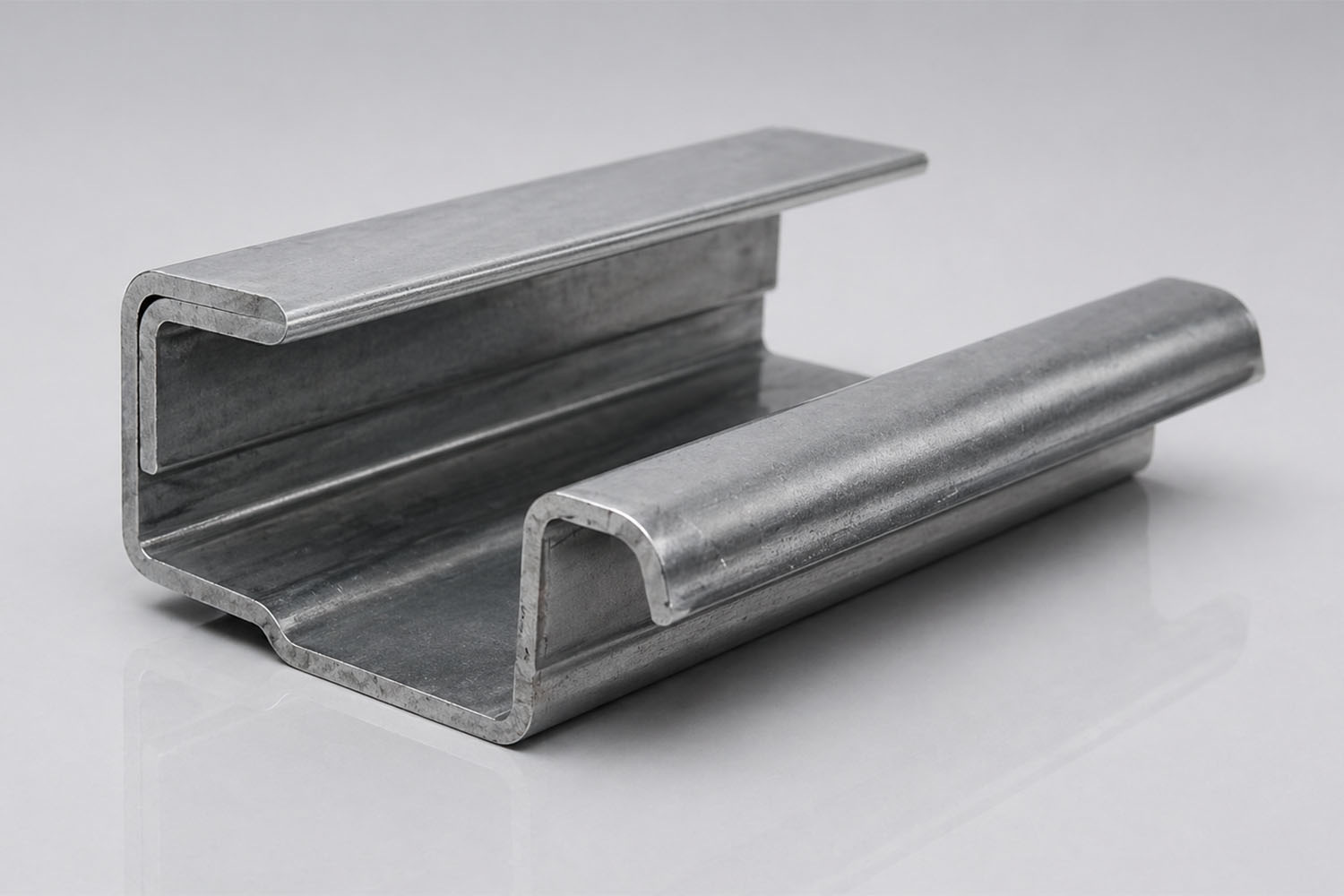
Modern automotive roll forming increasingly relies on High-Strength Low-Alloy (HSLA) and Ultra High-Strength Steels (UHSS), whose mechanical properties significantly increase the complexity of the forming process.
These materials, widely used for automotive safety components and structural assemblies, generate substantial forming loads and require precise engineering of both the roll forming tooling and the production line.
Maintaining tight dimensional tolerances over extended production runs demands exceptional process repeatability, making long-term process stability an essential requirement.
Automotive profiles frequently incorporate:
- variable cross-sections,
- functional areas,
- assembly features,
Maintaining high production speeds while manufacturing these complex geometries significantly increases the technical challenges of the production process.
Every in-line manufacturing operation must remain perfectly synchronised with strip movement to prevent dimensional drift or quality deviations.
A high-performance automotive roll forming line therefore combines exceptional production throughput with precise process control, ensuring consistent product quality throughout long manufacturing campaigns.
Material behaviour is one of the most critical factors governing the success of automotive cold roll forming.
Phenomena such as:
- springback,
- strain hardening,
- residual internal stresses,
must all be anticipated during the engineering phase of the production line.
The definition of:
- the number of forming passes,
- the distribution of forming forces,
- the geometry of the roll forming tooling,
directly determines profile stability and final dimensional conformity.
Failure to anticipate these parameters may result in:
- dimensional deviations,
- geometric defects,
- unstable production conditions,
all of which directly affect both the quality of the finished automotive components and the overall performance of the cold roll forming line.
Applications of Cold Roll Forming for Automotive Component Manufacturing
Cold roll forming is widely used throughout the automotive industry to manufacture a broad range of technical automotive components requiring exceptional dimensional accuracy, repeatability and industrial performance.
This manufacturing technology enables the continuous production of metal profiles with precisely controlled geometries, specifically engineered to meet the mechanical and functional requirements of modern vehicle design.
Cold roll forming is extensively used to manufacture automotive seat structures, particularly guide rails and support components.
Typical applications include:
- seat rails: U-sections, C-sections and precision open guide profiles,
- seat adjustment slides: interlocking sliding profiles,
- cross-members: closed box sections and omega profiles,
- mounting reinforcements: L-sections and Z-sections,
These components require outstanding dimensional accuracy and long-term repeatability to ensure the reliable operation of seat adjustment systems while meeting stringent automotive safety requirements.
An accurately engineered automotive roll forming line ensures consistent profile geometry throughout high-volume production while maintaining the tight tolerances demanded by vehicle manufacturers.
Body reinforcements and structural components represent one of the principal applications of automotive cold roll forming.
These components contribute directly to vehicle rigidity and to the management of mechanical loads during normal operation and collision events.
Typical applications include:
- door reinforcements: reinforced U-sections and multi-radius profiles,
- body pillars: closed sections and welded open tubular profiles,
- floor cross-members: omega and sigma profiles,
- longitudinal chassis members: closed box sections with high structural inertia,
- rocker panel reinforcements: Z-sections and asymmetrical profiles,
The ability to process HSLA and UHSS steels is essential for achieving the required structural performance while simultaneously reducing vehicle weight.
For these demanding applications, cold roll forming provides an optimal balance between lightweight design, mechanical strength and manufacturing efficiency.
Cold roll forming is also widely employed to manufacture automotive safety components subjected to highly demanding mechanical requirements.
Typical components include:
- crash boxes: multi-fold profiles and controlled-collapse geometries,
- impact cross-members: closed reinforced box sections,
- energy absorption reinforcements: profiles engineered for controlled deformation,
- side-impact protection members: open or semi-closed tubular profiles,
These products require highly stable manufacturing at elevated production speeds while maintaining exceptional dimensional consistency.
The production line may integrate additional in-line operations, including:
- punching,
- cutting,
- industrial marking,
thereby producing finished components directly from the roll forming process while reducing secondary manufacturing operations.
Automotive chassis components manufactured by cold roll forming must satisfy demanding requirements relating to mechanical strength, dimensional accuracy and long-term repeatability.
Typical products include:
- chassis cross-members: U-sections and box sections,
- technical support brackets: L-sections and Z-sections,
- precision guide profiles: open profiles with controlled geometry,
- mounting components: simple or multi-fold profiles,
The manufacturing process ensures highly stable production at high speed while allowing the integration of in-line punching, cutting and other complementary manufacturing operations.
The result is a highly efficient production system capable of manufacturing technically demanding automotive components with outstanding quality and repeatability.
Custom Automotive Roll Forming Lines: JIDET Machine Solutions
JIDET designs custom automotive cold roll forming lines developed specifically to meet the demanding requirements of the automotive industry, where precision, production throughput and complete control of material behaviour are critical success factors.
Every automotive roll forming line is engineered using a comprehensive systems approach that integrates:
- profile geometry,
- material grade – including HSLA and UHSS steels,
- required in-line manufacturing operations,
- target production throughput,
This engineering methodology ensures a production system capable of consistently manufacturing technical automotive components with exceptional dimensional accuracy, long-term process stability and high industrial productivity.
JIDET’s automotive roll forming lines are engineered to manufacture complex automotive components that require exceptionally high standards of dimensional accuracy and functional performance.
The sizing of the roll forming stations, the number of forming passes and the geometry of the roll forming tooling are all defined according to the profile design and the mechanical behaviour of the material.
The objective is to control the progressive deformation of the material in order to ensure:
- precise profile geometry,
- long-term production stability,
- outstanding repeatability,
even during extended production runs at high manufacturing speeds.
The engineering process also incorporates the anticipation of springback and residual internal stresses, both of which are essential to achieving the final dimensional conformity required for automotive components.
Automotive roll forming lines integrate a wide range of in-line manufacturing operations, including:
- punching,
- cutting,
- industrial marking,
- complementary forming operations,
This level of integration ensures complete synchronisation of the manufacturing process by maintaining perfect consistency between strip movement and every production operation.
The benefits include:
- optimised material flow,
- reduced intermediate handling,
- fewer secondary operations,
- consistently high component quality,
By integrating these operations directly into the production line, manufacturers improve productivity while maintaining exceptional dimensional repeatability throughout the manufacturing process.
Processing High-Strength Low-Alloy (HSLA) and Ultra High-Strength Steels (UHSS) requires a dedicated engineering approach because of the high forming loads and demanding mechanical constraints associated with these materials.
JIDET designs its automotive roll forming lines to control these parameters from the earliest stages of machine development.
Key engineering considerations include:
- mechanical sizing of the production line,
- structural rigidity of the machine frame,
- selection of roll tooling materials,
- balanced distribution of forming forces,
Together, these design principles help to:
- minimise deformation,
- control springback,
- maintain profile stability,
These factors are fundamental to ensuring the conformity of roll-formed automotive components, particularly for structural and safety-critical applications.
Design an Automotive Roll Forming Line with an Experienced Industrial Machinery Manufacturer
The success of an automotive cold roll forming line depends on a comprehensive engineering approach in which every design parameter is closely interconnected.
The performance of a roll forming machine for automotive components is determined not only by the technology employed, but by its ability to integrate every technical and industrial requirement from the earliest stages of the project.
Choosing an experienced manufacturer such as JIDET enables manufacturers to secure every one of these critical parameters.
JIDET’s expertise extends far beyond the supply of a production machine.
It encompasses the design of a complete manufacturing system in which:
- production line sizing,
- roll forming tooling design,
- integration of in-line manufacturing operations,
are perfectly coordinated.
This systems engineering approach delivers stable production, exceptional dimensional accuracy and long-term industrial performance while meeting the demanding quality and productivity requirements of the automotive industry.