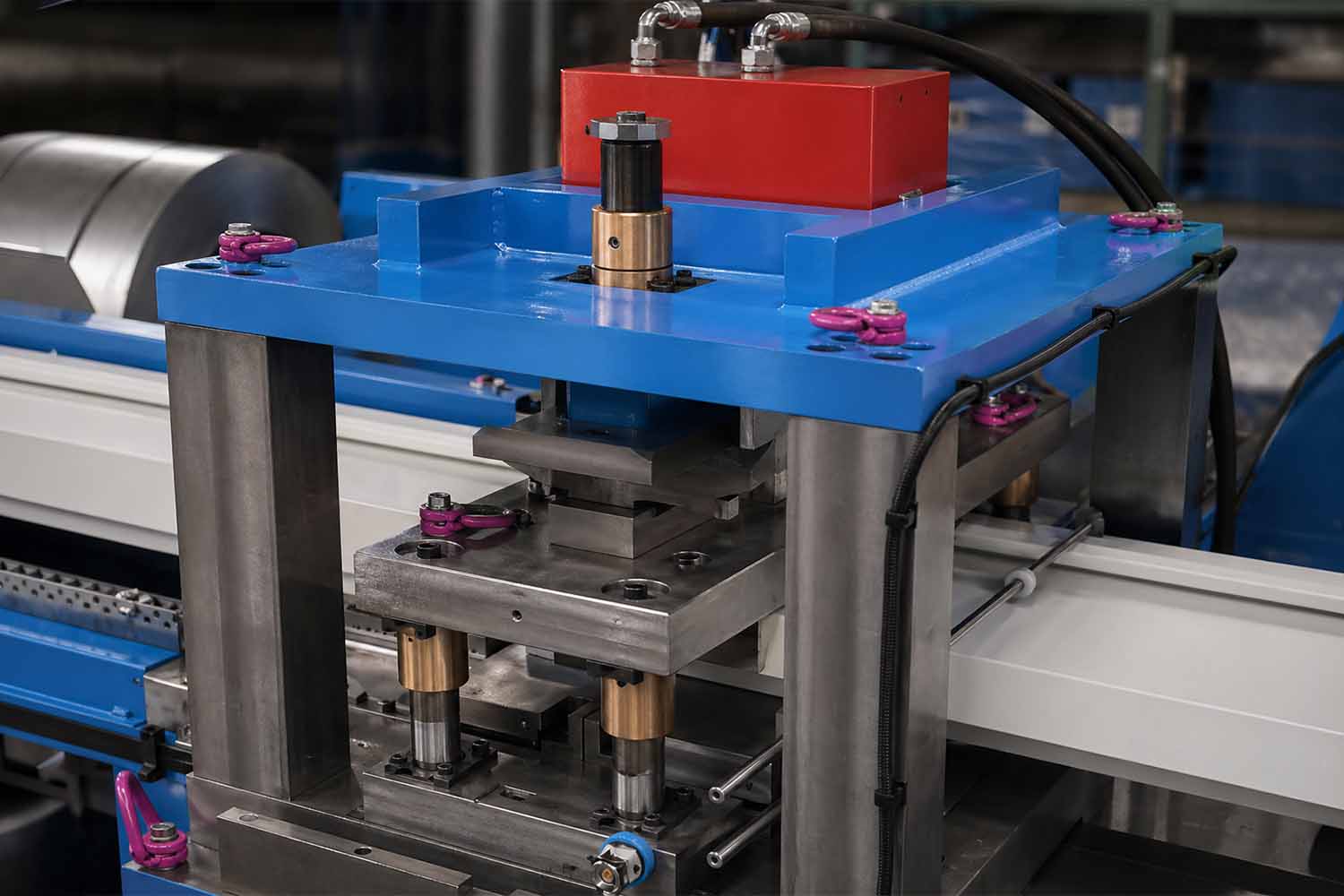

Cold roll forming tooling is the core of the roll forming process.
Beyond the roll forming machine itself, it is the roll forming rolls, their geometry, their forming sequence and their interaction with the material that determine the final quality of the finished profile.
The design of roll forming tooling can never be standardised.
It depends directly on the profile section to be produced, the behaviour of the material (steel, stainless steel or aluminium), its yield strength, springback characteristics, required dimensional tolerances and production constraints.
At JIDET, roll forming tooling is engineered as a complete system, fully integrated with the roll forming machine, to ensure controlled progressive forming, outstanding profile dimensional stability and high industrial repeatability.
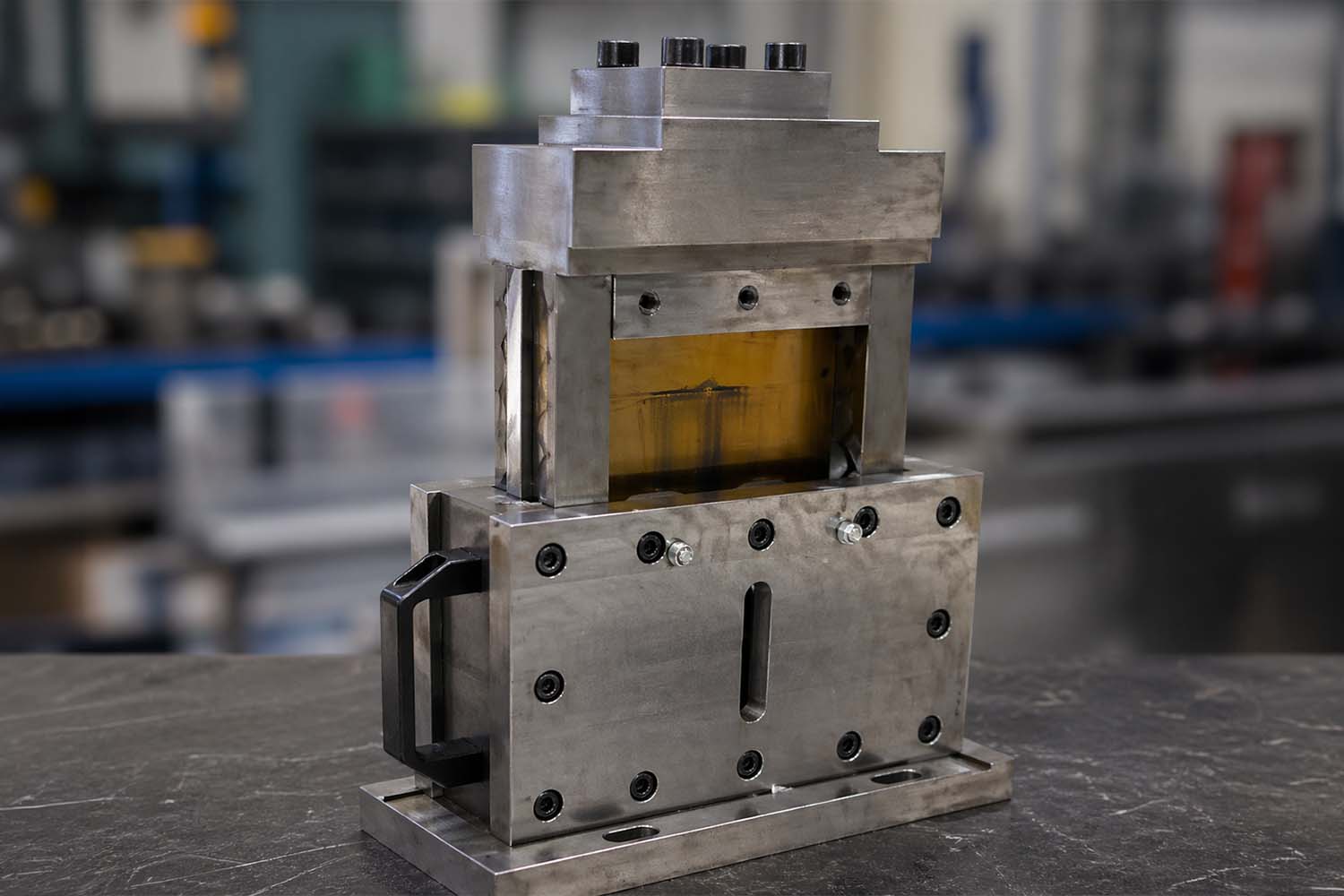
Pourquoi l’outillage de coupe est critique en profilage à froid
In a cold roll forming process, industrial performance does not rely solely on the roll forming machine.
Machine frame rigidity, transmission quality and adjustment accuracy are all essential prerequisites, but they are not sufficient on their own to guarantee profile conformity.
The true control of the cold roll forming process lies within the roll forming tooling.
A high-performance roll forming machine equipped with unsuitable tooling will inevitably produce unstable profiles, dimensional deviations and process variability that becomes increasingly difficult to control.
Conversely, custom roll forming tooling enables manufacturers to fully exploit the capabilities of the roll forming machine by ensuring controlled progressive forming and complete consistency throughout the manufacturing process.
From this perspective, roll forming tooling should never be regarded as a simple consumable or interchangeable component. It is a strategic element of the cold roll forming process, directly influencing production performance, process reliability and long-term manufacturing stability.
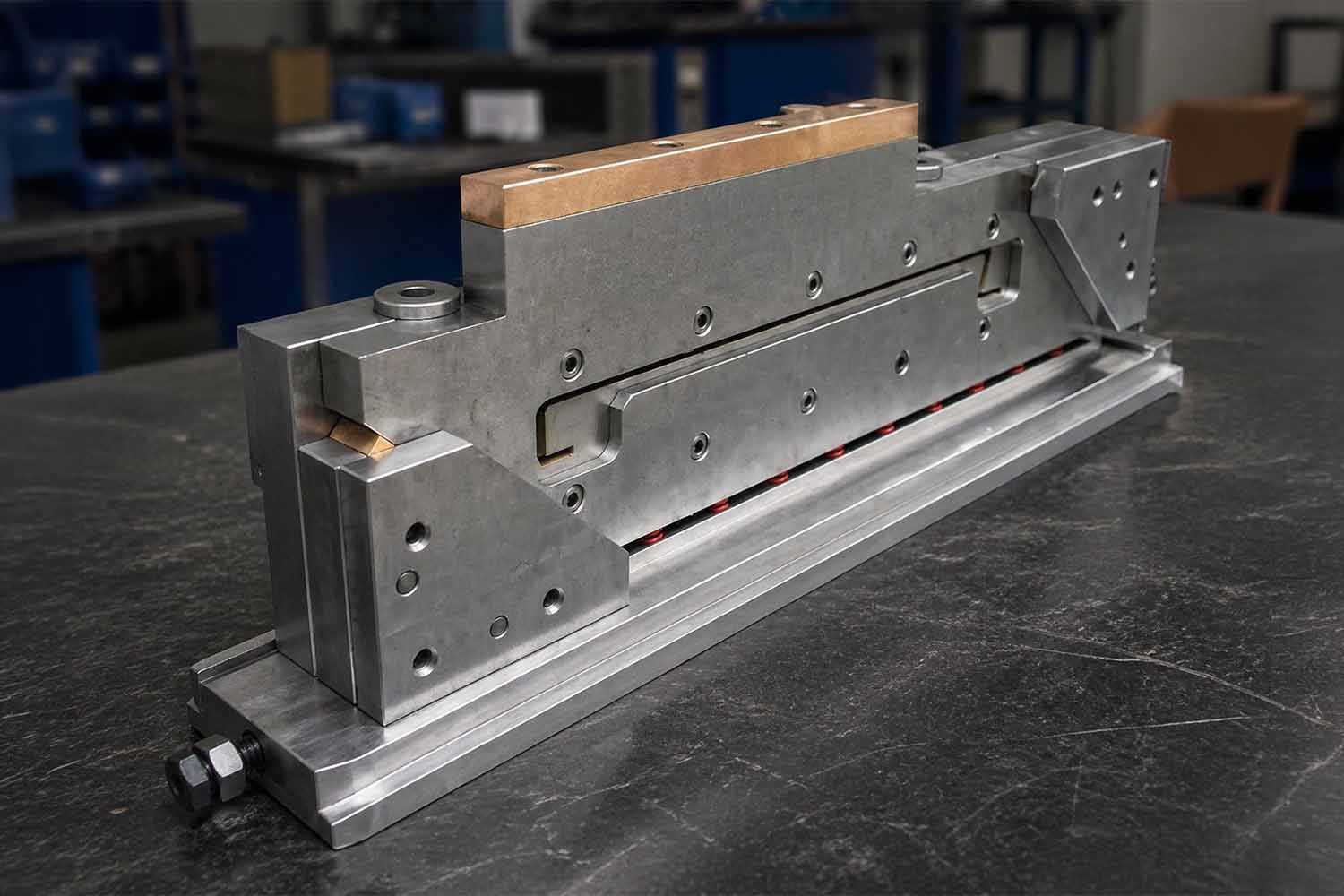
Standard roll forming tooling is generally based on generic roll geometries developed for relatively simple profiles and moderate production requirements.
Its limitations become apparent as soon as the profile incorporates:
- multiple bends or complex forming sequences,
- tight radii or rapid geometric transitions,
- asymmetric profile sections,
- critical functional areas,
- or demanding dimensional tolerance requirements,
Under these conditions, the use of standard roll forming rolls often results in:
- profile dimensional distortion, including profile opening, closure errors and twisting,
- poor distribution of forming forces,
- localised stress concentrations,
- surface marking or surface damage,
- process instability that becomes increasingly pronounced as production throughput increases,
The profile is effectively forced through a forming sequence that is not suited to either the profile geometry or the material behaviour, creating defects that are difficult to eliminate during subsequent production stages.
By contrast, custom roll forming tooling enables the geometry of each roll forming roll and the entire forming sequence to be precisely adapted to the actual profile and material characteristics. This ensures controlled deformation from the very first forming stations while preventing cumulative dimensional deviations throughout the roll forming process.
Roll forming tooling is the primary engineering element that controls the cold roll forming process.
Its function extends far beyond simply shaping the profile. It governs the progressive transformation of the material from one forming station to the next by precisely controlling forming forces and deformation paths.
The design of the roll forming rolls makes it possible to:
- distribute forming forces evenly throughout the roll forming machine, preventing local overloads,
- define the progression of each bend by introducing deformation in a controlled sequence,
- anticipate and compensate for springback through integrated geometric corrections within the roll profiles,
- stabilise the finished profile by reducing residual internal stresses,
- preserve surface integrity by minimising sliding, marking and unwanted deformation,
Each forming station performs a specific function within this progressive forming strategy.
The overall consistency of the roll forming tooling—including the number of forming passes, roll geometry and forming sequence-directly determines the quality of the finished profile.
Poorly designed roll forming tooling does more than reduce product quality; it creates an unstable manufacturing process that becomes difficult to control regardless of machine adjustments.
Beyond its technical performance, custom roll forming tooling is one of the most effective ways of improving manufacturing reliability.
Roll forming tooling specifically engineered for the profile, material and production requirements makes it possible to ensure:
- excellent dimensional repeatability, producing consistent profiles from one component to the next,
- compliance with tight dimensional tolerances, even for technically demanding profiles or high-speed production,
- significant reductions in scrap generated by roll forming defects,
- long-term process stability without progressive performance drift,
- improved adjustment stability, reducing operator intervention,
- compatibility with high production throughput while maintaining consistent product quality,
Conversely, unsuitable roll forming tooling introduces continuous process variability, requires constant machine corrections, increases material waste and reduces overall manufacturing productivity.
In demanding industrial environments, the objective of custom roll forming tooling extends far beyond producing a compliant profile.
It provides long-term manufacturing reliability, stabilises production performance and delivers sustainable reductions in the overall cost per component by ensuring a cold roll forming process that remains stable, repeatable and economically efficient.
Technical Design Criteria for Custom Cold Roll Forming Tooling
The design of custom cold roll forming tooling is never based on a standardised approach.
It results from a detailed engineering analysis of the profile to be manufactured, the material behaviour and the industrial production requirements, ensuring controlled progressive forming, dimensional stability and outstanding process repeatability.
Contrary to the simplified view of cold roll forming, where the rolls are considered merely as shaping tools, roll forming tooling is, in reality, the core element of the entire manufacturing process.
Every design parameter directly influences how the material deforms, stabilises and retains its mechanical properties throughout the cold roll forming process.
Custom roll forming tooling is therefore engineered as a fully integrated system in which the geometry of the roll forming rolls, their forming sequence, their dimensions and their machining accuracy work together to maximise the overall performance of the roll forming machine.
Profile geometry is the starting point for the design of all roll forming tooling.
Every characteristic of the profile section directly influences both the geometry of the roll forming rolls and the way deformation is progressively introduced throughout the forming process.
The presence of multiple bends, their orientation and their sequence require a specifically engineered forming strategy capable of preventing excessive local stresses while progressively distributing forming forces.
Whether the bending radii are open or tight, they directly determine the geometry of the roll forming rolls and their ability to guide material deformation without creating surface marking or localised thinning.
Asymmetric profile sections generate unbalanced stress distributions that must be compensated for during the tooling design stage to prevent twisting, distortion or unwanted profile deformation after roll forming.
Similarly, critical areas such as return flanges, enclosed sections, functional features or other sensitive profile zones require particular attention when designing the roll forming rolls, ensuring both the geometric accuracy and the mechanical integrity of the finished product.
Profile geometry therefore defines far more than the target cross-section. It directly governs the design of the roll forming rolls, their sequence throughout the line and the overall cold roll forming strategy.
Material behaviour is one of the most critical parameters in the engineering of cold roll forming tooling.
It determines how the material responds to forming forces and requires specific adaptations to the geometry of the roll forming rolls.
The material’s yield strength determines the force required to initiate plastic deformation, while springback requires geometric compensation to be integrated directly into the roll profiles.
High-yield-strength steels and stainless steels demand a more progressive forming strategy together with increased springback compensation to ensure that the finished profile remains fully compliant with dimensional specifications.
Work hardening, which progressively modifies the material’s mechanical properties during forming, must also be carefully considered in order to avoid excessive hardening or localised cracking.
Furthermore, sensitivity to surface marking-particularly with pre-painted steels or aluminium alloys – requires specially engineered roll forming rolls capable of minimising friction, sliding and cosmetic defects.
The design of each roll profile therefore incorporates compensation strategies that control material behaviour throughout the cold roll forming process, ensuring stable, repeatable and highly reliable production.
The forming sequence is the heart of roll forming tooling design.
It defines how deformation is progressively introduced from one forming station to the next, transforming the material without generating defects.
The number of forming passes can never be selected arbitrarily.
It depends directly on:
- profile complexity,
- material behaviour,
- required dimensional tolerances,
A forming sequence that is too short concentrates forming forces excessively, increasing the risk of cracking or material failure.
Conversely, an excessively long sequence may generate process instability, unwanted material movement or profile deviation.
Progressive forming is essential for distributing stresses evenly throughout the manufacturing process while avoiding local stress concentrations.
Each roll forming roll performs a specific function by introducing part of the deformation while preparing the material for the following station.
The controlled distribution of stresses across the complete roll forming process reduces uncontrolled springback, limits unwanted folds and prevents profile distortion such as twisting or profile opening.
A custom roll forming tooling solution therefore makes it possible to establish an optimised forming sequence that delivers the ideal balance between forming force, dimensional stability and final profile quality.
The sizing of the roll forming rolls is a key factor in both tooling performance and service life.
Roll diameter directly influences the way deformation is applied and how forming forces are distributed across the material.
Roll width must be matched precisely to the profile section in order to provide accurate guidance and maintain lateral stability throughout the forming process.
The material selected for the roll forming rolls is equally important.
It must provide sufficient mechanical strength to withstand repeated forming loads while maintaining excellent long-term durability.
Heat treatments applied to the rolls significantly increase hardness and wear resistance, particularly in high-throughput production environments.
Wear resistance is especially critical because it directly affects long-term process stability.
As roll wear gradually changes the forming geometry, dimensional deviations become increasingly difficult to control.
Accurate engineering of the roll forming rolls therefore guarantees both consistent profile quality and long service life for the roll forming tooling.
The manufacturing precision of roll forming tooling is a determining factor in the quality of the finished profile.
The roll forming rolls must be machined to extremely high levels of accuracy to reproduce the designed geometry precisely.
Roll concentricity is essential for maintaining consistent contact with the material, preventing forming defects and surface marking.
Correct roll alignment within the roll forming machine is equally critical to maintaining process stability.
Even minor alignment errors can generate unbalanced stresses, unwanted profile deformation and progressive deterioration of profile quality.
All of these parameters directly influence:
- dimensional tolerance capability,
- process repeatability,
- long-term production stability,
High-precision roll forming tooling does far more than reproduce a theoretical geometry.
It is a fundamental element in guaranteeing industrial profile quality, the reliability of the cold roll forming process and the overall performance of the manufacturing operation.
Cold Roll Forming Tooling and Industrial Productivity: Reducing Costs and Optimising the Manufacturing Process
In an industrial cold roll forming environment, performance is not measured solely by production speed.
It depends on the ability to manufacture compliant metal profiles consistently, with minimal waste and complete control over production costs.
Within this context, roll forming tooling plays a central role in optimising industrial productivity.
It directly influences forming quality, material utilisation, process stability and the operating efficiency of the roll forming machine.
Custom roll forming tooling, engineered in accordance with the profile geometry, material characteristics and production requirements, simultaneously improves several key performance indicators, including scrap reduction, material optimisation, production stability and reduced non-productive downtime.
Conversely, poorly designed or generic tooling generates hidden but significant losses that progressively reduce the profitability of the manufacturing process.
Reducing scrap is one of the most effective ways to improve profitability in cold roll forming.
Every forming defect – whether dimensional deviation, profile twisting, profile opening or surface marking – creates non-conforming components that directly increase manufacturing costs.
Properly engineered roll forming tooling controls material deformation from the very first forming stations by distributing forming forces progressively and preventing the local stress concentrations responsible for most defects.
A coherent forming sequence, combined with optimised roll forming roll geometry, minimises cumulative dimensional deviations and stabilises profile quality throughout production.
This level of process control significantly reduces scrap rates, particularly for technically demanding profiles and high-throughput production, where defects can otherwise multiply rapidly.
Beyond improving product quality, reducing scrap directly enhances overall manufacturing performance by minimising material waste, rework operations and production interruptions.
Material optimisation has become a major objective in modern cold roll forming, particularly when processing high-value materials or alloys with demanding mechanical characteristics.
Custom roll forming tooling maximises material utilisation by precisely controlling material deformation while limiting thinning, local thickening and unwanted profile distortion.
The progressive forming strategy – defined by both the geometry and sequence of the roll forming rolls – preserves the material’s mechanical integrity throughout the manufacturing process.
This engineering approach also makes it possible to anticipate and compensate for springback, avoiding excessive geometric corrections that lead to unnecessary material consumption or secondary adjustment operations.
By improving the dimensional stability of the finished profile, roll forming tooling enables manufacturers to produce components with optimum material efficiency, eliminating unnecessary overconsumption and reducing the cost per part.
Production stability is one of the key factors governing the performance of an industrial roll forming machine.
It determines the ability to maintain consistent product quality over extended production runs without dimensional drift or process variability.
Custom roll forming tooling stabilises the cold roll forming process by ensuring uniform stress distribution and complete consistency throughout the entire forming sequence.
It minimises process variations caused by tooling wear, material fluctuations and changing production conditions.
This stability delivers:
- improved profile repeatability,
- fewer operator adjustments,
- reduced machine stoppages associated with machine re-setting,
It also enables manufacturers to exploit high production throughput without compromising profile quality or process stability.
From an industrial perspective, high-performance roll forming tooling does far more than produce compliant profiles.
It guarantees continuous, reliable and predictable production over the long term.
Machine setup and product changeovers account for a significant proportion of indirect manufacturing costs in cold roll forming.
They directly influence machine uptime and the ability to process multiple production batches efficiently.
Optimised roll forming tooling reduces these transition times by simplifying roll positioning, improving adjustment repeatability and maintaining consistency across different production configurations.
The integration of solutions such as interchangeable cassette systems and indexed adjustment mechanisms enables safe, rapid profile changeovers while significantly reducing manual intervention.
This approach:
- reduces the risk of operator error,
- accelerates production restart,
- improves overall manufacturing flexibility,
As production programmes become increasingly diverse, the ability to minimise non-productive time has become a major competitive advantage.
Custom roll forming tooling directly contributes to this objective by making product transitions faster, more reliable and fully repeatable.
Cold Roll Forming Tooling and Industrial Flexibility: Managing Product Changeovers and Multi-Profile Production
In today’s manufacturing environment, the performance of a cold roll forming process is no longer measured solely by its ability to produce high volumes.
The ability to accommodate profile variations, short production runs and frequent product changeovers has become a key competitive advantage for industrial manufacturers.
Within this context, industrial flexibility depends largely on the design of the roll forming tooling.
Beyond the geometry of the roll forming rolls, it is the integration, mounting and adjustment solutions that enable the roll forming machine to be rapidly adapted to new production requirements.
Consequently, custom roll forming tooling is designed not only to maximise performance during continuous production but also to deliver the flexibility required by modern manufacturing environments.
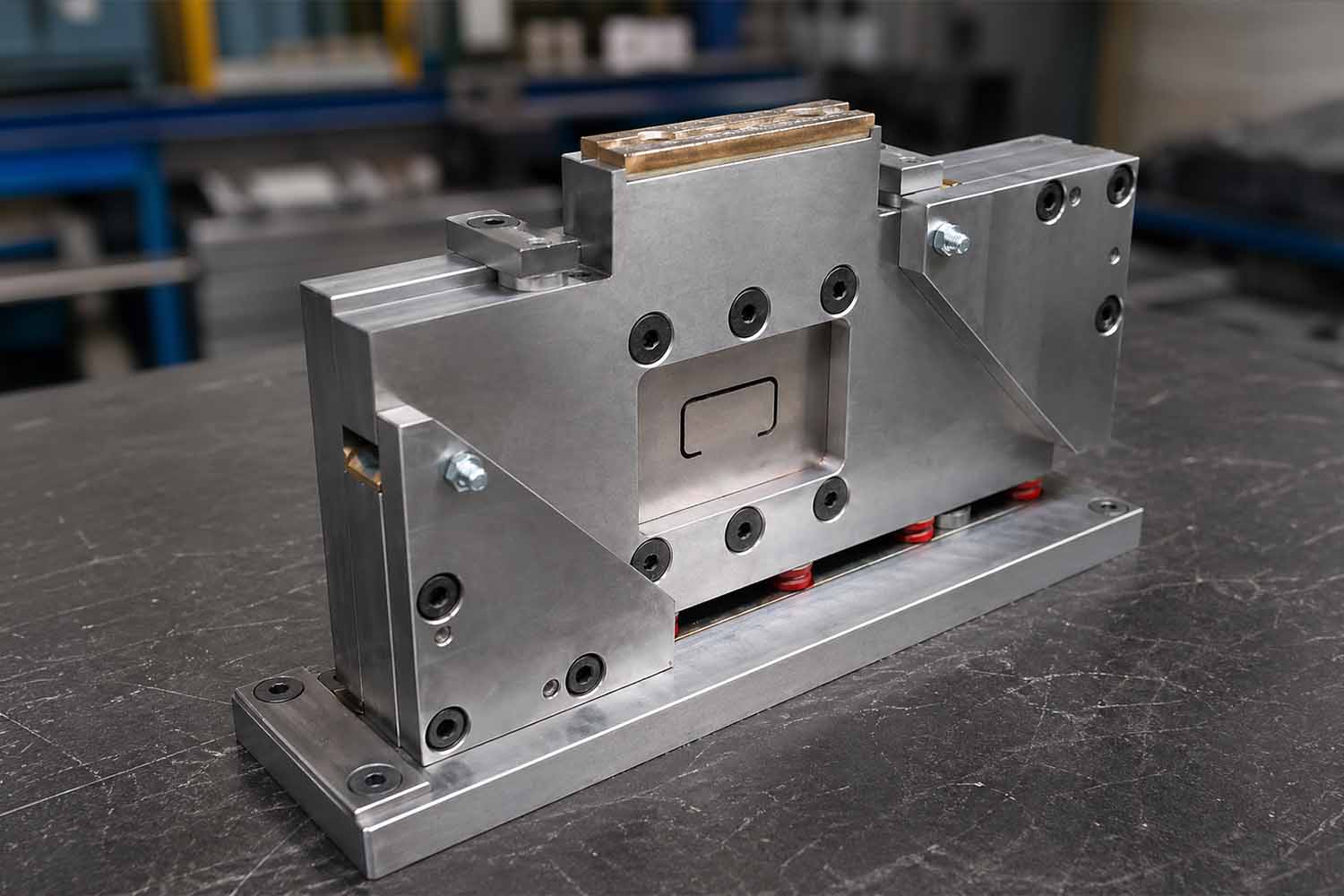
- The integration of interchangeable cassette systems is one of the most effective ways of increasing flexibility in an industrial roll forming machine.
This concept is based on grouping several forming stations into independent modules incorporating the roll forming rolls together with their associated machine settings.
These cassettes can be fully prepared offline before being installed rapidly on the machine, eliminating the need for complete readjustment during product changeovers.
This modular approach dramatically reduces intervention time while minimising the risk of operator error during machine setup.
It also improves adjustment consistency, since every cassette retains its validated reference settings.
From an industrial perspective, interchangeable cassette systems transform profile change management from a complex adjustment procedure into a fast, standardised and highly reliable operation.
They therefore represent a key component of flexible roll forming tooling, capable of supporting multiple production programmes without compromising product quality or process stability.
The repeatability of machine settings is one of the fundamental factors governing process control in cold roll forming, particularly in multi-product manufacturing environments.
Custom roll forming tooling incorporates engineering solutions that guarantee highly accurate repositioning of both the roll forming rolls and the forming stations, reducing dependence on operator experience alone.
The precision of the mechanical interfaces, the machining quality of every component and the integration of indexing and positioning systems ensure reliable and fully repeatable machine reconfiguration.
This ability to restore previously validated settings rapidly allows manufacturers to achieve production quality immediately after restart without lengthy or uncertain adjustment procedures.
It also reduces production variation between batches by maintaining long-term consistency throughout the cold roll forming process.
From an industrial engineering perspective, repeatable machine settings transform operator expertise into a controlled, stable and fully repeatable manufacturing process directly embedded within the roll forming tooling.
The ability to perform rapid product changeovers has become a key driver of industrial productivity.
Every production stop required to reconfigure a roll forming machine represents lost manufacturing time and has a direct impact on profitability.
Optimised roll forming tooling significantly reduces these transition periods by simplifying dismantling, tooling replacement and machine adjustment operations.
The combination of interchangeable cassette systems, precision positioning solutions and repeatable adjustment mechanisms dramatically accelerates product changeovers.
Reducing non-productive downtime enables manufacturers to:
- increase machine uptime,
- process a wider variety of production batches more efficiently,
- respond rapidly to changing customer requirements,
- improve overall manufacturing flexibility,
In industrial sectors where profile diversity and responsiveness have become essential competitive factors, custom roll forming tooling provides a strategic solution that combines flexibility, product quality and economic performance.
It enables manufacturers to move beyond rigid production methods towards a more agile manufacturing organisation capable of adapting quickly to changing market demands while maintaining the highest technical standards.
Roll Forming Tooling Manufacturer: Design Your Custom Roll Forming Rolls with JIDET
The performance of a cold roll forming process is never achieved by chance.
It is established during the earliest stages of engineering through a comprehensive approach that integrates the profile geometry, material characteristics, roll forming tooling and the roll forming machine itself.
Working with an experienced roll forming tooling manufacturer involves far more than simply manufacturing roll forming rolls.
It means engineering a complete tooling system capable of delivering controlled forming, dimensional stability and long-term industrial performance.
At JIDET, the design of custom roll forming tooling follows a structured engineering methodology that secures every stage of the project while optimising both technical performance and overall production economics.
The design of cold roll forming tooling always begins with a comprehensive engineering analysis of the profile to be manufactured.
This initial stage identifies the profile geometry constraints, critical areas, forming sequence, successive bends and the functional requirements associated with the finished component.
It also incorporates:
- required dimensional tolerances,
- assembly constraints,
- the operating conditions of the finished component,
The objective is to establish a coherent cold roll forming strategy capable of transforming the material without generating defects while ensuring that the finished profile fully complies with functional and dimensional requirements.
This engineering phase forms the foundation of the roll forming roll design process by defining the overall forming philosophy and manufacturing strategy.
Material behaviour is then fully integrated into the engineering of the roll forming tooling.
The analysis focuses on:
- yield strength,
- springback behaviour,
- ductility,
- work hardening,
- sensitivity to surface marking.
These parameters directly influence:
- the geometry of the roll forming rolls,
- the forming sequence,
- the compensation strategies incorporated into the tooling design,
Failure to accurately account for material behaviour can result in profile distortion, process instability and deterioration of surface quality.
A comprehensive material analysis enables custom roll forming tooling to be engineered precisely for the real operating conditions of the cold roll forming process, ensuring stable, repeatable and reliable production.
The design of the roll forming rolls represents the core of every tooling project.
Its purpose is to define both the geometry of each individual roll and their sequence throughout the roll forming machine, ensuring that material deformation is progressively controlled across every forming station.
This engineering phase incorporates:
- the distribution of forming forces,
- the progression of each bending operation,
- springback compensation,
- profile stability at the machine exit,
A carefully engineered forming sequence prevents excessive stress concentrations, material fracture, unwanted folds and profile distortion.
As a result, custom roll forming tooling is designed to achieve the optimum balance between forming forces, product quality and long-term process stability.
The engineering of roll forming tooling does not end with the manufacture of the roll forming rolls.
A comprehensive validation and commissioning phase is essential to fine-tune the cold roll forming process and ensure full profile conformity under real production conditions.
This stage verifies:
- compliance with dimensional tolerances,
- process stability,
- complete consistency between the roll forming tooling and the roll forming machine,
It also includes detailed optimisation of machine settings aimed at improving:
- profile quality,
- production throughput,
- manufacturing repeatability,
This engineering approach secures industrial start-up while enabling rapid achievement of optimum production performance.
Working with an experienced roll forming tooling manufacturer such as JIDET enables manufacturers to transform complex engineering challenges into fully controlled industrial solutions, delivering a cold roll forming process that is reliable, high-performing and built for long-term manufacturing excellence.