

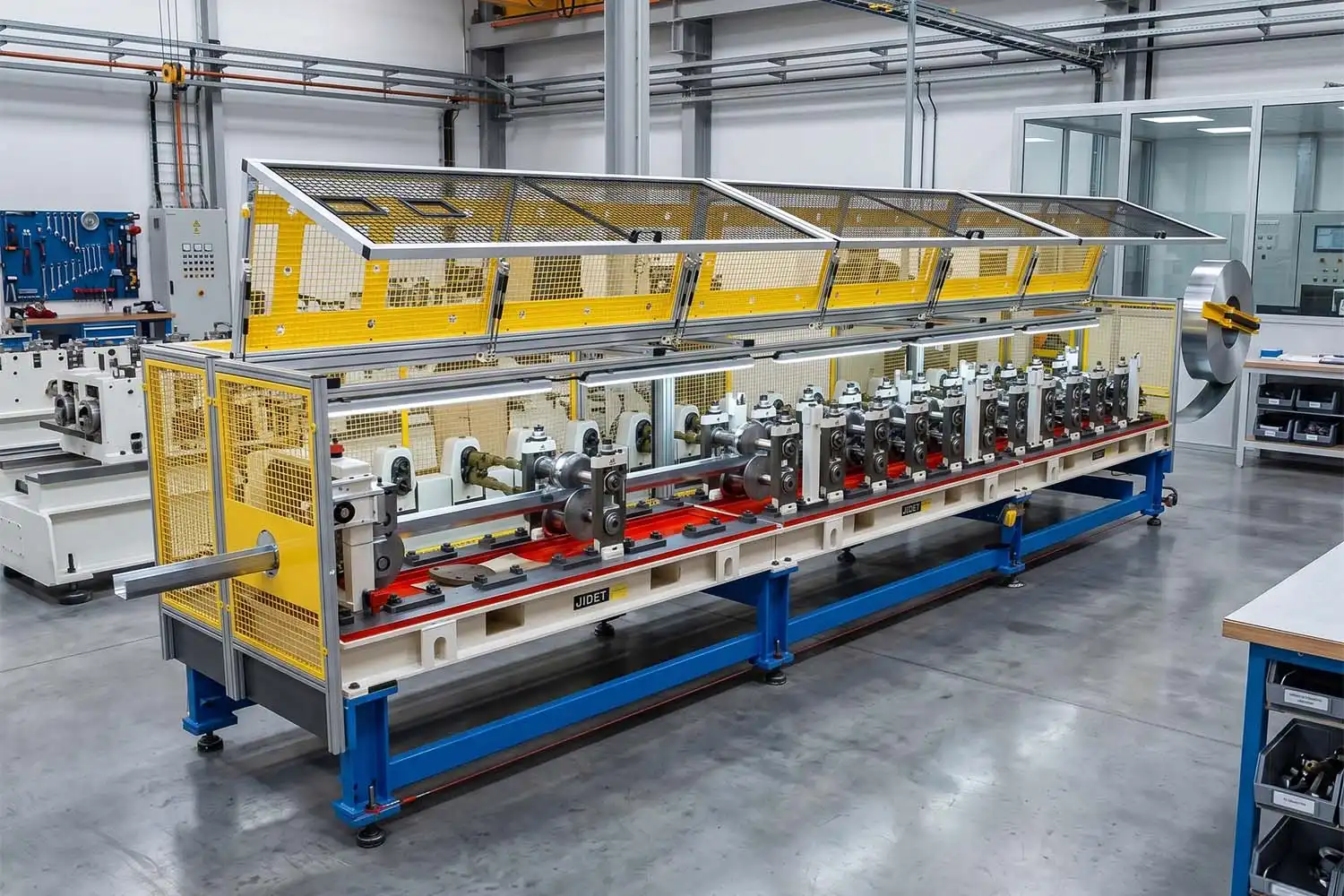
Cold roll forming machines for welded tube production enable the continuous manufacture of closed metal tubes from steel strip while meeting demanding requirements for dimensional accuracy, production throughput and long-term process stability.
A roll forming line for welded tubes is far more than a conventional forming machine.
It integrates a complete manufacturing process combining progressive roll forming, tube closing, in-line welding and additional manufacturing operations within one continuous production system.
As a specialist in custom cold roll forming solutions, JIDET designs and manufactures bespoke welded tube production lines capable of producing technical tubular profiles in standard, high-strength and stainless steels while ensuring complete control of material behaviour and manufacturing performance.
Engineering Challenges of Industrial Welded Tube Roll Forming Lines
Manufacturing welded metal tubes by cold roll forming relies on a continuous industrial process in which every stage – from progressive forming and tube closing to in-line welding – directly influences the final quality, dimensional accuracy and production stability of the finished tube.
For this reason, a welded tube production line cannot be based on a standard machine configuration.
Each project must be engineered according to:
- tube geometry (round, square, rectangular or custom closed sections),
- material grade (carbon steel, stainless steel or high-strength steel),
- integrated welding technology,
- target production throughput,
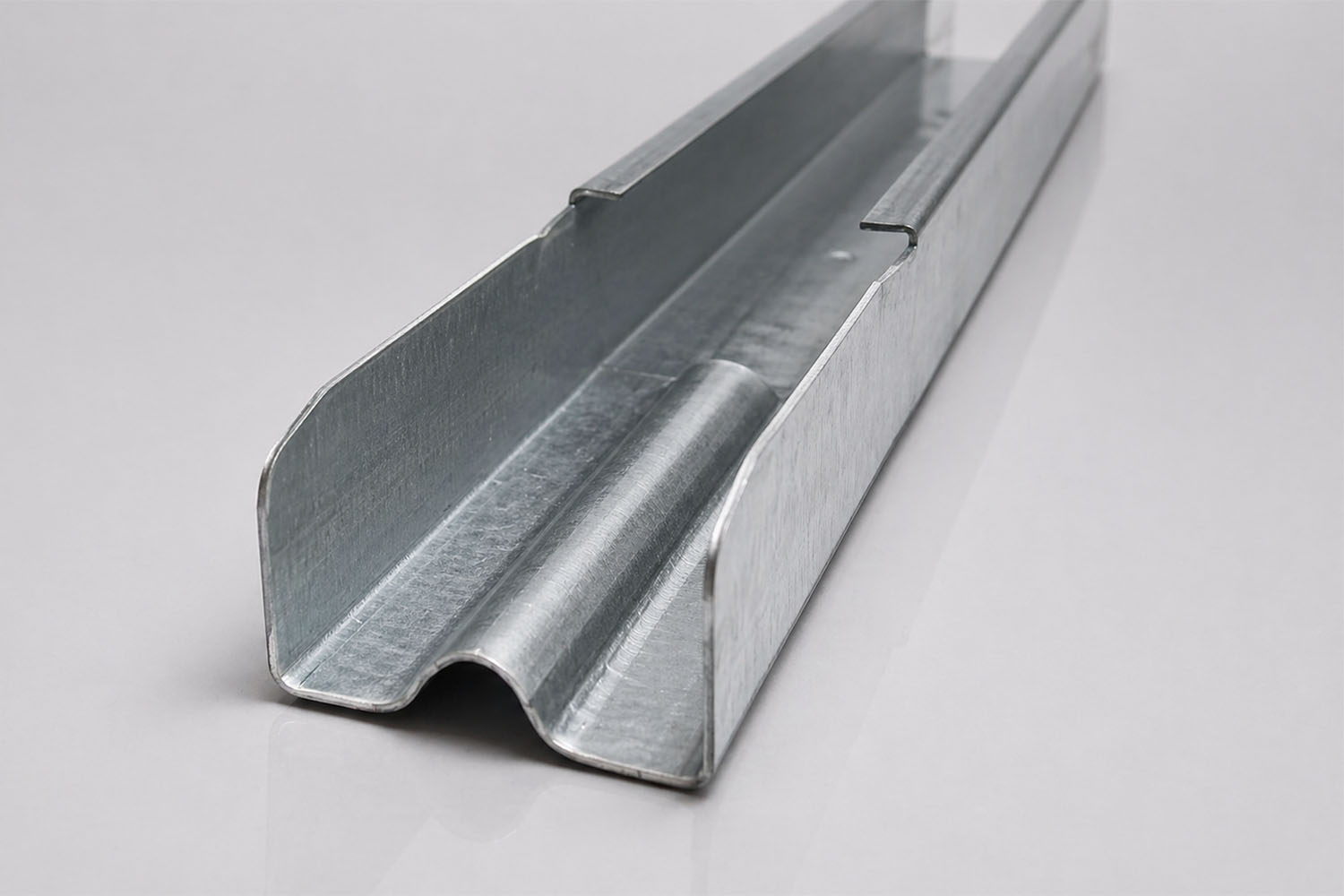
A welded tube is produced through the progressive forming of a steel strip, which is continuously transformed from a flat strip into an open profile before being closed and prepared for welding.
This forming stage is fundamental because it establishes the dimensional accuracy of the finished tube and the overall stability of the manufacturing process.
The production line must ensure smooth, progressive deformation without interrupting material flow or generating excessive forming stresses.
Achieving:
- uniform material deformation,
- accurate alignment of the strip edges before closure,
- stable tube geometry,
is essential to prepare the profile for a reliable welding operation.
The number of forming stations, the design of the roll forming tooling and the progression of the forming sequence all contribute to controlling stress distribution throughout the strip.
Poor control at this stage may result in:
- edge misalignment,
- unstable tube closure,
- welding defects,
- dimensional variation,
These issues become particularly critical when manufacturing square, rectangular or custom closed sections, where corner accuracy and section geometry must remain consistent throughout production.
In-line welding is one of the most critical stages in the manufacture of welded tubes, providing the structural continuity required for long-term mechanical performance.
Integrated directly into the production line, the welding process operates in perfect synchronisation with strip speed and therefore depends on:
- accurate edge preparation,
- stable tube geometry before welding,
- precise control of tube closure,
Successful welding relies on maintaining the correct balance between profile geometry, edge quality and overall process stability.
Depending on the application, the production line may incorporate several welding technologies, including:
- High-Frequency (HF) welding,
- TIG welding,
- Laser welding,
Each process requires dedicated engineering of the production line to ensure optimum performance.
The quality of the welded joint directly influences:
- mechanical strength,
- fatigue resistance,
- compliance with industrial specifications,
- long-term durability,
Any welding defect immediately compromises product performance and may result in component rejection or premature failure.
For high-volume manufacturing, maintaining stable welding conditions is essential to ensure reliable production at high operating speeds.
Material behaviour is one of the key parameters governing the production of welded tubes.
The deformation generated during progressive roll forming must be carefully controlled to maintain tube stability after closure and welding.
Phenomena such as:
- springback,
- strain hardening,
- internal stress distribution,
directly influence:
- tube geometry,
- straightness,
- dimensional stability,
whether manufacturing round, square, rectangular or custom tubular sections.
Machine design therefore combines:
- optimised roll tooling geometry,
- the correct number of forming stations,
- progressive distribution of forming loads,
The rigidity of the production line and the stability of the drive system are equally important in maintaining long-term process stability.
The objective is to ensure consistent dimensional accuracy, excellent repeatability over extended production runs and reliable manufacturing performance, even at high production speeds.
Industrial Applications of Cold Roll Forming for Welded Tube Manufacturing
Cold roll forming of welded tubes is used across a wide range of industries that require closed tubular profiles combining dimensional accuracy, structural integrity and reliable mechanical performance.
A welded tube production line enables the continuous manufacture of steel tubes with tightly controlled cross-sections, making them suitable for structural, technical and functional applications. The versatility of the process lies in its ability to deliver consistent tube geometry, high-quality welds and outstanding production repeatability, even during high-volume manufacturing.
Welded tubes are the preferred solution wherever manufacturers seek the optimum balance between structural strength, weight reduction, material efficiency and production throughput.
Cold roll forming enables the continuous production of closed structural tubes designed to withstand significant mechanical loads while providing rigidity to industrial structures.
Typical products include:
- square tubes,
- rectangular tubes,
- box sections,
- high-inertia closed profiles,
- welded round tubes,
- reinforced tubular sections,
In these applications, precise control of both the roll forming process and in-line welding ensures:
- consistent cross-sectional geometry,
- excellent mechanical performance,
- dimensional stability over the entire tube length,
The quality of the finished tube directly influences the performance and reliability of the structures into which it is integrated.
Welded tube production lines are widely used to manufacture tubes for metal furniture, architectural fittings and lightweight structural applications.
Typical profiles include:
- thin-wall rectangular tubes,
- light-gauge square tubes,
- aesthetic closed sections,
- precision round tubes,
- decorative tubular structures,
- lightweight tubular profiles,
These tubes are commonly used in:
- metal furniture,
- retail and commercial fittings,
- lightweight structures,
- non-structural industrial equipment,
Such applications require:
- excellent surface finish,
- visually consistent tube geometry,
- high dimensional accuracy,
Stable roll forming and reliable in-line welding are essential to ensure an attractive appearance while maintaining compatibility with downstream finishing operations such as painting, powder coating and assembly.
Cold roll forming of welded tubes is extensively used to manufacture technical components integrated into industrial machinery and automated production equipment.
Typical products include:
- conveyor tubes,
- tubular machine components,
- guide tubes,
- structural tubular members,
- functional closed profiles,
- equipment support tubes,
These components are commonly integrated into:
- conveyor systems,
- industrial machinery,
- automated production equipment,
- mechanical assemblies,
Maintaining:
- stable tube geometry,
- consistent cross-sections,
- high-quality welds,
is essential to ensure reliable integration within mechanical systems.
Even minor dimensional deviations may affect assembly accuracy, equipment performance and long-term operational reliability.
Roll formed welded tubes are also widely used in demanding industrial sectors such as energy, utilities and industrial infrastructure.
Typical applications include:
- support tubes for energy installations,
- tubular profiles for technical structures,
- mounting and fixing tubes,
- closed sections for outdoor equipment,
- long structural tubular members,
These products are designed to operate under demanding mechanical and environmental conditions while maintaining reliable long-term performance.
Their success depends directly on:
- structural strength,
- dimensional consistency,
- reliable weld quality,
- stable production throughout long manufacturing runs,
A robust cold roll forming line combined with a precisely controlled in-line welding process is therefore essential to ensure consistent product quality and uninterrupted industrial production.
Custom Welded Tube Production Lines
Every welded tube manufacturing project presents its own engineering challenges.
Tube geometry, material grade, welding technology, integrated manufacturing operations and production objectives all influence the design of the production line.
For this reason, JIDET develops custom welded tube production lines engineered as complete industrial manufacturing systems rather than standard machines.
Each project is designed according to:
- tube geometry (round, square, rectangular or custom closed sections),
- material type (carbon steel, stainless steel or technical alloys),
- integrated welding technology,
- required in-line operations,
- target production throughput,
This systems engineering approach ensures outstanding dimensional accuracy, reliable welding performance and long-term process stability, even under demanding industrial production conditions.
Designing a welded tube production line requires complete control of the manufacturing process, from progressive strip forming through to tube closing and in-line welding.
The number of forming stations, the roll pass design and the forming sequence are defined according to the tube geometry and the mechanical behaviour of the material.
The integration of the tube closing stage and the selected welding technology is considered from the earliest phases of machine design to ensure optimum process performance.
Every stage of the production line is engineered to deliver:
- smooth and progressive material deformation,
- uninterrupted material flow,
- precise edge alignment before welding,
- consistent tube geometry throughout the manufacturing process,
This engineering approach guarantees:
- accurate tubular profiles,
- high-quality welds,
- outstanding production repeatability,
even during long production runs at high operating speeds.
It is particularly well suited to the manufacture of precision tubes, custom closed sections and demanding industrial tubular components.
A high-performance welded tube production line integrates all essential manufacturing operations within a single continuous production process.
Depending on the application, integrated operations may include:
- in-line punching,
- cut-to-length,
- industrial marking,
- secondary machining or forming operations,
By synchronising these processes with strip movement and production speed, the line operates as one fully integrated industrial manufacturing system.
This approach delivers several key advantages:
- reduced material handling,
- fewer secondary operations,
- improved production flow,
- greater overall manufacturing efficiency,
For technical tubular products, integrating these operations enables finished components to leave the production line ready for immediate use or assembly, while maintaining outstanding dimensional accuracy and consistent product quality.
This level of process integration is a major advantage for manufacturers seeking an automated tube production line capable of combining high productivity, exceptional quality and competitive manufacturing costs.
Cold roll forming lines for welded tubes are engineered to operate in demanding industrial environments where production continuity, process stability and consistent product quality are essential.
They must sustain high production speeds while maintaining:
- constant dimensional accuracy,
- stable tube geometry,
- reliable welding performance,
Achieving these objectives requires:
- a robust machine structure,
- high frame rigidity,
- precise machine adjustment,
- stable drive systems,
Equally important is the perfect synchronisation between the roll forming and in-line welding processes, ensuring uninterrupted production flow throughout the manufacturing cycle.
A custom welded tube production line enables manufacturers to achieve exceptional industrial performance by combining high production throughput, precise dimensional control and complete mastery of the manufacturing process.
Design a Welded Tube Production Line with JIDET
The performance of a welded tube production line depends on a comprehensive engineering approach in which every stage of the manufacturing process is carefully controlled.
Tube geometry, material behaviour, welding technology and integrated in-line operations must all work together within one fully synchronised production system.
A cold roll forming machine for welded tubes is therefore much more than a forming solution – it is a complete industrial manufacturing system designed to deliver reliable production, consistent quality and long-term operational performance.
By partnering with JIDET, manufacturers benefit from proven expertise in the design of custom welded tube production lines that integrate progressive roll forming, tube closing, in-line welding and complementary manufacturing operations into a single, optimised production process.
The result is a high-performance manufacturing solution capable of producing technical welded tubes with exceptional dimensional accuracy, outstanding repeatability and reliable industrial productivity.