

Within an industrial punching machine or a cold roll forming line, in-line punching is far more than a simple hole-making operation. It is a critical manufacturing function that directly influences component accuracy, production throughput and the overall stability of the production line.
At this stage of the manufacturing process, the material is moving while simultaneously being subjected to significant mechanical stresses. Any weakness in the design of the punching tooling, or in its integration within the machine, immediately results in dimensional deviations, alignment errors, production instability and premature tooling wear.
Punching therefore becomes a potential source of manufacturing instability rather than a contributor to production performance.
At JIDET, punching tooling is engineered as a direct extension of both the industrial punching machine and the manufacturing process itself. This custom industrial punching tooling approach ensures exceptional positioning accuracy, outstanding dimensional repeatability and seamless integration of in-line punching within the production line.
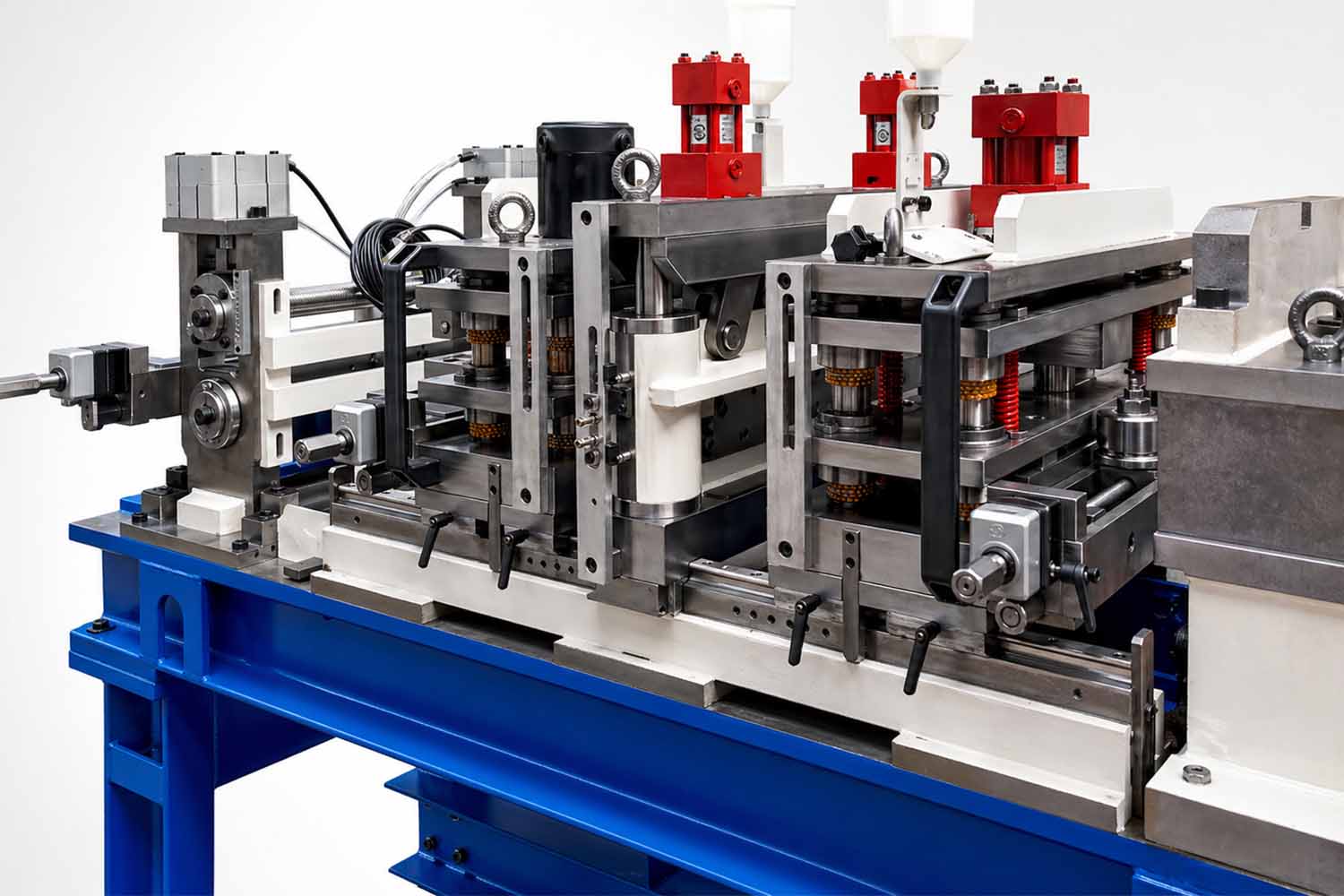
Why Punching Tooling Is a Critical Component of an Industrial Punching Machine
Within a cold roll forming line or an industrial punching machine, punching takes place at one of the most demanding stages of the manufacturing process.
It is generally performed dynamically, while the material is moving, already engaged in a forming sequence and often subjected to residual mechanical stresses generated during the cold roll forming process.
Under these conditions, punching tooling must simultaneously satisfy several demanding engineering requirements.
It must:
- deliver extremely accurate positioning of every punching operation,
- maintain perfect synchronisation with production line speed,
- control punching forces without disturbing profile geometry,
- ensure consistent dimensional repeatability, even during high-throughput manufacturing,
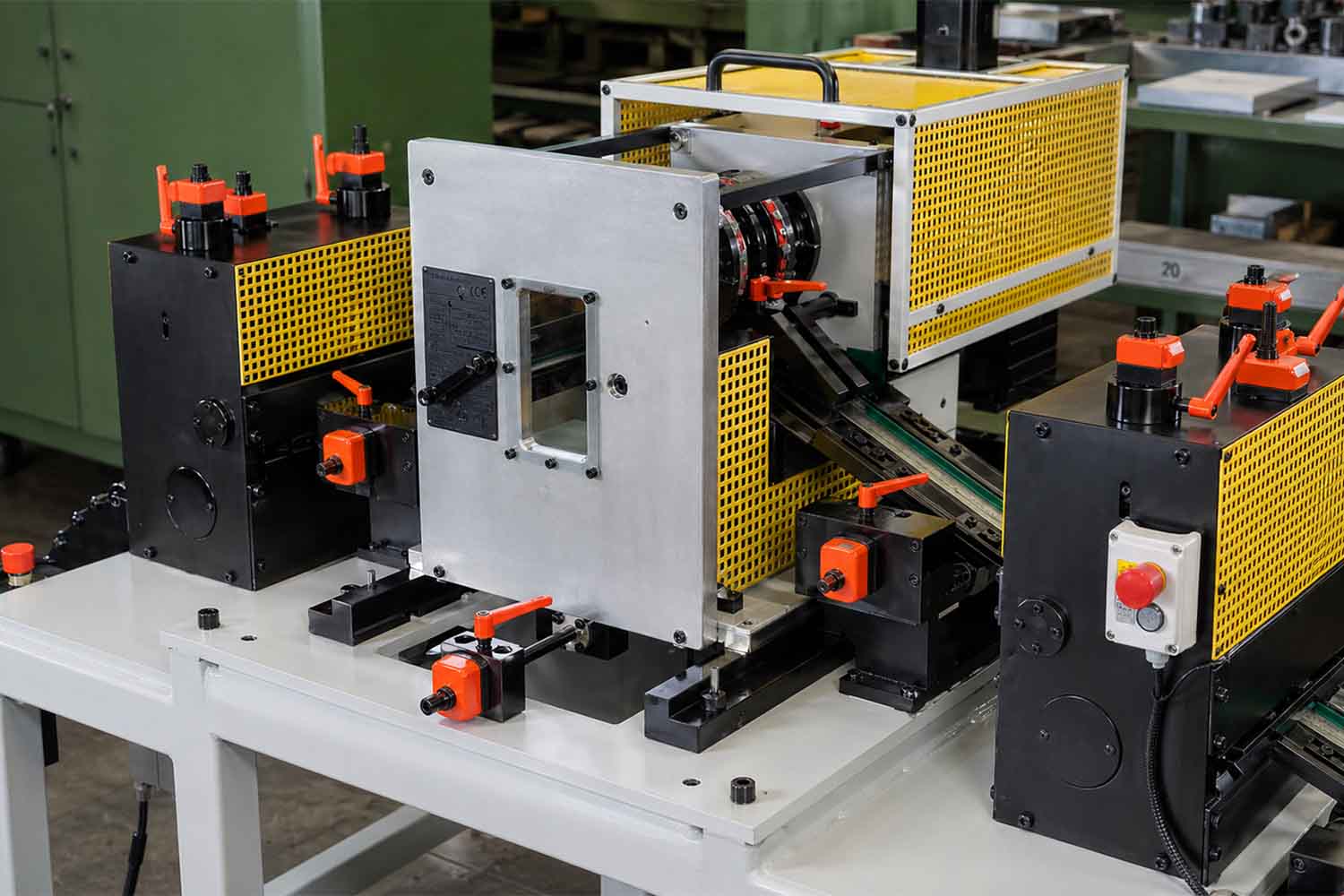
Standard punching tooling is generally designed to satisfy generic manufacturing requirements based on simplified assumptions regarding profile geometry, material characteristics and production speed.
Such tooling may perform adequately for relatively simple applications involving open profiles, generous tolerances and moderate production rates.
However, as soon as manufacturing environments become more demanding, these standard solutions rapidly reach their limits.
Complex profile geometries, multi-thickness configurations, high-strength steels and high-throughput manufacturing all introduce engineering constraints that conventional tooling cannot reliably accommodate.
A generic press tooling solution is therefore unable to guarantee stable, repeatable industrial production.
Instead, it introduces structural variability into the manufacturing process that is incompatible with the quality requirements of advanced industrial applications.
Within a cold roll forming line, punching must be considered as a direct continuation of the forming process rather than as an independent manufacturing operation.
It forms part of a continuous machine sequence in which every operation influences the next, and where even minor process disturbances can generate dimensional defects.
A properly engineered in-line punching system takes into account the actual condition of the material at the precise moment of punching.
It respects the ongoing deformation of the profile, adapts to residual internal stresses and performs the punching operation at the optimum point within the manufacturing sequence.
Punching therefore becomes an integral part of the cold roll forming process, contributing to the overall stability of the production line rather than reducing its performance.
The engineering of custom punching tooling enables manufacturers to address the real constraints of their production environment with precision.
It ensures:
- highly accurate positioning of punching operations,
- stable performance at high production speeds,
- exceptional dimensional repeatability,
- significant reductions in production scrap,
Beyond these immediate operational benefits, a custom-engineered approach fundamentally changes the role of punching within the production line.
Rather than being a source of process variability, punching becomes a genuine driver of industrial performance.
By integrating machine characteristics, material behaviour, profile geometry and production throughput from the earliest stages of design, industrial punching tooling becomes a key structural element of the manufacturing process, securing long-term production stability, improving product quality and optimising the overall economic performance of the production line.
Technical Design Criteria for Punching Tooling Used in Industrial Punching Machines
The performance of industrial punching tooling is never determined by a single design parameter.
It results from a comprehensive engineering approach that combines mechanical design, material behaviour and manufacturing process requirements.
Within an industrial punching machine or a cold roll forming line, every design decision directly influences positioning accuracy, production stability and tooling durability.
Poorly engineered or incorrectly integrated tooling immediately leads to dimensional deviations and process instability, whereas custom punching tooling provides long-term manufacturing reliability.
The objective is therefore not simply to perform a punching operation, but to deliver an in-line punching system that is accurate, repeatable and fully compatible with demanding industrial manufacturing environments.
Profile geometry is the starting point for every punching tooling design.
It directly determines the location of the punches, tooling accessibility, guidance quality and the distribution of punching forces throughout the operation.
From an industrial engineering perspective, the objective is not merely to create a hole or punched feature.
Every punching operation must be integrated into a constrained manufacturing environment where the material has already been formed—or is in the process of being formed.
Tool access may be limited, functional areas may be particularly sensitive and mechanical loads can be considerable.
These constraints must all be incorporated into the engineering of the custom punching tooling to ensure reliable production and consistent punching quality.
Material behaviour is a fundamental parameter in the engineering of industrial punching tooling.
Every material responds differently to punching forces, directly influencing the force required, tooling wear and the quality of the finished punched feature.
Several material properties must be evaluated during the design phase, including:
- yield strength,
- material thickness,
- hardness,
- surface treatments and coatings,
These characteristics determine:
- punch sizing,
- functional clearance between the punches and dies,
- the overall punching strategy,
Failure to account correctly for material behaviour inevitably results in process instability and rapid deterioration in punching performance.
For this reason, punch sizing and tooling design must always be directly matched to the material characteristics to guarantee stable, durable and highly reliable industrial punching.
Within an in-line punching environment, synchronisation is a critical engineering requirement.
The punching system must remain perfectly aligned with:
- material feed speed,
- machine production rate,
- the precise position of the profile at the moment of punching,
Even minimal synchronisation errors immediately result in positional deviations, functional defects and reduced dimensional repeatability.
These deviations become particularly critical for components requiring precision assembly or tight dimensional tolerances.
A properly engineered custom punching tooling solution ensures complete synchronisation between the punching operation, the industrial punching machine and the entire production line.
Positioning accuracy lies at the heart of every high-performance industrial punching system.
It directly determines component conformity and the ability of finished parts to be assembled without secondary operations or adjustment.
High-performance punching tooling must consistently provide:
- precise positioning of every punching operation,
- outstanding dimensional repeatability,
- clean punched edges without burrs or deformation,
These performance levels depend upon several critical mechanical factors, including:
- the clearance between the punch and die,
- guidance accuracy,
- the overall rigidity of the tooling assembly,
Punching accuracy has a direct impact on downstream assembly operations, component functionality and the perceived quality of the finished product.
It therefore represents one of the most important engineering criteria when designing reliable industrial punching tooling.
Within an industrial manufacturing environment, punching tooling must be engineered to operate intensively while maintaining consistent performance throughout its service life.
Tool durability is essential for ensuring production continuity and controlling operating costs.
Throughout continuous production, punches and dies are subjected to repeated operating cycles, significant mechanical loads and progressive wear mechanisms that can gradually reduce punching quality.
The selection of:
- tool steels,
- heat treatment processes,
- wear-resistant coatings,
plays a decisive role in extending tooling service life.
The objective is twofold:
- maintain consistent in-line punching performance,
- minimise costs associated with maintenance, tooling replacement and production downtime,
Well-engineered industrial punching tooling therefore becomes a direct contributor to the economic optimisation of the entire manufacturing line by combining long service life, stable performance and reduced operating costs.
Punching Tooling Manufacturer: Engineering High-Performance Industrial Punching Systems with JIDET
The performance of an industrial punching system never depends solely on the intrinsic quality of the tooling itself.
It results from a comprehensive engineering approach that seamlessly integrates the industrial punching machine, press tooling, material behaviour and the entire manufacturing process.
This systems engineering philosophy ensures reliable, accurate and stable in-line punching, eliminating the performance issues that arise when tooling is designed without considering real production constraints.
Working with an experienced punching tooling manufacturer such as JIDET means far more than simply sizing punches and dies.
It means engineering a complete manufacturing system capable of meeting the highest industrial standards for quality, dimensional repeatability and long-term production performance.
Every custom industrial punching tooling project begins with an in-depth analysis of the profile to be manufactured and the customer’s production requirements.
This engineering phase identifies:
- profile geometry,
- sensitive functional areas,
- punching locations,
- dimensional constraints,
The study also incorporates:
- the operating conditions of the finished component,
- required dimensional tolerances,
- downstream assembly requirements,
The objective is to establish a coherent punching strategy that positions every punching operation precisely where required without weakening the profile structure or disturbing the manufacturing process.
This engineering stage forms the foundation of the punching tooling design, ensuring complete consistency between the required functionality and real industrial production conditions.
Material behaviour is then fully integrated into the engineering of the in-line punching system.
Material characteristics – including yield strength, thickness, hardness and surface treatments – directly influence punching forces, tooling wear and the quality of the finished punched features.
This engineering analysis makes it possible to:
- correctly size the tooling,
- anticipate wear mechanisms,
- ensure long-term process stability,
- maintain reliable performance at the required production throughput,
Ignoring either material characteristics or manufacturing constraints inevitably results in production variability and progressive performance degradation.
Conversely, a comprehensive engineering analysis enables JIDET to deliver industrial punching tooling that provides stable, durable and highly repeatable production performance.
The design phase transforms all identified engineering constraints into a fully integrated mechanical solution.
It includes:
- the selection of punches and dies,
- punching force calculations,
- definition of functional clearances,
- engineering of the overall tooling architecture,
Integration within the industrial punching machine is considered from the very beginning of the project to ensure full compatibility with:
- machine kinematics,
- production throughput,
- process synchronisation requirements,
Tooling rigidity, guidance accuracy and overall mechanical stability are optimised to guarantee consistent positioning accuracy while minimising production variability.
The objective is to engineer custom punching tooling capable of operating reliably under the demanding conditions of modern industrial manufacturing.
Engineering an industrial punching system extends well beyond the manufacture of the tooling itself.
A comprehensive validation phase is essential to secure production start-up and verify component conformity under real manufacturing conditions.
This stage includes:
- production trials,
- fine adjustments,
- optimisation of operating parameters,
to achieve the required levels of positioning accuracy, production throughput and dimensional repeatability.
Commissioning also enables production behaviour to be validated before full-rate manufacturing, ensuring a smooth ramp-up without compromising product quality.
By partnering with JIDET, manufacturers secure the long-term quality of their components, maximise production line productivity and improve the profitability of their in-line punching operations through a comprehensive engineering approach focused on industrial performance.