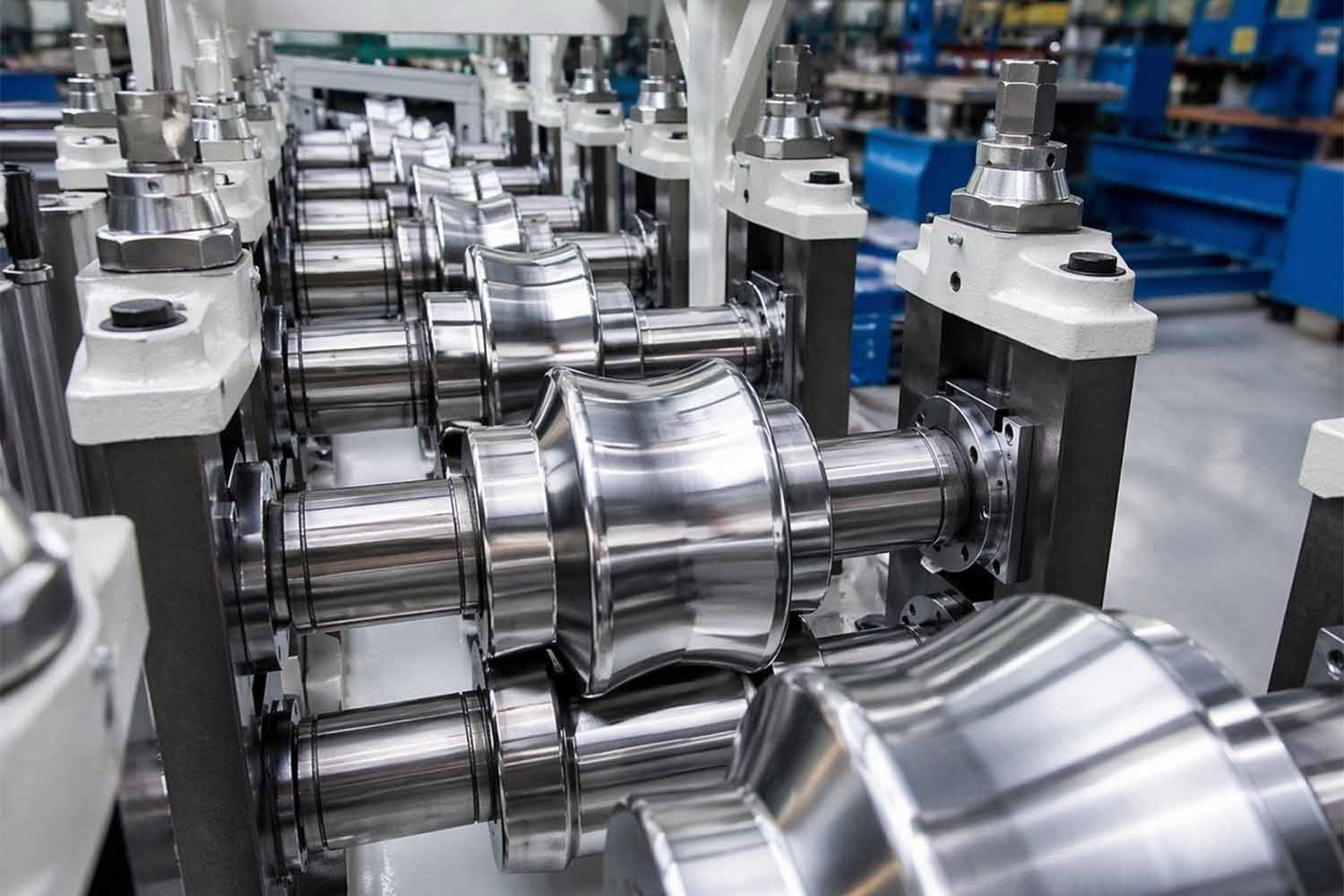

In a cold roll forming process, cutting is far more than a secondary operation. It is a critical stage that directly determines finished product quality, material flow stability and the overall performance of the production line.
When the profile exits the roll forming machine, the material is still subjected to residual forming stresses. Any inconsistency during the cutting operation can result in profile deformation, dimensional variations, surface defects or production instability at high throughput, ultimately affecting the entire manufacturing line and reducing both productivity and profitability.
For this reason, cutting tooling must be engineered as a direct extension of the roll forming machine, fully integrated with the forming process rather than treated as an independent module.
A custom in-line cutting system, specifically designed for cold roll forming, ensures outstanding industrial repeatability, dimensional accuracy and reliable operation at high production speeds.
At JIDET, every custom cutting tooling solution is engineered around the specific characteristics of each cold roll forming process, delivering exceptional repeatability, precise cut lengths and consistent performance even under demanding production conditions.
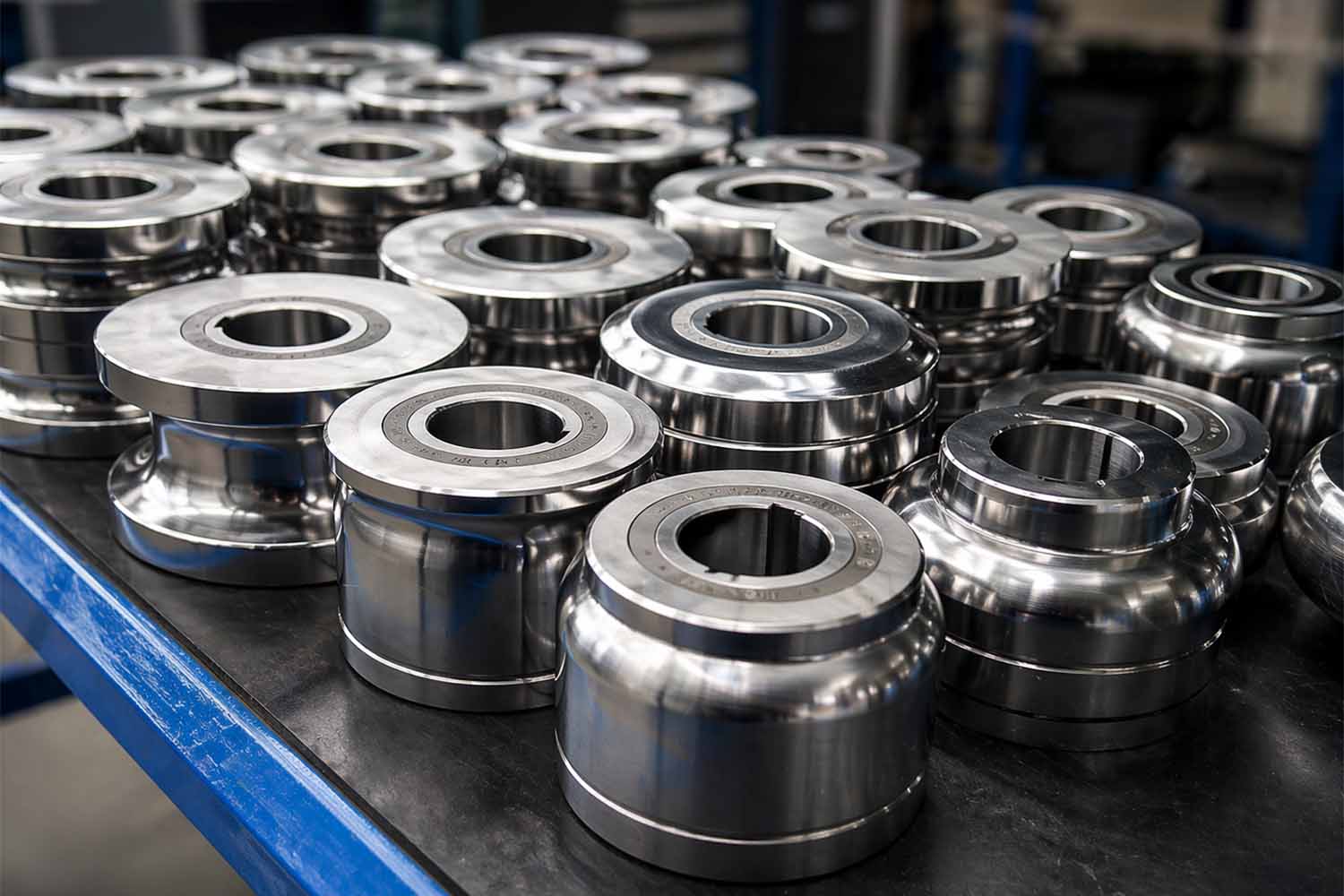
Why Cutting Tooling Is Critical in Cold Roll Forming
Within a cold roll forming line, the cutting operation performs a decisive function at one of the most critical stages of the manufacturing process. It must occur with absolute precision and at the correct point within the forming sequence to guarantee the quality of the finished profile.
The cut must be perfectly synchronised with the production cycle and the continuous movement of the roll forming line.
It must also match the line speed under high-production conditions without compromising product quality. At the same time, the cutting system must preserve the profile geometry by preventing deformation during the cutting operation while consistently achieving the required cut length within the tightest dimensional tolerances.
Poorly controlled cutting has immediate consequences for both the manufacturing process and the finished product.
It can generate tensile or compressive forces that distort the profile, create deformation immediately after cutting, reduce dimensional stability and compromise production repeatability, making the process increasingly difficult to control while increasing the number of non-conforming parts.
Cutting should therefore never be considered simply as the final stage of the production line.
Instead, it acts as a synchronisation mechanism for the entire manufacturing process, ensuring process consistency, dimensional accuracy and continuous production stability.
Like roll forming tooling, the cutting system must be engineered as a fully integrated part of the overall manufacturing solution, directly contributing to the stability, precision and efficiency of the complete cold roll forming process.
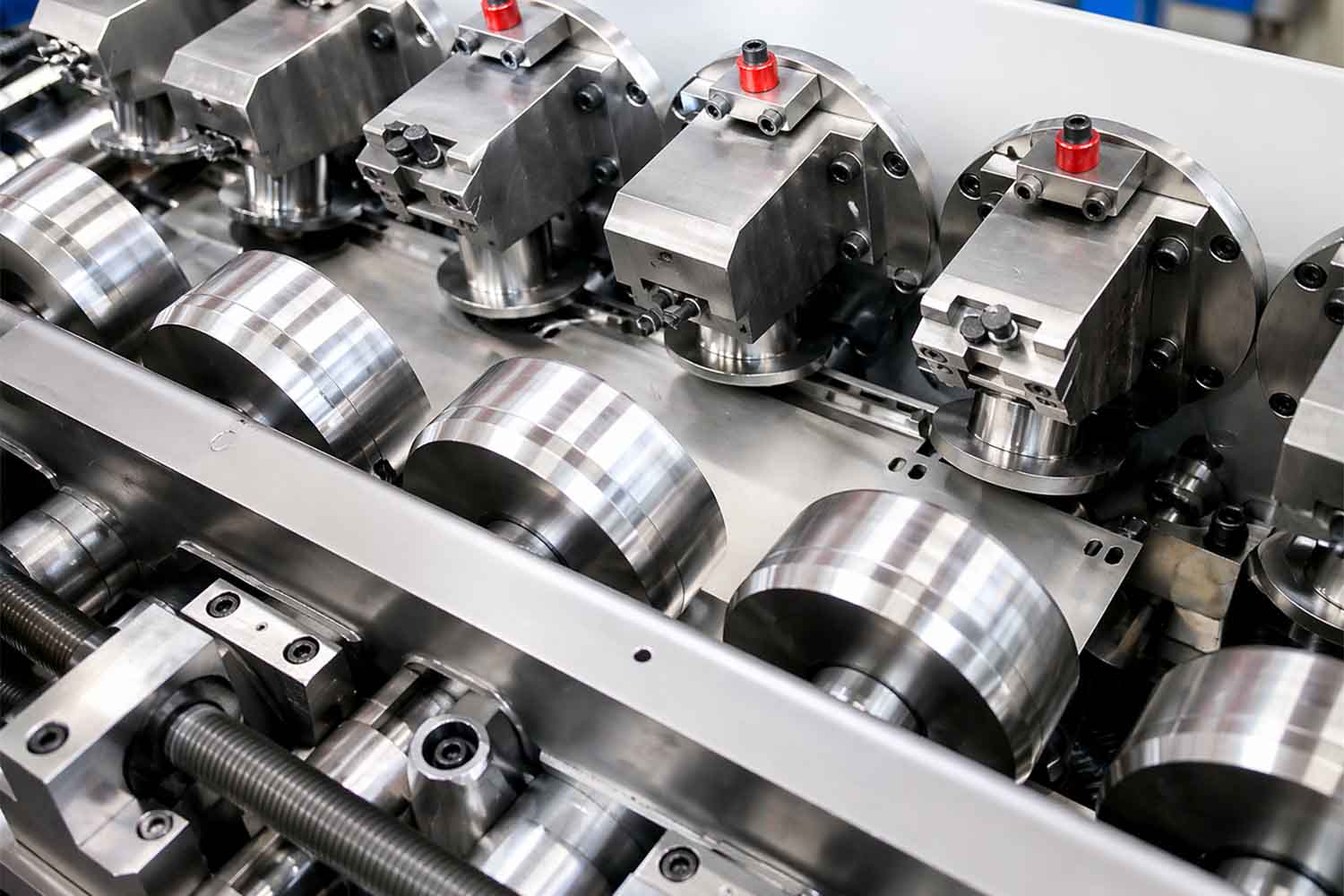
Standard cutting systems are generally designed for relatively simple production environments involving open profiles, moderate production throughput and relatively generous dimensional tolerances.
While these solutions may be suitable for less demanding applications, their limitations become evident when manufacturing:
- complex profile geometries,
- high-yield-strength steels,
- stainless steel profiles,
- high-speed production programmes,
- components requiring tight dimensional tolerances,
Under these operating conditions, conventional cutting systems frequently produce:
- cuts that are not perfectly square to the profile,
- profile deformation caused by poorly controlled cutting forces,
- premature tool wear that reduces equipment service life,
- process instability resulting in greater dimensional variation and inconsistent product quality,
A generic cutting system cannot maintain the stable, repeatable performance required for advanced cold roll forming applications.
Any instability introduced during the cutting operation immediately affects the synchronisation of the entire production line, reducing manufacturing efficiency and compromising overall process performance.
The cutting operation should never be considered independently from the cold roll forming process.
Instead, it must be engineered as the natural continuation of the work carried out by the roll forming tooling.
A properly designed cutting system makes it possible to:
- respect the kinematics of the roll forming process, ensuring that cutting takes place at the correct point within the forming sequence,
- maintain uninterrupted material flow throughout the production line,
- eliminate sudden force variations by integrating the cutting operation into the overall material deformation strategy,
A high-performance in-line cutting system guarantees perfect continuity of material flow, synchronises cutting with material deformation and prevents residual stresses from affecting the finished profile after forming.
Cutting therefore becomes a true extension of the roll forming tooling, contributing directly to the overall stability and performance of the manufacturing process.
Custom cutting tooling overcomes the limitations of standard cutting systems while delivering significant improvements in manufacturing performance and process reliability.
A cutting system specifically engineered for the production process ensures:
- outstanding dimensional repeatability from one component to the next,
- stable performance at high production throughput,
- reduced scrap through accurate and consistent cutting,
- precise cut-length control while maintaining the tightest dimensional tolerances,
Rather than representing the final operation of the production line, custom cutting tooling becomes a strategic component of the entire manufacturing process.
By adopting a fully engineered solution, cutting is transformed from a potential source of production instability into a powerful driver of productivity, product quality and long-term manufacturing profitability.
Cutting Technologies in Cold Roll Forming
Cutting technologies play a fundamental role in ensuring the precision, repeatability and stability of the cold roll forming process.
The most appropriate cutting solution depends on several factors, including the profile geometry, production throughput, material characteristics and the required dimensional tolerances.
Each cutting technology offers specific advantages and engineering constraints. Selecting the right solution is essential to maximise productivity, maintain product quality and optimise the overall profitability of the manufacturing process.
A flying cut-off system performs the cutting operation while moving synchronously with the roll forming line, eliminating the need to stop the profile during production.
This technology is particularly suited to high-throughput production environments, where maintaining continuous material flow is essential to maximise productivity.
Its principal advantage is the ability to achieve very high production speeds without interrupting the manufacturing process, allowing manufacturers to combine maximum throughput with excellent product quality.
However, this solution also presents significant engineering challenges.
Perfect synchronisation between the cutting system and the roll forming line is essential. The moving cutting unit must match the profile speed precisely throughout the cutting cycle while maintaining absolute positional accuracy.
Any synchronisation error can immediately result in:
- cut-length deviations,
- profile deformation,
- dimensional inaccuracies,
- reduced production repeatability,
Designing a custom flying cut-off system therefore requires advanced mechanical engineering, high-precision motion control and seamless integration with the overall cold roll forming process.
A stop cut-off system temporarily stops the profile before performing the cutting operation.
Unlike flying cut-off technology, the cutting process is carried out while the material remains stationary, significantly simplifying the cutting mechanism.
The primary advantages of this solution include:
- excellent cutting accuracy,
- simpler mechanical design,
- easier maintenance,
- reduced system complexity,
Because cutting takes place without relative movement between the tool and the profile, dimensional control is easier to maintain and the risk of synchronisation errors is considerably reduced.
However, these benefits are achieved at the expense of production throughput.
Stopping the profile for every cut interrupts material flow, reducing the overall efficiency of the roll forming line.
For this reason, stop cut-off systems are generally preferred for:
- moderate production volumes,
- complex profiles requiring maximum cutting precision,
- applications where productivity is less critical than dimensional accuracy,
Modern cutting tooling can incorporate several secondary manufacturing operations directly into the cutting station, transforming it into a complete in-line finishing solution.
Depending on the application, these integrated systems may combine:
- punching,
- notching,
- embossing,
- bending,
- necking,
- and other secondary forming operations,
Integrating multiple processes into a single in-line cutting system eliminates the need for additional downstream equipment and significantly simplifies the overall production process.
This approach offers several major industrial benefits:
- reduced investment in secondary equipment,
- shorter production cycles,
- fewer handling operations,
- improved dimensional consistency,
- lower manufacturing costs,
By combining several operations within a single production stage, manufacturers can significantly increase productivity while reducing the risk of dimensional variation introduced by transferring components between multiple machines.
Integrated multi-operation cutting systems are particularly well suited to demanding industrial environments where high production throughput, exceptional product quality and maximum process efficiency are critical competitive factors.
Technical Design Criteria for Custom Cutting Tooling
Within a cold roll forming process, cutting tooling is far more than a consumable component. It is a critical engineering system that must be designed to withstand demanding production conditions while delivering outstanding accuracy, repeatability and long-term durability.
Every design parameter directly influences production stability, finished profile quality and the overall efficiency of the manufacturing process.
From profile geometry to material behaviour and tool life, each technical criterion contributes to achieving precise cutting, minimising scrap and optimising manufacturing costs.
For this reason, custom cutting tooling must be engineered as an integral part of the cold roll forming line, fully synchronised with both the roll forming machine and the production process.
La réduction des rebuts constitue l’un des premiers leviers de rentabilité en profilage à froid.
Chaque défaut de formage – dérive géométrique, vrillage, ouverture de profil, marquage de surface – entraîne une non-conformité qui impacte directement le coût de production.
Un outillage de profilage adapté permet de maîtriser la déformation dès les premières stations, en répartissant les efforts et en évitant les concentrations de contraintes responsables des défauts.
La cohérence de la séquence de formage, associée à une géométrie de galets optimisée, limite les dérives cumulatives et stabilise la qualité du profil en sortie.
Cette maîtrise du process de profilage à froid permet de réduire significativement les taux de rebut, en particulier sur les profils techniques ou les productions à haute cadence, où les défauts peuvent rapidement se multiplier.
Au-delà de la qualité produit, la réduction des rebuts contribue directement à améliorer la performance économique globale, en limitant les pertes matière, les reprises et les arrêts de production.
Material behaviour is another fundamental consideration when engineering custom cutting tooling.
Every material reacts differently under cutting forces, directly affecting:
- cutting force requirements,
- tool wear,
- cut quality,
- long-term process stability,
High-yield-strength steels, stainless steels and other advanced alloys generally require a more progressive cutting strategy together with optimised force distribution in order to minimise profile deformation.
Several parameters must be carefully evaluated during the engineering phase, including:
- the material’s yield strength, which determines the cutting force required to initiate shearing,
- material thickness, influencing blade design, cutting depth and force distribution,
- surface treatments such as pre-coated steels or aluminium alloys, which require cutting solutions that minimise surface marking and abrasion,
A comprehensive understanding of material behaviour enables the cutting tooling to be engineered specifically for the actual production conditions, ensuring consistent cutting quality, extended tool life and stable manufacturing performance.
Perfect synchronisation between the cutting system and the roll forming line is essential for maintaining a stable cold roll forming process.
The cutting operation must remain precisely coordinated with:
- the material feed speed,
- the production cycle,
- the overall throughput of the manufacturing line,
Any deviation between the cutting cycle and the movement of the profile immediately introduces dimensional errors, profile deformation and production instability.
Accurate synchronisation allows the cutting system to operate seamlessly within the manufacturing process, maintaining continuous production while preserving dimensional accuracy.
Conversely, poor synchronisation reduces process repeatability and generates production variability that directly affects manufacturing reliability.
For high-performance custom cutting tooling, synchronisation is therefore not simply a control function—it is one of the key engineering principles governing overall production stability.
A high-performance cutting system must consistently achieve exceptional dimensional accuracy, particularly when manufacturing demanding profiles from advanced materials.
To guarantee full compliance with engineering specifications, the cutting process must maintain:
- consistent cut lengths within the required dimensional tolerances,
- perfectly square cuts relative to the profile,
- excellent repeatability throughout the entire production run,
Even minor deviations in cut length or cutting angle can create assembly problems, reduce product quality and increase manufacturing costs.
Maintaining this level of precision throughout production directly contributes to:
- higher product quality,
- lower scrap rates,
- improved manufacturing efficiency,
- greater customer confidence in the finished components,
Cutting tooling must be engineered to withstand intensive production cycles while maintaining its original geometry and cutting performance over extended periods.
High production throughput subjects cutting tools to continuous mechanical loads, making wear resistance a critical engineering requirement.
To maximise service life, cutting tools may incorporate:
- hardened tool steels,
- specialised heat treatments,
- wear-resistant coatings,
- advanced tool materials selected according to the application,
A robust tooling design not only extends tool life but also reduces maintenance interventions and limits unplanned production stoppages.
Preventive maintenance strategies based on regular inspection and scheduled servicing help maintain cutting accuracy while significantly reducing the risk of unexpected failures.
The combination of durable tooling and proactive maintenance ensures long-term manufacturing reliability, consistent product quality and optimum production performance.
Cutting Tooling and Industrial Productivity
In today’s manufacturing environment, the performance of a cold roll forming process is no longer measured solely by production volume.
The ability to accommodate multiple profile configurations, short production runs and frequent product changeovers has become a major competitive advantage for industrial manufacturers.
Within this context, manufacturing flexibility depends largely on the design of the cutting tooling.
Beyond the cutting blades themselves, it is the integration, mounting and adjustment solutions that enable the cutting system to adapt quickly to changing production requirements while maintaining consistent cutting quality.
Consequently, custom cutting tooling is engineered not only to maximise performance during continuous production but also to provide the flexibility required by modern manufacturing environments.
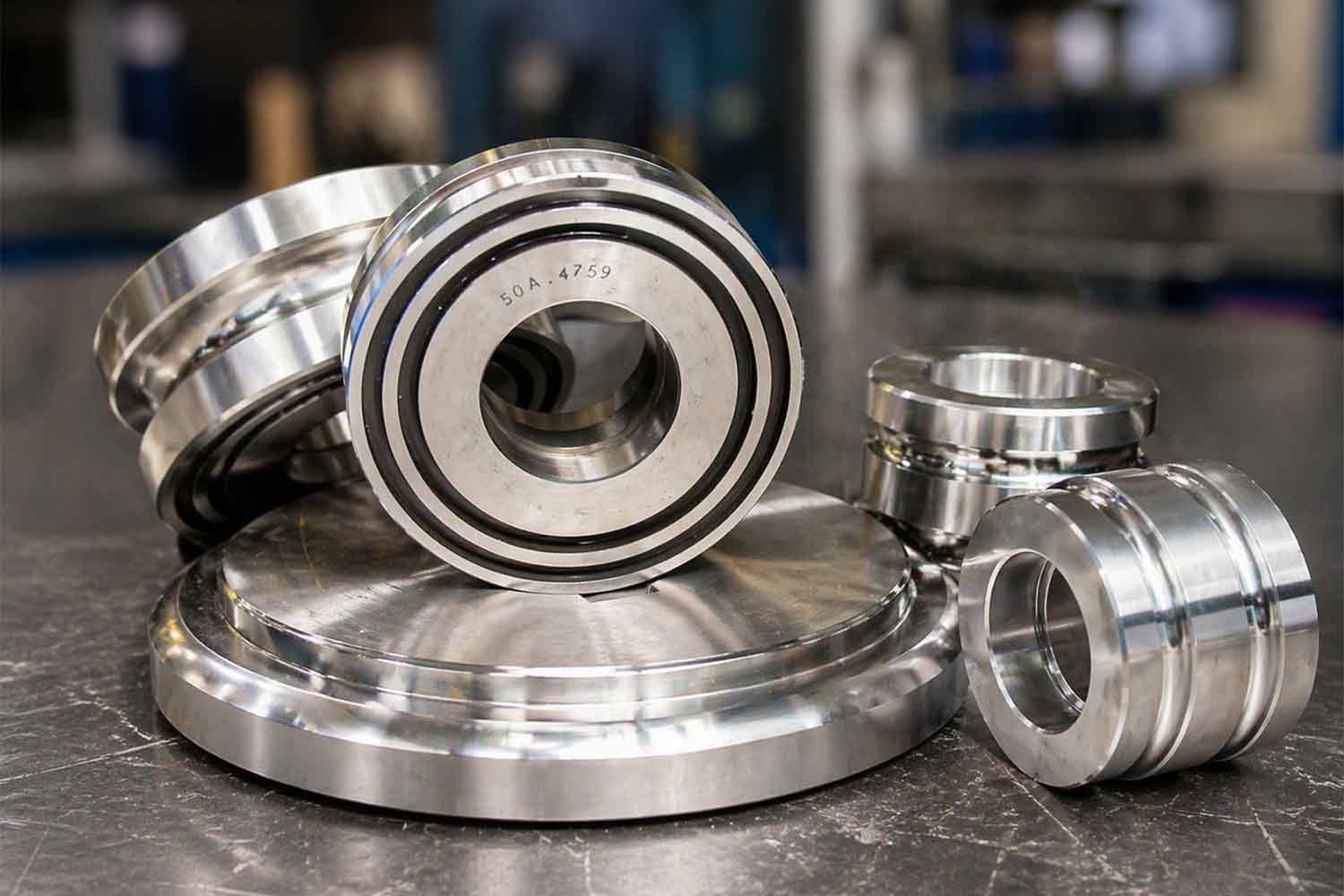
The integration of interchangeable tooling cassettes is one of the most effective ways of increasing flexibility within an industrial cold roll forming line.
This concept consists of grouping the cutting components into self-contained modules that can be prepared offline before being installed rapidly on the production line.
Because each cassette retains its validated mechanical settings, product changeovers can be completed quickly without requiring extensive machine adjustments.
This modular approach offers several significant advantages:
- substantially reduced setup times,
- lower risk of operator error,
- greater consistency between production batches,
- improved manufacturing flexibility,
From an industrial engineering perspective, interchangeable tooling cassettes transform product changeovers from lengthy adjustment procedures into fast, repeatable and highly reliable operations.
They therefore represent a key feature of custom cutting tooling designed for manufacturers processing multiple product references.
The repeatability of machine settings is fundamental to maintaining a stable and predictable cold roll forming process, particularly in multi-product manufacturing environments.
Custom cutting tooling incorporates precision mechanical interfaces, locating systems and indexing solutions that ensure highly accurate repositioning of the cutting unit following maintenance or product changeovers.
These engineering features minimise dependence on operator experience by allowing previously validated settings to be restored rapidly and consistently.
The benefits include:
- faster production restart,
- reduced setup variability,
- improved dimensional consistency,
- enhanced long-term process stability,
In industrial manufacturing, repeatable machine settings convert operator know-how into a controlled and fully reproducible production process embedded directly within the cutting system itself.
Rapid product changeovers have become a major driver of manufacturing competitiveness.
Every production stop required to replace or adjust cutting tooling reduces machine uptime and directly affects manufacturing profitability.
Optimised custom cutting tooling minimises these interruptions by simplifying:
- tooling removal,
- replacement operations,
- adjustment procedures,
- production restart,
The combination of modular tooling cassettes, precision positioning systems and repeatable adjustment mechanisms significantly reduces non-productive time while improving operational reliability.
As a result, manufacturers can:
- maximise machine uptime,
- process a wider range of product references,
- respond more rapidly to customer requirements,
- improve overall manufacturing flexibility,
In highly competitive industrial sectors, custom cutting tooling becomes far more than a production accessory.
It is a strategic manufacturing solution that combines productivity, flexibility and cutting precision while enabling companies to adapt rapidly to changing production demands without compromising quality or process stability.
Cutting Tooling Manufacturer: Design Your Custom In-Line Cutting System with JIDET
The performance of a cold roll forming process is established long before production begins.
It is achieved through a comprehensive engineering approach that integrates profile geometry, material behaviour, roll forming tooling, cutting tooling and the roll forming machine into a single, fully optimised manufacturing system.
Working with an experienced cutting tooling manufacturer involves far more than supplying cutting equipment.
It means engineering a complete in-line cutting solution capable of delivering exceptional cutting accuracy, long-term process stability and sustainable industrial performance.
At JIDET, every custom cutting tooling project follows a structured engineering methodology that secures each stage of development while optimising both technical performance and manufacturing profitability.
Every custom cutting tooling project begins with a comprehensive engineering analysis of the profile to be manufactured.
This initial phase identifies the profile geometry, critical cutting areas, dimensional requirements and the functional characteristics of the finished component.
The engineering study also considers:
- required dimensional tolerances,
- assembly requirements,
- production constraints,
- the operating conditions of the finished part,
The objective is to define a cutting strategy that integrates seamlessly with the cold roll forming process, ensuring that every cut preserves the profile geometry while meeting the required quality standards.
This analysis establishes the engineering foundation for the entire cutting system and ensures that the tooling is perfectly matched to the manufacturing process.
Material behaviour is then incorporated into the engineering of the custom cutting tooling.
The analysis focuses on the material characteristics that directly influence cutting performance, including:
- yield strength,
- ductility,
- material thickness,
- work hardening,
- surface finish and coating sensitivity,
These parameters determine:
- blade geometry,
- cutting forces,
- tool materials,
- wear resistance requirements,
- the overall cutting strategy,
Failure to account for these characteristics may result in excessive tool wear, profile deformation, poor cut quality or unstable production performance.
A detailed material analysis enables JIDET to design cutting tooling specifically adapted to real production conditions, ensuring stable, repeatable and highly reliable manufacturing.
The engineering of the cutting tooling represents the central stage of every project.
Its objective is to design a cutting solution that is fully integrated with the roll forming machine and perfectly synchronised with the production process.
During this phase, the engineering team defines:
- the cutting technology best suited to the application,
- blade geometry,
- cutting sequence,
- synchronisation with the roll forming line,
- integration with any additional in-line manufacturing operations,
Every design decision aims to optimise:
- cutting accuracy,
- dimensional repeatability,
- process stability,
- production throughput,
- overall equipment reliability,
Rather than functioning as an isolated module, the cutting system becomes a fully integrated component of the cold roll forming process, contributing directly to the stability and efficiency of the entire production line.
Engineering a high-performance cutting system extends well beyond the manufacture of the tooling itself.
A comprehensive validation and commissioning phase is essential to confirm cutting performance under real production conditions and optimise every aspect of the manufacturing process.
This stage verifies:
- dimensional compliance,
- cut quality,
- synchronisation with the roll forming line,
- long-term process stability,
It also includes detailed optimisation of machine parameters to improve:
- cutting accuracy,
- production throughput,
- process repeatability,
- overall manufacturing performance,
This structured engineering approach enables rapid industrial commissioning while ensuring that production reaches optimum performance in the shortest possible time.
By working with an experienced custom cutting tooling manufacturer such as JIDET, manufacturers benefit from engineered solutions that transform complex production challenges into reliable, stable and highly efficient industrial processes, delivering long-term productivity, exceptional product quality and sustainable manufacturing performance.